

Simcoe County AND Barrie Just Cut Residential Development Charges by 50% — What Does That Mean for Home Buyers?

Could cutting one government fee really make it cheaper to build a home in Simcoe County?

For once, the answer might actually be yes. 😏

But before we start celebrating a 50% discount on new houses — sadly, this is not the real estate version of a Black Friday sale.

There has been a major change to residential development charges in Simcoe County, and Barrie has now made a very similar move of its own.

The important part?

Development charges were not eliminated. They were cut by 50% — and not every charge connected to building a new home disappears with that reduction.

So, what exactly changed? How much money are we talking about? Does this apply in Innisfil, Bradford, Essa, Springwater and other Simcoe County municipalities? What about Barrie? And most importantly...

Will any of this actually make new homes more affordable?

Let’s break it down without requiring a municipal-finance degree. 😂


What Are Development Charges in Ontario?

First, what exactly are development charges?

Development charges — often called DCs — are fees municipalities collect primarily from developers when new development is built.

The idea is fairly simple:

Growth requires infrastructure.

More homes can mean a need for:

  • roads
  • water and wastewater infrastructure
  • transit
  • paramedic services
  • waste management
  • recreation and other municipal services

Instead of having existing taxpayers pay the entire cost of infrastructure needed because of new growth, municipalities collect development charges from new development.

The County of Simcoe explains that its development charges help finance capital projects needed to service increased demand resulting from growth.

Makes sense.

The problem is that these charges can become a significant upfront cost of building housing.

And while the developer may technically write the cheque, development costs are ultimately part of the economics of building and pricing new homes.

Translation?

There is no magical money tree behind the sales centre. 🌳😂

If it costs substantially more to build a home, those costs can influence what needs to be charged for the finished product.


Why Are Development Charges Being Reduced in 2026?

This change comes through the Ontario Development Charge Reduction Program, or DCRP.

The program is part of the broader Canada–Ontario infrastructure partnership and is designed to encourage municipalities to lower residential development charges while senior governments help fund housing-enabling infrastructure.

Participating municipalities must reduce residential development charges by 30% to 50% or more for three years.

In return, eligible infrastructure projects can receive funding from the federal and provincial governments, with up to 90% of eligible project costs funded by the senior levels of government and at least 10% coming from the municipality.

The infrastructure can include things such as:

roads, water systems, wastewater systems and transit.

So instead of asking municipalities to simply slash the fees they use to pay for growth and then figure out how to build everything...

The program tries to address both sides.

Reduce the cost of housing development while still funding the infrastructure needed to support that housing.


Did Simcoe County Reduce Development Charges by 50%?

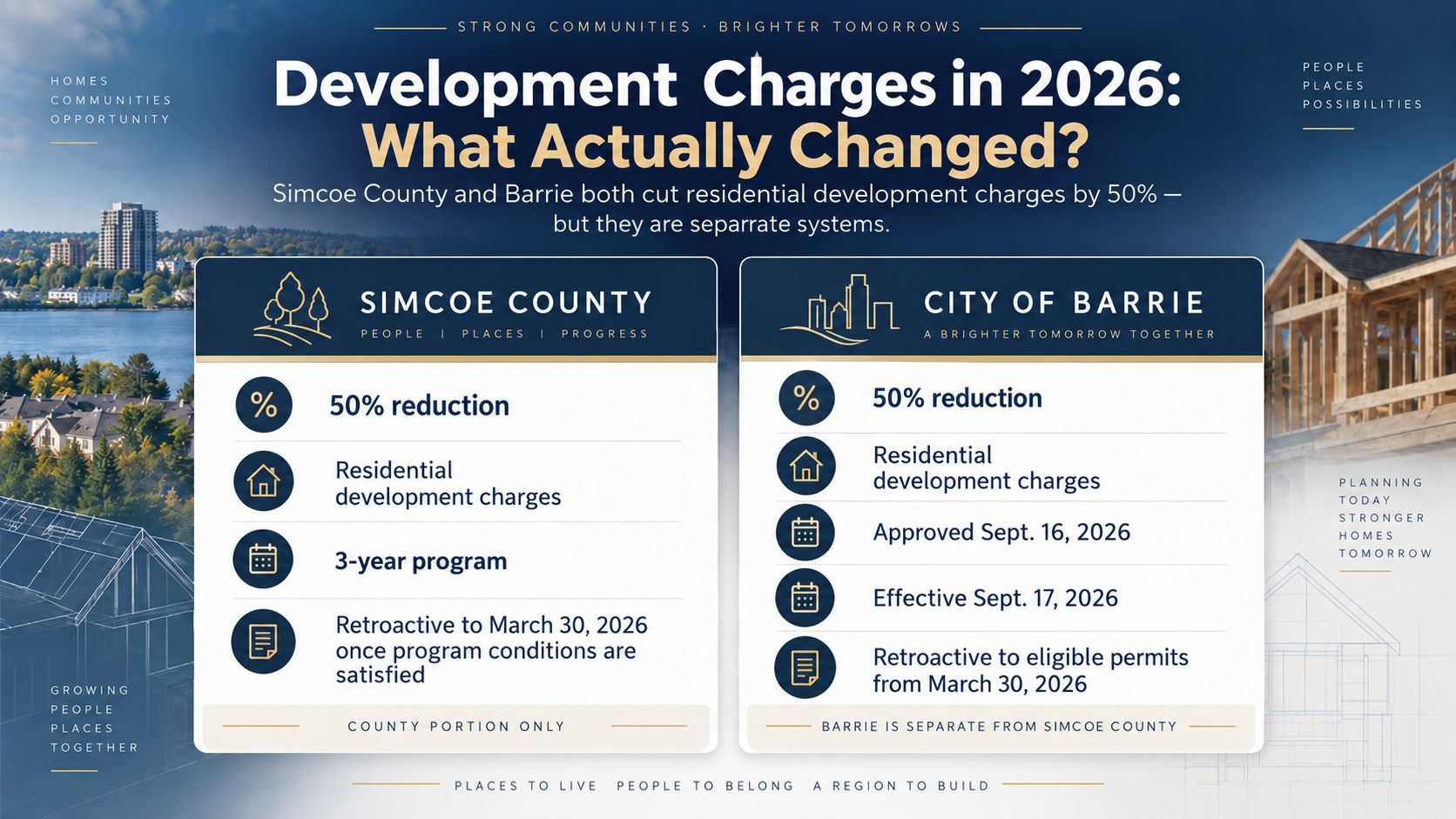
Yes — County Council approved a 50% reduction to residential development charges.

This is where the story became much more significant than the original June announcement.

On June 9, 2026, Simcoe County Council directed staff to apply to the Development Charge Reduction Program and supported, in principle, reducing residential development charges by between 30% and 50% or more for three years.

Then, on August 20, 2026, County Council went further.

Council approved an amendment reducing the County of Simcoe residential development charge by 50% from the rates in effect on March 30, 2026.

The reduction applies to all residential development types throughout the County and is intended to remain in place for three years from March 30, 2026.

The County's By-law 7194-26 specifically establishes the 50% reduction and states that it applies throughout Simcoe County.

There is one important technical detail.

The County by-law says the reduction comes into force once the requirements of the program have been satisfied, including execution of the necessary Transfer Payment Agreement. Once effective, the reduction is designed to apply retroactively to March 30, 2026.

So if you're involved in an actual development, don't calculate your budget from this blog and start ordering countertops. 😂

Always confirm the current applicable charge directly with the municipality and County for the specific property and permit.


How Much Were Simcoe County Development Charges Before the 50% Reduction?

Now we get to the interesting part.

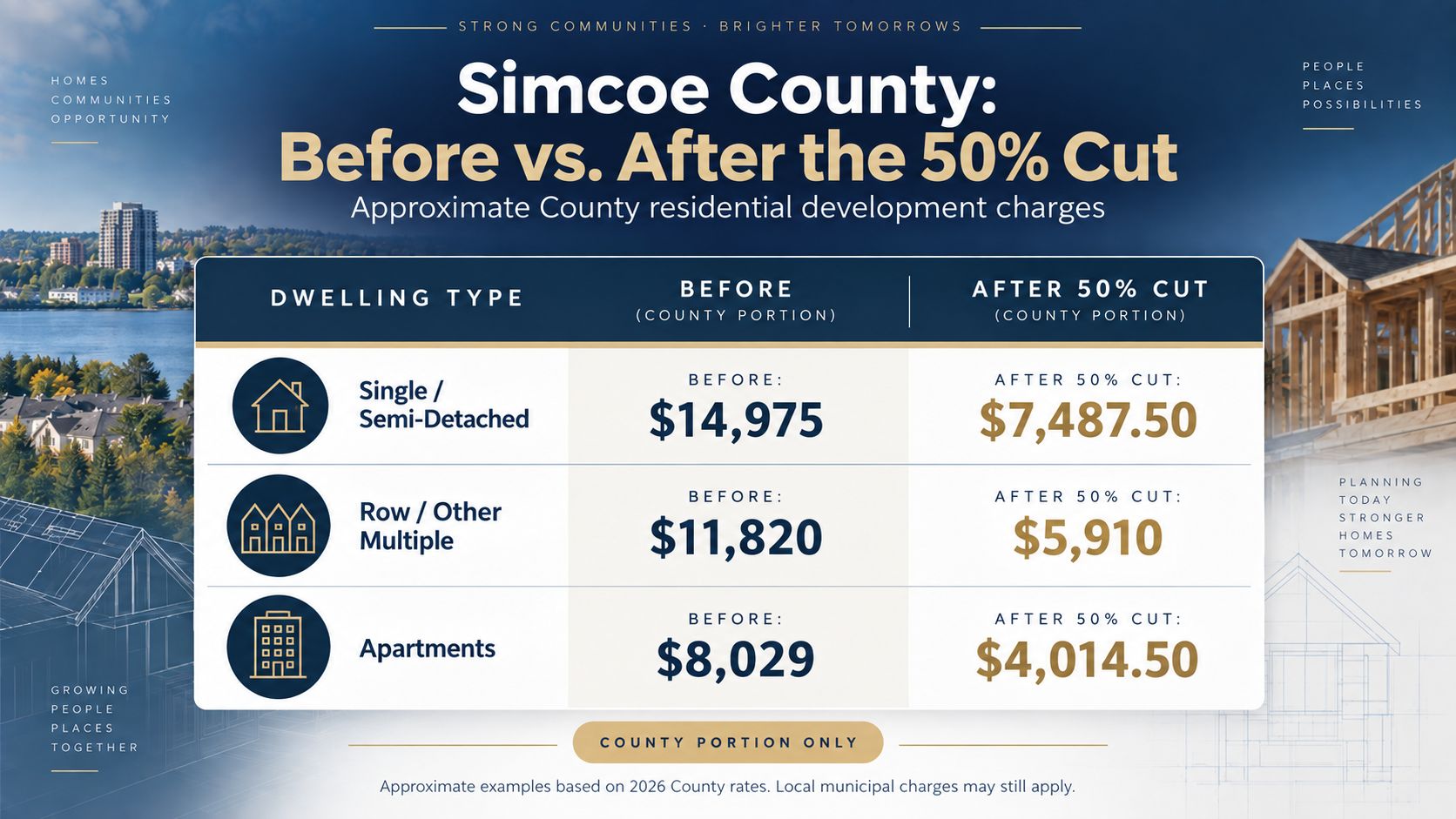
The County of Simcoe's published 2026 residential development charges were:

Residential type2026 County chargeApprox. amount at 50%
Single or semi-detached home$14,975$7,487.50
Row / other multiple residential$11,820$5,910
Apartment$8,029$4,014.50

These were the County-wide rates effective January 1, 2026.

For a new detached home, that means the County portion alone could drop by roughly $7,487.

Not insignificant.

But...

Here comes the part that is going to confuse a LOT of people.


Does a 50% Simcoe County Cut Mean All Development Charges Are 50% Lower?

No.

And this may be the most important part of this entire article.

If you're building in a municipality within Simcoe County, there can be more than one layer of development charges.

Think of it like a very expensive municipal lasagna. 😂

You may have:

County development charges

PLUS

local municipal development charges

PLUS potentially other applicable fees, levies or charges depending on the project.

The County's 50% reduction applies to the County of Simcoe residential development charge.

It does not automatically cut every local municipality's development charge in half.

So if you are building in Innisfil, for example, you need to look at both:

County of Simcoe charges + Town of Innisfil charges

The same concept applies in the County's other member municipalities.

That distinction matters enormously when someone hears:

“Development charges were cut 50% in Simcoe County!”

True...

But not necessarily all of them.


Which Municipalities Are Actually Part of Simcoe County?

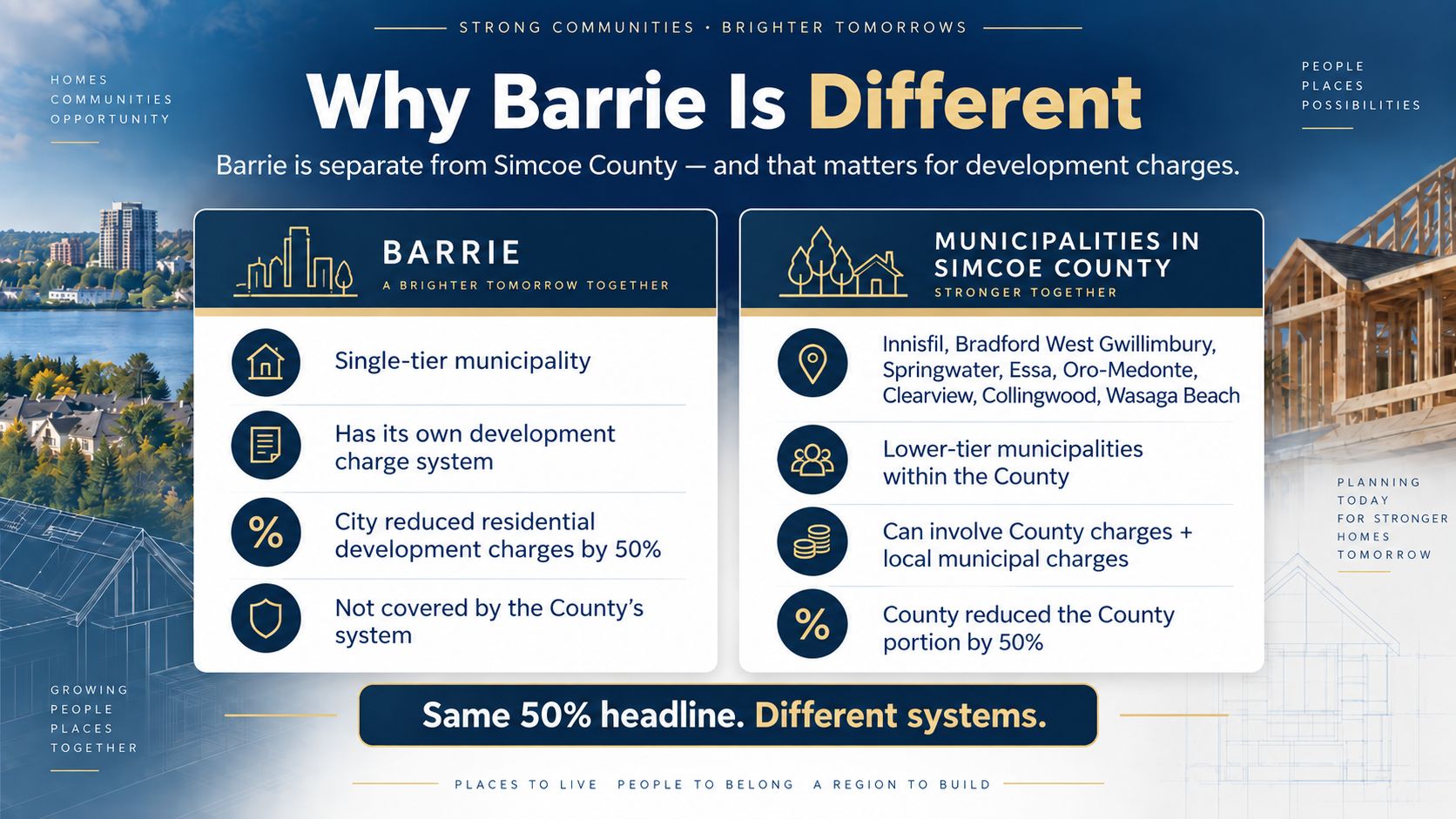
The County of Simcoe has 16 member municipalities, including communities such as:

Innisfil, Bradford West Gwillimbury, Springwater, Essa, Oro-Medonte, Clearview, Collingwood, Wasaga Beach, New Tecumseth and others.

The County is what's known as an upper-tier municipality, while those towns and townships operate as lower-tier municipalities.

That means certain responsibilities are handled locally and others at the County level.

And then there is Barrie.

Because apparently Ontario municipal government thought this needed one more plot twist. 😂


Is Barrie Part of Simcoe County?

Geographically? Yes.

Politically and administratively? No.

This surprises a lot of people.

You can literally drive from Barrie into another Simcoe County municipality in minutes, and Barrie is deeply connected economically with the surrounding region.

But the City of Barrie is a separated city.

Barrie officially became a separated city in 1959.

Today, Barrie operates as a single-tier municipality.

That means it does not sit underneath the County of Simcoe municipal government the way Innisfil, Springwater or Essa do.

The City describes the difference this way: Barrie makes its own municipal planning decisions rather than having those decisions governed by an upper-tier regional municipality. By comparison, municipalities inside Simcoe County operate within both local and County policy structures.

The County similarly confirms that Barrie and Orillia are politically and administratively separate from Simcoe County, even though they remain geographically and economically connected to it.

That distinction is especially important when we're talking about development charges.


Does the Simcoe County 50% Development Charge Reduction Apply in Barrie?

No — not because Barrie is covered by the County reduction.

Barrie has its own development charge system.

But here is what makes this blog extremely timely:

Barrie just cut its residential development charges by 50% too.

On September 16, 2026, Barrie City Council approved an amendment reducing the City's residential development charge rates by 50%.

The new rates took effect September 17 and are being applied retroactively to eligible building permits issued on or after March 30, 2026.

So we now have two separate decisions:

Simcoe County → 50% County residential DC reduction

and

City of Barrie → separate 50% City residential DC reduction

Same percentage.

Different municipal governments.

Different development-charge systems.

This is why saying “Simcoe County eliminated development charges” would be misleading.


How Expensive Were Barrie's Development Charges?

Barrie's development charges are much larger than the County portion because Barrie is a single-tier municipality and its charges fund a broad range of City infrastructure and services.

For 2026, Barrie's published development charge for a single or semi-detached home within the former municipal boundary was approximately $106,277.

In the Salem and Hewitt's Secondary Plan areas, the corresponding published charge was approximately $119,770.

A simple 50% comparison would put those figures around:

$53,138.50 instead of $106,277

and

$59,885 instead of $119,770

That is a very meaningful change in the economics of building a new home.

However, exact development charges vary by dwelling type, location, credits, exemptions and project circumstances, so anyone building or developing should confirm the current amount with the City of Barrie rather than relying on a general example.

Barrie maintains its own development charge calculator for project-specific estimates.


So Did the Government Eliminate Development Charges?

No.

That headline would definitely get clicks.

It would also be wrong. 😂

Residential development charges have been substantially reduced, not universally eliminated.

And the program does not mean every charge connected to building a home disappears.

For Simcoe County, the reduction applies specifically to the County residential development charge.

Local municipal charges may still apply depending on where you're building.

Barrie operates separately and has now implemented its own 50% residential development-charge reduction.

And the reductions are temporary — the DCRP framework is built around a three-year period, not a permanent abolition of development charges.


Who Actually Gets the Development Charge Savings?

This is where the conversation gets more interesting.

Development charges are generally part of the development process, so developers and builders see the reduction directly.

That does not necessarily mean a buyer walks into a sales office tomorrow and sees:

$899,000

NOW $849,000 BECAUSE DEVELOPMENT CHARGES WERE CUT! 😂

Housing prices aren't calculated quite that simply.

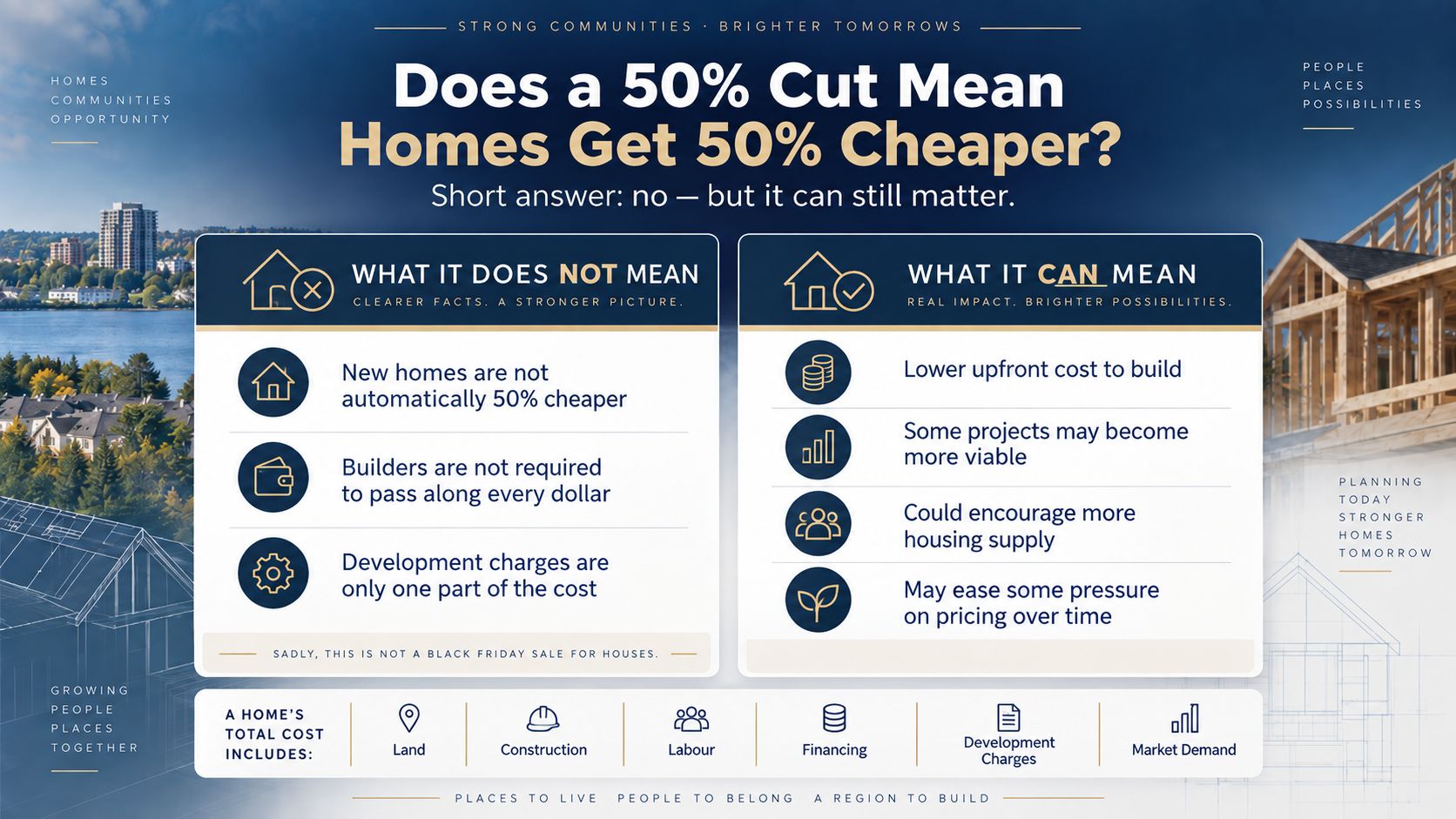
Builders consider many costs:

  • land
  • financing
  • construction
  • labour
  • materials
  • development charges
  • municipal approvals
  • servicing
  • marketing
  • taxes
  • market demand
  • expected profit
  • risk

Reducing one substantial cost can improve the financial viability of a project.

But whether that reduction ultimately appears as a lower purchase price depends on the project and the market.


Are Builders Required to Pass the 50% Savings Directly to Buyers?

Not necessarily dollar-for-dollar.

This distinction is important.

The goal of reducing development charges is to improve the economics of residential construction and encourage more housing to be built.

That can potentially help buyers in several ways.

A project that previously didn't make financial sense may become viable.

A builder may be able to launch sooner.

More projects may proceed.

More housing supply may eventually create greater competition.

And lower development costs may reduce some upward pressure on new-home prices.

But a municipal DC reduction does not automatically guarantee that the selling price of every new home falls by the identical amount saved.

Market pricing still matters.

If buyers are willing to pay $800,000 for a home, a builder isn't necessarily going to price it at $792,500 simply because one cost dropped by $7,500.

Economics is rude like that. 😂


Could Lower Development Charges Increase Housing Supply in Simcoe County?

That is one of the major objectives behind the program.

Development charges are a significant upfront cost before a development reaches completion.

Reducing those costs can improve what developers call project feasibility.

In very simple terms:

Does the math work?

If land, financing, construction and government charges push the cost of a project too high relative to what buyers will pay, the project may not move forward.

Reduce a major cost and suddenly the numbers may look different.

That doesn't mean thousands of homes magically appear next Tuesday.

Housing construction still depends on:

  • available land
  • servicing capacity
  • zoning
  • approvals
  • financing
  • interest rates
  • construction costs
  • labour
  • market demand

But development charges are one part of that equation.


Why Don't Municipalities Just Get Rid of Development Charges Completely?

Because someone still has to pay for the infrastructure.

Imagine building thousands of homes without expanding:

roads,

sewers,

water infrastructure,

transit,

waste systems,

and emergency services.

It wouldn't go particularly well.

Development charges were designed around the principle that growth should contribute toward the infrastructure required by growth.

The challenge is balance.

Set development charges too low and existing taxpayers may shoulder more of the infrastructure burden.

Set them too high and some housing projects may become economically difficult to build.

The new DCRP tries a different approach by having federal and provincial governments contribute significantly toward eligible housing-enabling infrastructure while municipalities reduce residential development charges.


What Does the Development Charge Reduction Mean for Innisfil?

This is especially relevant for Innisfil real estate and new construction.

Because Innisfil is a lower-tier municipality within Simcoe County, residential development there can involve both County of Simcoe development charges and Town of Innisfil development charges.

The County portion is the part affected by the County's 50% reduction.

So anyone buying:

  • a new construction home in Alcona
  • a new build elsewhere in Innisfil
  • land to build a custom home
  • a property being redeveloped
  • a residential development project

should understand that “development charges” are not necessarily one single number.

That is the question I would be asking the builder or municipality:

“Exactly which development charges apply to this property, and which ones have been reduced?”

Much better question than assuming everything is suddenly 50% cheaper.


What About Bradford, Springwater, Essa and Other Simcoe County Communities?

The same principle applies.

The County of Simcoe reduction affects the County-level residential development charge across residential development throughout the County, subject to the by-law's implementation requirements.

But the municipality where the property is located may have its own separate development charge.

So the total cost of development can still vary dramatically between:

Innisfil vs Bradford,  Springwater vs Essa, Collingwood vs Wasaga Beach and so on.

This is one reason location matters even when two new homes look nearly identical.


Does This Affect Resale Homes?

Not directly.

If you're buying an existing resale home, you're generally not receiving a development-charge invoice at closing simply because you purchased the property.

The development charge is connected to development and building activity, not the normal resale of an existing house.

But there could still be indirect effects.

If reduced development charges encourage substantially more new-home construction, increased housing supply can influence competition throughout the broader market.

New construction and resale don't operate in completely separate universes.

If buyers suddenly have more options in one segment, it can influence another.


What If I'm Buying a Brand-New Home From a Builder?

This is where I would pay closer attention.

Ask the builder:

What development charges are included in the purchase price?

Can development charges increase before closing?

Is there a development-charge adjustment clause in the agreement?

Does the new 2026 reduction affect this particular project?

If the builder receives a retroactive development-charge reduction, how is that handled?

New construction Agreements of Purchase and Sale can contain adjustments, caps and additional charges, so this is something buyers should understand before signing.

And please...

Do not skim a 45-page builder agreement because the kitchen has really pretty quartz. 😂

Have the agreement reviewed by a lawyer experienced in new construction.


Could Development Charge Reductions Affect Custom Home Buyers?

Potentially, yes.

If you're buying vacant land or planning to tear down and build, development charges can become a significant part of your construction budget depending on the circumstances.

But exemptions, credits and redevelopment rules can apply.

For example, existing development on a property may affect the calculation.

So before buying land because you've already mentally designed the dream kitchen...

Find out the development costs first.

Land price is only the beginning.


Will This Make Homes in Simcoe County More Affordable?

Possibly — but don't expect one policy to solve housing affordability by itself.

A 50% reduction in residential development charges can materially reduce the cost of creating housing.

That matters.

But affordability is affected by much more than development charges:

interest rates

construction costs

land prices

labour

taxes

municipal approval timelines

housing supply

buyer demand

and financing conditions.

Reducing DCs attacks one piece of a much larger puzzle.

The longer-term question is whether lower development costs lead to more projects actually getting built.

Because increasing housing supply may ultimately matter even more than the immediate fee reduction.


Why Is This Especially Important for Simcoe County Right Now?

Simcoe County continues to grow, and communities around Lake Simcoe, Barrie, Innisfil and Bradford have experienced substantial development pressure.

The County has also been working on other measures intended to make housing approvals faster, including its Housing Faster Community Planning Permit System toolkit released in June 2026.

That makes the development-charge reduction part of a bigger housing conversation:

How do we build enough homes?

How quickly can they be approved?

Who pays for the infrastructure?

And how do we prevent the cost of creating housing from becoming so high that fewer homes get built?

Those are much bigger questions than simply:

“Did development charges go down?”


So What's the Bottom Line for Home Buyers in Simcoe County?

Here is the easiest way to remember this:

Development charges were NOT eliminated.

Simcoe County approved a 50% reduction in its residential development charges for three years as part of the Development Charge Reduction Program. The County amendment provides for retroactive application to March 30, 2026 once its implementation conditions are satisfied.

Local municipal charges can still exist.

Building in Innisfil, Bradford, Essa, Springwater or another County municipality can involve charges beyond the County portion.

Barrie is separate from Simcoe County.

Barrie is a single-tier municipality and therefore has its own development-charge system.

And Barrie has now independently reduced residential development charges by 50%.

Barrie's reduction took effect September 17, 2026 and applies retroactively to eligible permits from March 30, 2026.

Lower development charges don't guarantee an identical reduction in new-home prices.

But lowering a significant development cost may help make some housing projects more financially viable and encourage additional housing construction.

And ultimately, more housing supply is something buyers should be paying attention to.
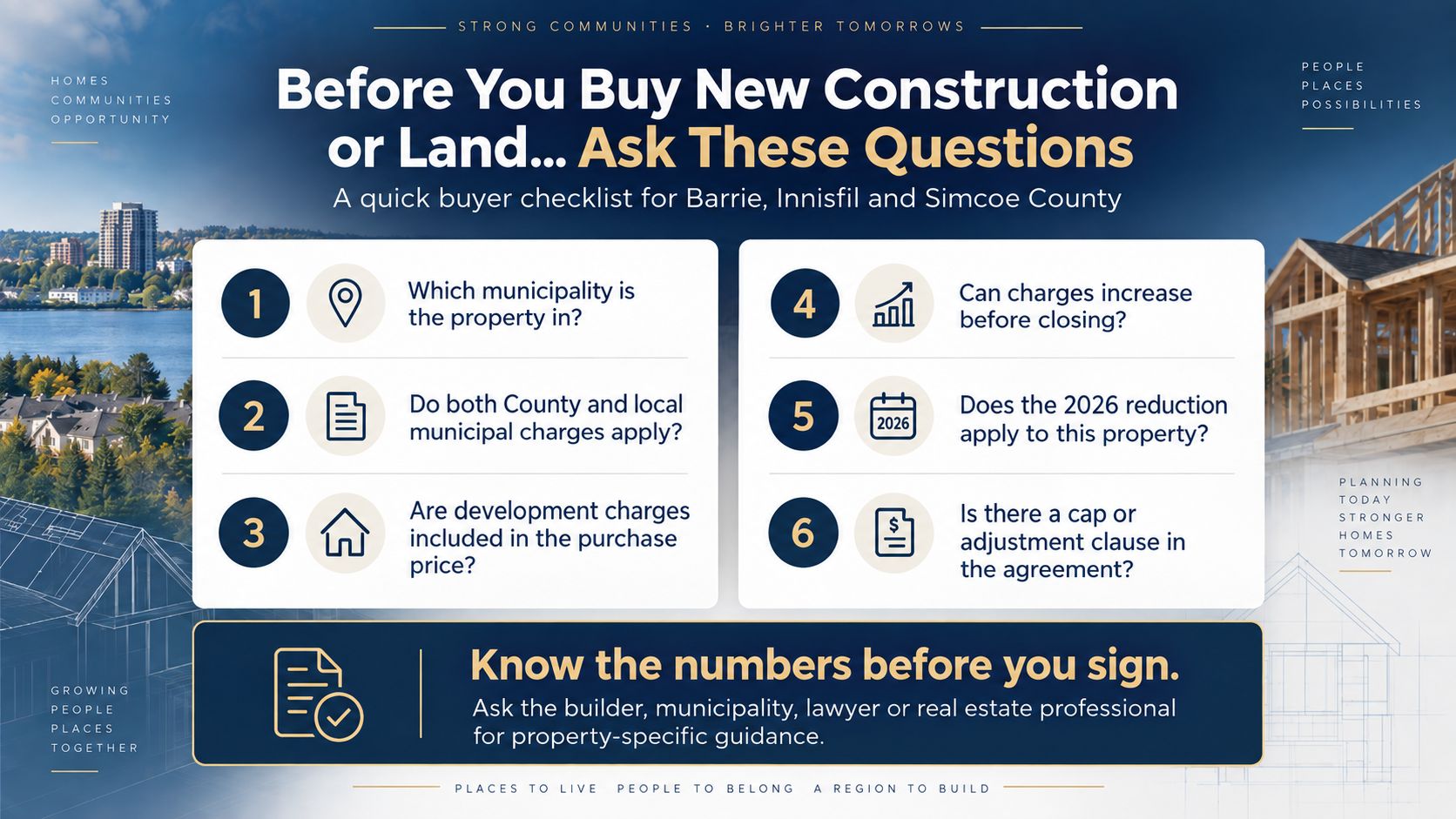


Thinking About Buying New Construction or Building in Barrie, Innisfil or Simcoe County?

This is where the headline and the actual numbers can be two very different things.

Before buying a new build, vacant land or a property you plan to redevelop, you want to know:

What charges actually apply?

Which municipality are you in?

Is there both a County and local charge?

Does the 2026 reduction apply?

And what other costs are waiting quietly in the fine print? 👀

I work throughout Barrie, Innisfil, Lake Simcoe and Simcoe County, and understanding the local differences can matter just as much as finding the right property.

Thinking about buying, building or investing in the area? Let's talk before you make the move.


Frequently Asked Questions About Simcoe County Development Charges

Did Simcoe County eliminate development charges in 2026?

No. Simcoe County approved a 50% reduction in residential development charges, rather than eliminating them entirely.

How long will the Simcoe County development charge reduction last?

The County amendment provides for the reduced residential rates to remain in effect for three years from March 30, 2026, subject to the implementation requirements in the by-law.

Are development charges in Innisfil reduced by 50%?

The County of Simcoe portion is subject to the County reduction. However, the Town of Innisfil can impose its own municipal development charges, so buyers and builders should confirm the total applicable charges.

Did Barrie cut development charges in 2026?

Yes. Barrie City Council approved a 50% reduction in residential development charges on September 16, 2026, with the reduced rates effective September 17 and retroactive to eligible building permits issued from March 30, 2026.

Is Barrie part of Simcoe County?

Barrie is geographically within the Simcoe area but is politically and administratively separate from the County of Simcoe. It is a single-tier municipality with its own municipal government and development-charge system.

Do resale home buyers pay development charges?

Normally, development charges relate to new development or redevelopment rather than an ordinary resale transaction. Different rules may apply when additional development, reconstruction or changes of use are involved.

Will new homes be 50% cheaper because development charges fell 50%?

No. Development charges are only one component of the cost of building housing. Reducing them can lower development costs, but home prices are also influenced by land, construction costs, financing, supply, demand and other expenses.


Thinking About Buying New Construction, Building or Investing in Barrie, Innisfil or Simcoe County?

The headline may say “50% reduction” — but the amount that actually applies to a property can depend on the municipality, the type of development and the project itself.

If you’re considering a new build, vacant land, redevelopment opportunity or investment property in Barrie, Innisfil, Lake Simcoe or Simcoe County, let’s look at the property and the local market before you make the move.

Have a property in mind? Contact me and let’s talk about what you’re buying, where you’re buying it and what questions you should be asking before you sign.



Important Note

This article is for general real estate information only and is not legal, tax, planning, engineering or municipal-development advice. Development charges, exemptions, credits, fees and eligibility can vary by property and project and may change over time. Buyers, builders and property owners should confirm current charges directly with the applicable municipality and obtain independent legal and professional advice where appropriate.


Sep 22, 2026

Recent Blog Posts

Nov 14, 2026

Christmas magic has officially arrived in Ontario!

Starting today, November 14th, and continuing throughout the holiday season, some of Ontario's most beautiful Christmas markets are opening their doors.

Think thousands of twinkling lights, charming wooden Christmas cabins, handmade gifts, delicious holiday treats, cozy bonfires and festive music.

Whether you're planning a romantic Christmas date, a family adventure, a girls' day out or simply looking for a little holiday magic, I've rounded up 10 of the best Christmas markets worth visiting in Ontario this year.

And here's the best part: several are just a short drive from Barrie and Innisfil!

Some markets run for only one weekend, while others continue right through Christmas and into January 2027.

So grab your favourite Christmas sweater, turn up the holiday music and start planning!


🎄 1. Friday Harbour Holiday Market | Innisfil, Ontario

Best for: A magical waterfront Christmas experience - But you will have to wait another week! 

📍 3999 Friday Drive, Innisfil, Ontario

📅 November 20 – December 27, 2026 (select dates)

🎟️ Free admission and parking

If there's one Christmas market I recommend visiting near Barrie, this is definitely one of them!

Friday Harbour transforms its beautiful waterfront Promenade and Piazza into a European-inspired Christmas village.

Imagine strolling along the waterfront surrounded by sparkling Christmas lights, charming chalet-style cabins and festive decorations.

Why it's worth visiting:

  • A spectacular 40-foot Christmas tree

  • Beautifully decorated Christmas market cabins

  • Unique gifts from local artisans

  • Festive food and holiday treats

  • Cozy warming lounges and igloos

  • Santa's Workshop

  • Christmas carollers and live entertainment

Don't miss: The Christmas tree lighting celebration on Saturday, November 28, at 5 PM.

And if you're planning a romantic evening, enjoy a walk through the market followed by dinner at one of Friday Harbour's restaurants.

It's the perfect way to embrace the holiday season without travelling far from home!

👉 Official website and event schedule: Friday Harbour Holiday Market


🎄 2. Toronto Distillery Winter Village | Toronto, Ontario

Best for: The ultimate European-style Christmas market

📍 Distillery Historic District, Toronto

📅 November 12, 2026 – January 3, 2027

🎟️ Free during designated hours; tickets required during certain evenings and peak periods.

If you've ever dreamed of experiencing a traditional European Christmas market, the Distillery Winter Village should be on your list!

The historic cobblestone streets become a spectacular winter wonderland filled with thousands of sparkling lights.

It's one of Ontario's most recognizable Christmas destinations, and for good reason.

Why it's worth visiting:

  • A magnificent Christmas tree

  • Beautiful European-style market cabins

  • Unique Christmas gifts and artisan products

  • Festive foods and seasonal beverages

  • Christmas carollers

  • Santa and his elves

  • Incredible Christmas photo opportunities

My tip: Go after sunset!

The lights make this market especially magical in the evening, and the surrounding restaurants make it a wonderful destination for a Christmas date night.

Important: On Saturday, November 14, tickets are required from 4 PM to 10 PM. Admission rules vary throughout the season, so check before visiting.

👉 Official website and tickets: Toronto Distillery Winter Village


🎄 3. Elora Christmas Market | Elora, Ontario

Best for: Romance, Christmas lights and small-town charm

📍 Downtown Elora, Ontario

📅 November 14, 2026 – January 3, 2027

🕒 Wednesday to Sunday, noon – 8 PM, with special holiday hours

🎟️ Free admission

Looking for something that feels straight out of a Christmas movie? Elora might be exactly what you're looking for!

This beautiful historic village transforms into a magical Christmas destination, illuminated by more than 88,000 twinkling lights.

With its historic buildings, charming streets and beautiful festive decorations, Elora offers a truly memorable holiday experience.

Why it's worth visiting:

  • More than 88,000 Christmas lights

  • Charming artisan market chalets

  • Beautiful historic streets

  • Unique Christmas gifts

  • Festive food and seasonal treats

  • Outdoor fire tables

  • Wonderful restaurants and cafés nearby

My tip: Arrive before sunset so you can explore the charming village during the day and enjoy the Christmas lights as darkness falls.

This is one of my favourite recommendations for couples looking for a romantic Christmas outing!

👉 Official website: Elora Christmas Market


🎄 4. Niemi's Scandinavian Christmas Market | Mount Albert, Ontario

Best for: A charming Scandinavian Christmas experience

📍 18463 Highway 48, Mount Albert, Ontario

📅 November 13 – December 19, 2026

🕒 Fridays and Saturdays, noon – 8 PM

🎟️ Free market admission; additional activities require tickets.

If you love European Christmas traditions, Niemi's Scandinavian Christmas Market deserves a spot on your holiday bucket list.

Located on a beautiful family farm, this market combines Scandinavian traditions, charming decorations, handmade gifts and festive treats.

Why it's worth visiting:

  • Scandinavian Christmas atmosphere

  • Local artisans and handmade gifts

  • Traditional Finnish products

  • Fresh baked goods and festive treats

  • Cozy bonfires

  • Beautiful Christmas decorations

  • Farm animals

  • Christmas train rides and Santa experiences available through ticketed activities

There's something special about Christmas on a farm, especially with the smell of fresh baked goods and the warmth of a bonfire.

My tip: Visit later in the afternoon to experience the market before and after sunset.

👉 Official website: Niemi Family Farm Christmas Market


🎄 5. Richmond Hill Merry Marketplace | Richmond Hill, Ontario

Best for: Christmas lights, entertainment and festive outdoor shopping

📍 Richmond Green Park, 1300 Elgin Mills Road East

📅 November 14, 21, 28 and December 5 and 12, 2026

🕒 Saturdays, 4 PM – 8 PM

🎟️ Free admission

Looking for a Christmas market with beautiful lights and plenty of festive entertainment?

Richmond Hill's Merry Marketplace is a wonderful option!

Richmond Green Park transforms into a festive outdoor marketplace with thousands of twinkling lights.

Why it's worth visiting:

  • Artisan vendors and unique gifts

  • Beautiful Christmas light displays

  • Live entertainment

  • Santa and Mrs. Claus

  • Festive food and beverages

  • Interactive activities

  • Cozy fire pit warming stations

  • Christmas photo opportunities

Each Saturday features a different holiday theme.

Don't miss: Opening night on November 14 features Grinchmas!

The Christmas lights remain illuminated nightly until 10 PM throughout the season.

👉 Official event details: Richmond Hill Merry Marketplace


🎄 6. Quayle's Outdoor Christmas Market | Coldwater, Ontario

Best for: A rustic Christmas market close to Barrie

📍 4567 12 Line North, Coldwater, Ontario

📅 November 14–15, 2026 (final weekend)

🕒 11 AM – 4 PM

If you love the charm of a countryside Christmas market, Quayle's Brewery offers a wonderful holiday experience.

Surrounded by the beautiful rural scenery of Simcoe County, this outdoor market features carefully selected vendors, seasonal shopping and festive food.

Why it's worth visiting:

  • Outdoor Christmas market atmosphere

  • Handpicked artisan vendors

  • Unique Christmas gifts

  • Festive decorations

  • Seasonal food

  • A warm indoor brewery to escape the cold

With different vendors featured each weekend, it's a lovely place to discover unique Christmas gifts while supporting local businesses.

Important: November 14 and 15 are the final market dates for 2026.

👉 Official website: Quayle's Brewery Events


🎄 7. Aurora Christmas Market | Aurora, Ontario

Best for: A beautiful evening Christmas market

📍 Aurora Town Square, 50 Victoria Street, Aurora

📅 November 27–29 and December 4–6, 2026

🕒 5 PM – 8:30 PM

🎟️ Free admission

Aurora's Christmas Market is another festive destination worth adding to your calendar.

Recognized among Ontario's Top 100 Festivals and Events, this market offers a wonderful combination of holiday shopping, entertainment and seasonal activities.

Why it's worth visiting:

  • Unique Christmas gifts

  • Local artisan vendors

  • Delicious seasonal food

  • Holiday entertainment

  • Hands-on workshops

  • Family-friendly Christmas activities

With different vendors appearing throughout the event, there are plenty of opportunities to discover something special.

My tip: This is a great option for an evening outing if you're travelling from Barrie, Bradford or Newmarket.

👉 Official website: Aurora Christmas Market


🎄 8. Drysdale's Christmas on the Farm | Egbert, Ontario

Best for: Families and traditional Christmas magic

📍 6635 Simcoe Road 56, Egbert, Ontario

📅 November 21 – December 20, 2026

🕒 Saturdays and Sundays, 10 AM – 4 PM

There's nothing quite like the magic of Christmas on a traditional Christmas tree farm!

Drysdale's Christmas on the Farm brings the holiday season to life in a beautiful rural setting just outside Barrie.

Why it's worth visiting:

  • Traditional Christmas tree farm atmosphere

  • Festive holiday village

  • Beautiful Christmas trees

  • Seasonal family activities

  • Visits with Santa

  • Horse-related holiday experiences

  • Wonderful countryside scenery

It's an especially lovely outing for families who want to create Christmas memories together.

My tip: Bring your camera! A beautiful Christmas tree farm makes a wonderful setting for family holiday photos.

👉 Event information: Drysdale's Christmas on the Farm


🎄 9. Christmas Magic Market | Barrie, Ontario

Best for: Supporting local Barrie artisans

📍 Lions Gate Banquet Centre, 386 Blake Street, Barrie

📅 Saturday, November 14, 2026 only

🕒 11 AM – 4 PM

🎟️ Free admission and parking

Looking for a Christmas market right here in Barrie?

The Christmas Magic Market is a wonderful way to kick off your holiday shopping while supporting local entrepreneurs.

This indoor market brings together a variety of vendors offering unique handmade creations and specialty gifts.

Why it's worth visiting:

  • Local artisans and handmade gifts

  • Unique Christmas shopping

  • Holistic wellness vendors

  • Free community workshops

  • Festive photo opportunities

  • A complimentary wreath-decorating activity, while supplies last

Visitors are encouraged to bring a non-perishable food donation for the Barrie Food Bank.

It's a wonderful reminder that the Christmas season is also about supporting our neighbours and local community.

👉 Event information: Christmas Magic Market Barrie


🎄 10. The Merry Little Market | Innisfil, Ontario

Best for: Local handmade gifts and giving back

📍 Innisfil Community Church, 1571 Innisfil Beach Road

📅 Saturday, November 14, 2026 only

🕒 10 AM – 3 PM

🎟️ Admission: $1 or a food donation

Sometimes the smaller Christmas markets are where you discover the most thoughtful gifts!

The Merry Little Market brings together local small businesses and artisans for a cozy holiday shopping experience.

Why it's worth visiting:

  • Handmade Christmas gifts

  • Local small businesses

  • Sweet holiday treats

  • Free Santa photos from 11 AM to 1 PM

  • Children's holiday activities

  • Christmas shopping that gives back

Admission proceeds benefit the Innisfil Food Bank.

Supporting local businesses while helping families in our community? That's what the holiday season is all about!

👉 Official event information: The Merry Little Market Innisfil


🎁 Which Ontario Christmas Market Should You Visit?

With so many wonderful Christmas markets throughout Ontario, choosing just one can be difficult!

Here are my recommendations depending on the experience you're looking for.


🎄 2 Bonus: Park Place Christmas Tree Lighting | Barrie, Ontario

Best for: Kicking off the Christmas season with the whole family!

📍 Park Place, 100 Mapleview Drive East, Barrie

📅 Saturday, November 14, 2026

🕒 3 PM – 6 PM

Christmas officially comes to life at Park Place in Barrie today!

If you're looking for a magical way to kick off the holiday season, the Annual Park Place Christmas Tree Lighting is an event you won't want to miss!

The Village Courtyard transforms into a festive celebration filled with Christmas music, family activities and holiday cheer.

Why it's worth visiting:

  • 🎅 Meet Santa and Mrs. Claus

  • 🚂 Enjoy a ride on the holiday train

  • 🐴 Take a festive horse-drawn carriage ride

  • 🎶 Listen to live Christmas carollers

  • 🎨 Face painting and special mascot appearances

  • 📸 Capture memories at the outdoor holiday photo booth

  • 🎄 Watch the beautiful Christmas tree light up!

My tip: Arrive early to enjoy the activities before the tree lighting celebration.

And while you're there, explore the shops and restaurants at Park Place!

It's a wonderful way to celebrate the start of Christmas right here in Barrie.

👉 Official Park Place Christmas Tree Lighting Details


🎆 Downtown Barrie Noella Christmas Tree Lighting | November 21, 2026

Best for: Christmas lights, live music, Santa and fireworks!

📍 Meridian Place and Downtown Barrie, Ontario

📅 Saturday, November 21, 2026

🕒 3 PM – 8 PM

🎟️ Free admission

If there's one Christmas celebration in Barrie you absolutely don't want to miss, it's the Downtown Barrie Noella Tree Lighting!

This annual event brings together some of our city's most loved Christmas traditions, all in one magical afternoon and evening.

Here's what makes it special:

  • Live entertainment featuring The Redhill Valleys at 4 PM

  • Holiday music from Brett Caswell's Choir Revolution

  • Festive family activities in the Noella Kids Zone

  • Barrie's Santa Claus Parade beginning at 5 PM

  • The annual Christmas tree lighting celebration

  • A spectacular fireworks display

  • The Rotary Club of Barrie's beautiful waterfront Festival of Trees

My tip: Make an evening of it! Arrive early, explore the shops and cafés along Dunlop Street, enjoy the Santa Claus Parade and stay for the Christmas tree lighting and fireworks.

And don't forget to bring a non-perishable food item for the Barrie Food Bank or a new, unwrapped toy for the Rock 95 and Kool FM Toy Drive.

It's a wonderful way to celebrate Christmas while giving back to our community.

👉 Downtown Barrie Noella Christmas Tree Lighting: Official Event Details

❤️ My Favourite Part of Christmas in Barrie and Simcoe County

One of the things I love most about living in the Barrie and Lake Simcoe area is how much there is to experience throughout the year.

From beautiful summer days along Lake Simcoe to colourful autumn walks and magical Christmas markets, every season brings something special.

And Christmas is no exception!

We have wonderful local experiences right here in Barrie and Innisfil, with even more beautiful destinations just a drive away.

You don't have to travel across the world to experience a little European Christmas magic!

Sometimes, it's closer than you think.

So whether you're exploring a market with your children, enjoying a romantic evening with someone special or discovering a new destination with friends, I hope this guide inspires you to get out and enjoy the season.

And remember, when you shop at local Christmas markets, you're supporting small businesses, artists and entrepreneurs who help make our communities so special.

Which Ontario Christmas market is your favourite?

And did I miss one that deserves to be on this list?

I'd love to hear your recommendations!


Planning to Move to Barrie, Innisfil or Simcoe County?

There's so much more to choosing a community than finding the perfect house.

It's about discovering the lifestyle, neighbourhoods, local businesses and experiences that make a place feel like home.

As a local real estate broker specializing in Barrie, Innisfil and the Lake Simcoe area, I love sharing the places, events and experiences that make our communities special.

Whether you're thinking about buying, selling or simply exploring what our area has to offer, I'm always happy to help.


Gemma Leggett | Real Estate Broker

RE/MAX Hallmark York Group

🏆 Top 100 RE/MAX Hallmark

🏡 $100M+ in Real Estate Sales

📞 416-824-7475

🌐 gemmaleggett.ca

Event dates, times, admission requirements and activities are subject to change. Please check the official event websites before travelling.

...
Nov 06, 2026

You got the keys. You popped the champagne. And then… the washing machine flooded the floor.

Or maybe the furnace stopped working. The dishwasher won't drain. Or that beautiful light fixture you loved when you toured the house? Gone.

Welcome to homeownership!

But here's the question nobody wants to ask after spending hundreds of thousands of dollars:

Who pays when something isn't working after closing? You or the seller?

The answer isn't always as straightforward as you'd think.

Whether you're buying a condo in Barrie, a family home in Innisfil or a waterfront property in Simcoe County, understanding your rights and responsibilities before closing could save you thousands of dollars and a whole lot of frustration.

Let's break it down.


1. What Happens If Appliances Don't Work After Closing in Ontario?


Imagine this: You move into your new home. The fridge is there. The stove is there. The washer and dryer are exactly where they're supposed to be.

Everything looks perfect.

Until you actually try using them.

The washer doesn't drain. The dryer makes a noise that sounds like it's preparing for takeoff. And the dishwasher? Apparently, it's just decorative.

Does the seller have to fix or replace them?

Possibly. But it depends on your Agreement of Purchase and Sale (APS), the condition of the appliances at closing, any warranties in the agreement and the evidence available.

In Ontario, buyers should not assume that appliances automatically come with a warranty simply because they are included in the sale.

A properly drafted agreement may contain a provision stating that specified appliances, chattels or fixtures will be in good working order on completion.

But even then, there can be disagreements over what that actually means.

And that's where things get interesting.


2. What Does "Good Working Order" Actually Mean?

This is one of the most important things Ontario homebuyers should understand.

You might see wording in your Agreement of Purchase and Sale that says appliances or other included items must be in "good working order on completion, normal wear and tear excepted."

Sounds reassuring, doesn't it?

But there's a catch.

Good working order doesn't necessarily mean brand-new condition.

Consider these examples:

  • A dryer runs and dries clothes but makes a loud squeaking noise.

  • A refrigerator keeps food cold, but one shelf is damaged.

  • A dishwasher completes its cycle but makes an unusual grinding sound.

  • A washing machine runs, but the water connections appear to be leaking.

Are these appliances in good working order?

The answer depends on the facts, the wording of the contract, the seriousness of the problems and the available evidence.

A seller might believe that an older dryer is functioning adequately.

A buyer might reasonably question whether a dryer that makes a continuous, abnormal noise is operating properly.

Neither opinion automatically settles a legal dispute.

The lesson? Don't rely on assumptions about what "working" means. Discuss the warranty wording and any known concerns with your REALTOR® and real estate lawyer before signing.

3. Are Sellers Responsible for Broken Appliances After Closing?

Not automatically.

There are several questions to consider:

  1. Was the appliance specifically included in the purchase agreement?

  2. Did the seller provide a warranty about its condition?

  3. Did the warranty remain enforceable after closing?

  4. Was the problem present when the transaction closed?

  5. Can the buyer document the problem and its cause?

These details matter.

For example, an appliance might break two weeks after closing because a component suddenly fails. That does not necessarily mean the seller breached the agreement.

But if there is credible evidence that an appliance failed to meet an express warranty at the time of closing, the buyer may have a contractual claim.

A warranty is important, but it isn't an automatic repair service.

If a seller disputes the buyer's claim, resolving the disagreement may require negotiation or legal action.

And sometimes, the cost of pursuing a claim can exceed the cost of the appliance itself.

That's why prevention is so important.

4. What About Plumbing Problems Discovered After Closing?

Now we're getting into potentially expensive territory.

Imagine moving into your new home and discovering:

  • A leaking pipe underneath the kitchen sink.

  • A toilet that constantly runs.

  • A shower that doesn't provide hot water.

  • A drain that repeatedly backs up.

  • A washing machine connection that leaks when used.

  • Water entering the basement.

These problems are not all treated the same way.

A worn toilet component may be a relatively minor maintenance issue.

An undisclosed serious plumbing defect that makes the property unsafe could raise very different legal questions.

In Ontario real estate, you'll sometimes hear two terms:

Patent defects: Problems that can generally be discovered through reasonable observation and inspection.

Latent defects: Hidden problems that are not generally discoverable through reasonable inspection. Certain serious latent defects, particularly those affecting safety or habitability, may create seller disclosure obligations.


Not every hidden defect automatically makes the seller legally responsible.

The circumstances matter, including what the seller knew, the nature of the defect, any misrepresentations and the agreement's terms.

If you discover a plumbing problem after closing, document the issue, prevent further damage and contact the appropriate professionals.

5. What If the Furnace or Air Conditioner Doesn't Work After Closing?

Let's imagine you've just moved into your new home in Barrie. It's February. It's freezing outside. You turn up the thermostat.

Nothing.

Congratulations! You've apparently purchased a very expensive refrigerator.

Joking aside, a furnace problem can be far more serious than a broken appliance.

Heating and cooling equipment may be subject to different contractual provisions, warranties, ownership arrangements and maintenance responsibilities.

Before purchasing a property, buyers should investigate:

  • The age and condition of the furnace and air conditioner.

  • Available maintenance and service records.

  • Whether the equipment is owned, rented or financed.

  • Whether the agreement includes an applicable working-order warranty.

  • Any known problems or recommended repairs.

Important: Just because a furnace is physically inside the home doesn't necessarily mean the seller owns it.

Rental equipment can create additional obligations and monthly payments, so the contract and any related rental agreements need careful review.

If your heating system stops working immediately after closing, contact an HVAC professional when necessary and speak with your lawyer about whether the issue may involve a contractual obligation.

If the lack of heat creates an immediate safety concern, prioritize safety rather than waiting for a legal dispute to be resolved.

6. What If a Fixture Is Missing or Damaged When You Move In?

Have you ever walked into a home and fallen in love with a beautiful chandelier?

You imagine it hanging above your dining table. 

You buy the house. You move in.And the chandelier has mysteriously disappeared.

Surprise!

This is why understanding the difference between chattels and fixtures is so important.

What is a chattel?

A chattel is generally movable personal property that is not permanently attached to the home.

Examples commonly include freestanding refrigerators, washers, dryers and movable furniture.

Chattels should be expressly included in the Agreement of Purchase and Sale if you expect them to remain.

What is a fixture?

A fixture is generally an item attached to the property in a way that makes it part of the real estate.

Examples may include built-in cabinetry, certain attached appliances and installed light fixtures.

Fixtures are generally included unless specifically excluded, but classification can depend on the circumstances.

My advice? If you want something included, make sure it's clearly documented.

Don't assume that because you saw an item during a showing, it will still be there on closing day.

And sellers: if you're planning to take that sentimental chandelier, make sure it's properly excluded in the agreement.

Nobody needs a chandelier dispute on moving day.

7. Can You Test Appliances During a Final Walkthrough in Ontario?

Yes, when the agreement, access and seller's permission allow for the checks you want to perform.

But here's something buyers sometimes misunderstand.

A pre-closing visit is not an unlimited opportunity to inspect, repair or dismantle the property.

The seller still owns the home before closing.

Your rights to enter and the permitted purpose of the visit depend on your Agreement of Purchase and Sale and any additional arrangements.

That said, the final visit is an excellent opportunity to check whether the property appears to be in the agreed condition.

Where permitted, consider checking:

  • Whether included appliances appear to operate.

  • Whether taps deliver hot and cold water.

  • Whether toilets flush and visible plumbing leaks are present.

  • Whether heating and cooling controls respond.

  • Whether included light fixtures work.

  • Whether garage doors and openers operate.

  • Whether agreed-upon repairs appear complete.

  • Whether included items are still present.

One warning: Pressing the start button on a washing machine does not prove it can complete a full cycle.

Likewise, briefly turning on a furnace doesn't establish that it has no hidden defects.

If a particular system is especially important or concerning, discuss professional inspection or testing arrangements before removing an applicable inspection condition.

And if something seems wrong during the final visit, the issue can be raised with your lawyer before closing.

8. What Should You Do If Something Doesn't Work After Closing?

First, don't panic. 

And please don't start arguing with the seller on social media.

Here's a practical approach.


Step 1: Document the problem

Take clear photographs and videos.

Record what happened and when you first noticed it.

For example, if the dryer makes an unusual noise, record the noise during operation.

If water is leaking, photograph the source where it is safe to do so.

Step 2: Prevent further damage

If water is actively leaking, shut off the appropriate water supply if you can do so safely.

For electrical, gas or other hazardous problems, avoid using the equipment and contact a qualified professional.

Your safety comes first.

Step 3: Review your Agreement of Purchase and Sale

Look at the provisions covering:

  • Included chattels and fixtures.

  • Working-order warranties.

  • Seller repair obligations.

  • Any special clauses or schedules.

  • Whether particular warranties survive closing.

Don't assume every agreement contains the same protections.

Step 4: Contact your REALTOR® and real estate lawyer

Your REALTOR® can help you locate relevant transaction documents and communicate concerns through the appropriate channels.

Your lawyer can advise you about the agreement, potential remedies, evidence and any applicable deadlines.

Step 5: Get a professional assessment

Where appropriate, obtain a written inspection, repair estimate or technician's report.

An independent professional may be able to identify what failed, possible causes and whether the condition appears longstanding.

That evidence can be useful if responsibility is disputed.

Step 6: Consider your options before spending money on a legal dispute

Possible options may include negotiating a resolution, requesting repairs or compensation, or obtaining advice about a legal claim.

The right choice depends on the amount involved, the strength of the evidence, the agreement and the potential costs.

9. Can You Sue the Seller for Repairs After Closing in Ontario?

Depending on the circumstances, you may be able to pursue a contractual or other legal claim.

Ontario's Small Claims Court handles eligible monetary claims up to $50,000, as of October 2026.

But there's a big difference between being legally entitled to pursue a claim and deciding that litigation is financially worthwhile.

Consider a hypothetical example:

You move in and discover that an included washer and dryer may need $2,500 in repairs or replacement.

You believe the seller breached the working-order warranty.

The seller disagrees.

You now need to consider:

  • Can you prove the condition existed at closing?

  • Does the agreement actually cover the problem?

  • What evidence supports the necessary repairs or damages?

  • What are the filing, representation and other potential legal costs?

  • How much time and stress could the dispute involve?

  • Is there a realistic opportunity to negotiate a settlement?

Winning a claim is not guaranteed, and litigation can involve cost risks.

My point isn't to discourage buyers from protecting their rights. It's to explain why having the right wording, doing your due diligence and preserving evidence matters so much.

10. Does a Home Inspection Cover Appliances, Plumbing and Heating?

A home inspection can reveal important information, but it isn't a guarantee that everything in the home will work perfectly.

The scope of an inspection depends on the inspector, inspection agreement, accessibility and the condition of the property at the time.

For example:

A home inspector may inspect visible plumbing components and accessible heating equipment.

But that doesn't necessarily mean they will run every appliance through a complete operating cycle, inspect concealed plumbing or guarantee the remaining life of a furnace.

Ask your home inspector exactly what is and isn't included.

If you have specific concerns, you may need a licensed plumber, HVAC technician, electrician or appliance specialist.

A professional inspection is one layer of protection.

A properly drafted purchase agreement is another.

And a meaningful final visit is another.

They work together.

11. The Ontario Homebuyer's Before-and-After-Closing Checklist

Here is the checklist I encourage buyers to keep handy.


12. How Can Ontario Buyers Protect Themselves Before Closing?

After years of helping people buy and sell homes across Barrie, Innisfil and Simcoe County, one thing remains true:

Buying a home isn't just about negotiating the price. It's about understanding what you're actually buying.

A beautiful kitchen doesn't tell you whether the dishwasher works.

A freshly painted basement doesn't tell you whether there's a hidden moisture issue.

And a furnace that turns on during a showing doesn't tell you how many winters it has left.

That's why I believe buyers deserve more than a tour of the property and a set of keys.

They deserve guidance, careful preparation, informed questions and a clear understanding of their purchase agreement.

Because the last thing I want for my buyers is to celebrate their new home on Monday and discover an expensive, avoidable surprise on Tuesday.

The best closing-day surprise? Finding a bottle of champagne in the fridge. Not finding out the fridge doesn't work.


Thinking About Buying a Home in Barrie, Innisfil or Simcoe County?

The price you negotiate matters. But so does everything that comes with the home.

From understanding the Agreement of Purchase and Sale to coordinating inspections and preparing for closing, I help buyers approach their purchase with confidence, clarity and a strategy.

Let's make sure you know what you're buying before you get the keys.


Gemma Leggett | REALTOR®
Barrie, Innisfil & Simcoe County Real Estate
Waterfront & Residential Property Specialist
Website: https://gemmaleggett.ca


Disclaimer: This article is for general educational purposes only and does not constitute legal, financial, engineering or home inspection advice. Real estate contracts and property disputes are fact-specific. Buyers and sellers should consult a qualified Ontario real estate lawyer and other appropriate professionals about their particular circumstances. Information reflects Ontario rules and resources available in November 2026.

...
Nov 03, 2026

We are in November and I’ve been telling my buyers for weeks: waiting for both prices AND mortgage rates to keep falling may not play out the way people expect!

Fixed mortgage rates had already moved higher through the fall. Then on October 28, the Bank of Canada raised its policy rate by 0.25%.

You would expect that to freeze the market, but that’s not what happened!

In Barrie, prices softened, yet more homes sold and they sold faster.

That’s the part buyers should be paying attention to, because the question may no longer be: “Will prices come down more?”

It may be: “Will I still get the same opportunity once everyone else decides to stop waiting?”


📊 October 2026 Simcoe County Real Estate Market in 60 Seconds

Here’s the big picture across Simcoe County:


October’s average Simcoe County sale price dipped by about 2.1% from September. At the same time, transaction volume also fell by about 8.9%.

Homes that did sell moved faster.

So while fewer buyers pulled the trigger overall, the buyers who were in the market were clearly more focused and decisive.


🏙️ Barrie Real Estate Market: Buyers Came Back for Value

Barrie had one of the more interesting October results.


Barrie’s average sale price dropped by about 6.4% from September. But sales actually increased from 138 to 150.

And homes sold faster too. That tells me buyers did not disappear, they are just more price-conscious and they have been for a while now. 

When product lined up with what buyers felt was fair value, they stepped in.

Barrie is still attracting attention, but buyers are rewarding the homes that are priced right, well presented, and realistic from day one.


🌊 Innisfil Real Estate Market: Fewer Sales, Bigger Price Swings


Innisfil behaved differently again!


At first glance, October looks very strong for price. Average sale price rose by almost 10%, but sales volume dropped sharply, from 61 sales in September to 40 in October.

That’s why Innisfil is one of those markets where monthly averages need context.

A smaller number of sales, especially in a market with waterfront, luxury, and higher-end homes, can move the average price A LOT! 

So yes, prices rose. But that does not automatically mean the whole market heated up.

What it really tells me is that the mix of homes that sold in October was likely stronger and more expensive, while the overall pace of activity softened.


👀 What October Is Telling Me About Buyers

This is probably the most important part of the whole update.

October was not really a story about panic. And it wasn’t a story about buyers disappearing either.

It was a story about buyer discipline... and it's been like this for months now! 

Across these markets:

  • Simcoe County prices slipped and sales slowed
  • Barrie prices adjusted, and buyers responded
  • Innisfil sales dropped, but higher-priced homes influenced the average

When the right home comes out at the right price, buyers are still acting.


📉 October vs. the Rest of 2026: What Changed?

Earlier this year, spring activity was stronger.

Then summer started to cool.
And now fall is showing us a more selective market.

Let's look at Simcoe County:

  • July 2026: 764 sales
  • August 2026: 696 sales
  • September 2026: 650 sales
  • October 2026: 592 sales

That’s a pretty clear downward trend in transaction volume heading into fall.

Let's look at Barrie:

  • July 2026: 189 sales
  • August 2026: 164 sales
  • September 2026: 138 sales
  • October 2026: 150 sales

Looking at the Barrie real estate market from October 2025 to October 2026, the trend is clear: prices have softened, and sales activity is still below last year’s level.

The average Barrie sale price moved from $737,362 in October 2025 to $630,937 in October 2026, a decline of approximately 14.4% year-over-year.

Sales also fell from 181 homes sold in October 2025 to 150 in October 2026, down about 17.1%.

But the year was not a straight line down.

Barrie saw stronger activity through the spring, with sales climbing to 210 in May, before easing through the summer and early fall. October then brought a small rebound from September, with sales increasing from 138 to 150.


Let's look at Innisfil:

  • July 2026: 63 sales
  • August 2026: 57 sales
  • September 2026: 61 sales
  • October 2026: 40 sales

The average Innisfil sale price moved from $935,465 in October 2025 to $783,447 in October 2026, a decline of approximately 16.3% year-over-year.

Sales also dropped from 61 homes sold in October 2025 to 40 in October 2026, down about 34.4%.

But Innisfil has not moved in a straight line.

Prices have fluctuated considerably throughout 2026, while sales activity was strongest in the spring before slowing through summer and fall. October is a good example of why one month alone can be misleading: the average sale price jumped almost 10% from September, even though only 40 homes sold.

What does that mean?

The Innisfil housing market remains highly sensitive to the type and price range of homes selling in any given month. With fewer transactions, higher-end properties, waterfront homes and larger detached homes can have a much bigger impact on the average sale price.


So October really reinforced something I’ve been saying for a while:

This is not a one-speed market. Barrie, Innisfil and Simcoe County are all moving differently.


🏦 What’s Happening Behind the Scenes in the Financial World?

October was a big month financially, and several developments matter directly to Canadian real estate.


1. The Bank of Canada Finally Raised Rates

On October 28, the Bank of Canada increased its policy rate by 0.25% to 2.50%, its first rate increase since 2023.

The reason was primarily inflation. The Bank said higher energy prices and rising business costs were becoming more persistent, and it even left the door open to another increase if needed.

Why it matters:
Variable-rate mortgages and lines of credit became more expensive immediately. Buyers who have been waiting for borrowing costs to keep falling just got an important reminder: rates can move in both directions.


2. Fixed Mortgage Rates Had Already Moved Higher

Even before the Bank of Canada increased its rate, fixed mortgage rates had been climbing because Canadian bond yields moved higher.

By early November, competitive five-year fixed rates were starting around 4.44%, after lenders increased pricing through October.

That’s an important distinction:

The Bank of Canada controls variable-rate pressure.
The bond market heavily influences fixed rates.

So buyers waiting for another Bank of Canada announcement before making a decision may already be late to the rate move.


3. Inflation Is Still Refusing to Behave

Canada’s inflation rate reached 3.1% in September, up from 3.0% in August. Gasoline was a major contributor, while inflation excluding gasoline was much closer to the Bank’s target.

At the same time, Canada’s economy remains uneven. GDP was essentially flat again in August, and Statistics Canada’s preliminary estimate suggested a 0.1% decline in September.

So the Bank is dealing with a difficult combination:

inflation that is too high + economic growth that is not particularly strong.

That makes the path for interest rates much less predictable.


4. The U.S. Is Dealing With the Same Problem — Only Bigger

South of the border, inflation also heated up in September.

The U.S. Federal Reserve had already raised rates by 0.25% in September, then held its federal funds rate at 3.75%–4.00% on October 28. Interestingly, two Fed officials actually voted for another increase.

U.S. mortgage rates also surged during October. The 30-year fixed mortgage briefly reached roughly 7.4%, near a three-year high, as Treasury yields climbed sharply.

Why should Canadian homeowners care?

Because U.S. bond markets influence global borrowing costs. When U.S. Treasury yields jump, Canadian bond yields often feel pressure too.


5. Canada–U.S. Trade Tensions Are Back in the Picture

New tariffs and counter-tariffs between Canada and the United States added another layer of uncertainty in October.

The Bank of Canada specifically identified trade tensions, tariffs and higher import costs as risks to both Canadian growth and inflation.

That matters for housing because tariffs can affect:

  • construction materials, renovation costs, business confidence, employment, inflation and ultimately, mortgage rates!

The Bottom Line

October changed the conversation. For most of 2026, buyers were asking: “When will rates come down?”

Now the better question may be: “What happens if they don’t?”

Prices in parts of Barrie and Simcoe County have already adjusted considerably from a year ago, inventory remains available, and buyers still have negotiating power.

But if someone is waiting for the perfect combination of lower prices + lower mortgage rates + no competition, October was a pretty good reminder that those three things may never arrive at the same time.


🏡 Thinking About Selling in Barrie, Innisfil or Simcoe County?

October reinforced something important for sellers:

The market is still moving, but buyers are rewarding value much faster than they are rewarding optimism.

1. Pricing strategy matters more than ever.

Barrie is the clearest example.

The average sale price dropped from $673,919 in September to $630,937 in October, but sales actually increased from 138 to 150 and homes sold faster.

That tells me buyers are still willing to act when they see value.

Starting too high can cost you the strongest part of your listing launch.

2. More sales does not automatically mean sellers have more leverage.

Barrie had more transactions in October, but prices softened.

Innisfil showed the opposite pattern: average prices rose sharply, but only 40 homes sold, down from 61 in September.

Monthly averages can move dramatically depending on what sells.

That is why your pricing strategy should be based on:

your neighbourhood + your property type + your competition + recent comparable sales

not one city-wide headline.

3. Preparation still separates listings.

In this market, the launch matters.

Repairs. Staging. Photography. Video. Landscaping. Pricing. Timing. Marketing.

Buyers have options. A property that feels well prepared and properly positioned can stand out quickly.

A property that feels overpriced or unfinished can sit.

4. Pay attention to what the market is telling you.

No showings? That is information.

Lots of showings but no offers? Also information.

Repeated feedback about price, condition or competition? That matters too.

The market does not always say what sellers want to hear, but it usually says something useful.


🔑 Thinking About Buying in Simcoe County This Fall?

October gave buyers a very important reminder:

Waiting does not automatically make buying cheaper.

Prices may soften, but mortgage rates can rise at the same time.

The Bank of Canada increased its policy rate on October 28, and fixed mortgage rates had already moved higher through the fall.

So the buyer who waits for another $20,000 or $30,000 price drop may not necessarily end up with a lower monthly payment.

Look for value, not just discounts.

Barrie is showing why.

Prices softened in October, but buyers responded and more homes sold.

That suggests some buyers recognized opportunity instead of waiting for a perfect bottom.

Watch days on market.

A listing on day 5 is very different from one sitting at day 75.

Longer market time can create leverage, especially when a seller has competition.

Understand the seller's position.

Not every seller is equally motivated. Some need to move. Some can wait.

That difference can completely change the negotiation.

Keep your mortgage approval current.

This became even more important in October. Mortgage rates are moving again.

Know what your payment looks like today, not what it looked like three months ago.


🔮 What Am I Watching for the Rest of 2026?

Three things matter most now.

1. What happens to inventory

If listings remain high while sales stay lower, buyers will continue to have options and negotiating power.

If sellers withdraw listings for winter and inventory drops quickly, that balance could tighten.

2. Whether rates move again

The Bank of Canada raised its policy rate to 2.50% on October 28 and indicated another increase could still be needed if inflation remains persistent.

The next Bank of Canada announcement is December 9, 2026.

That will be a major one to watch.

3. When sidelined buyers decide they've waited long enough

There are still buyers waiting for: lower home prices

and lower mortgage rates.

But October showed exactly why that strategy is difficult.  Those two things do not necessarily move together.

If prices soften enough to attract more buyers while borrowing costs remain elevated, competition can return before rates ever come back down.

So... Is Simcoe County Still a Buyer's Market?

In many situations:

Yes, buyers still have leverage. But not everywhere and not on everything.

A home sitting for 80 days with five competing listings?

Buyer leverage.

A renovated Barrie home priced correctly from day one?

Different story.

A rare Lake Simcoe waterfront property with excellent shoreline and little competition?

Completely different again.

That is why broad market labels only tell part of the story.

We are not operating in one real estate market.

We are operating in dozens of smaller markets at the same time.

❓ October 2026 Simcoe County Real Estate FAQ

What is the average home price in Simcoe County in October 2026?

The average Simcoe County sale price was $734,964 in October 2026, down from $750,436 in September.

A total of 592 homes sold, compared with 650 in September.

Average days on market improved from 50 days to 42 days.

What is the average home price in Barrie in October 2026?

The average Barrie sale price was $630,937.

The median sale price was $622,500, with 150 homes sold.

Average days on market dropped to 36 days, compared with 45 in September.

What is the average home price in Innisfil in October 2026?

The average Innisfil sale price was $783,447.

The median sale price was $756,000, with 40 homes sold.

Average days on market improved from 45 days in September to 40 days in October.

Are Barrie home prices falling in 2026?

Barrie prices have moved up and down throughout the year, but October's average sale price was notably lower than both September 2026 and October 2025.

At the same time, sales increased month over month.

That suggests buyers responded when pricing became more attractive.

Are Innisfil home prices going up?

October's average Innisfil sale price increased significantly from September.

However, only 40 homes sold.

In a smaller market like Innisfil, a few higher-priced sales can move the monthly average substantially.

That is why one month should not be treated as a trend by itself.

Is now a good time to buy a house in Barrie?

For some buyers, October created stronger opportunities.

Prices softened, inventory remained available and fewer buyers were competing aggressively.

But mortgage rates also moved higher, so the monthly payment matters just as much as the purchase price.

Is now a good time to buy in Innisfil?

Innisfil continues to offer opportunities, particularly for buyers who understand how much property type affects value.

Detached homes, newer subdivisions, rural properties and Lake Simcoe waterfront homes can behave very differently.

Is now a good time to sell in Simcoe County?

It depends on your property.

Homes are still selling, but buyers are responding very differently depending on price, condition and competition.

Strategic pricing and preparation remain critical.

What is happening with Lake Simcoe waterfront real estate?

Waterfront continues to operate as its own highly localized market.

Shoreline quality, water depth, exposure, lot size, renovation level, road access and location can dramatically affect value.

A Simcoe County average should never be used by itself to price a Lake Simcoe waterfront home.

The Bottom Line

October gave us an interesting combination:

Prices softened across Simcoe County. Barrie sales increased. Innisfil sales dropped sharply. Homes that sold generally moved faster.

And then mortgage rates moved higher.

That is why I do not think buyers should assume that waiting automatically creates a better opportunity.

The market is offering value in certain areas right now, but conditions can change quickly.

For sellers, strategy matters.

For buyers, timing matters.

And for both, local data matters far more than a national headline.

Thinking of Buying or Selling in Barrie, Innisfil or Lake Simcoe?

I closely track Barrie real estate prices, Innisfil real estate trends, Simcoe County housing inventory, Lake Simcoe waterfront properties, days on market, recent comparable sales, mortgage-rate changes and local buyer behaviour.

Whether you're searching for homes for sale in Barrie, planning a move to Innisfil, considering selling your home, or looking for a Lake Simcoe waterfront property, the numbers only become useful when you understand what they mean for your specific situation.

Gemma Leggett | Barrie & Lake Simcoe Real Estate Broker


Disclaimer

Market statistics referenced in this update are based on September 2026 MLS®/Habistat data available at the time of publication and may be revised. Average and median sale prices can be influenced by the number and type of properties sold during a particular month and should not be interpreted as the change in value of an individual property. Mortgage rates shown are examples of publicly advertised rates and can change without notice; actual rates depend on the lender, mortgage product, borrower qualifications, down payment and other factors. Economic information is based on publicly available data from sources including the Bank of Canada, Statistics Canada and the Canadian Real Estate Association. This article is provided for general informational purposes and is not intended as financial, legal, mortgage or investment advice. For advice specific to your circumstances, consult the appropriate licensed professional.

...
1
2
3
...
102