

You got the keys. You popped the champagne. And then… the washing machine flooded the floor.
Or maybe the furnace stopped working. The dishwasher won't drain. Or that beautiful light fixture you loved when you toured the house? Gone.
Welcome to homeownership!
But here's the question nobody wants to ask after spending hundreds of thousands of dollars:
Who pays when something isn't working after closing? You or the seller?
The answer isn't always as straightforward as you'd think.
Whether you're buying a condo in Barrie, a family home in Innisfil or a waterfront property in Simcoe County, understanding your rights and responsibilities before closing could save you thousands of dollars and a whole lot of frustration.
Let's break it down.
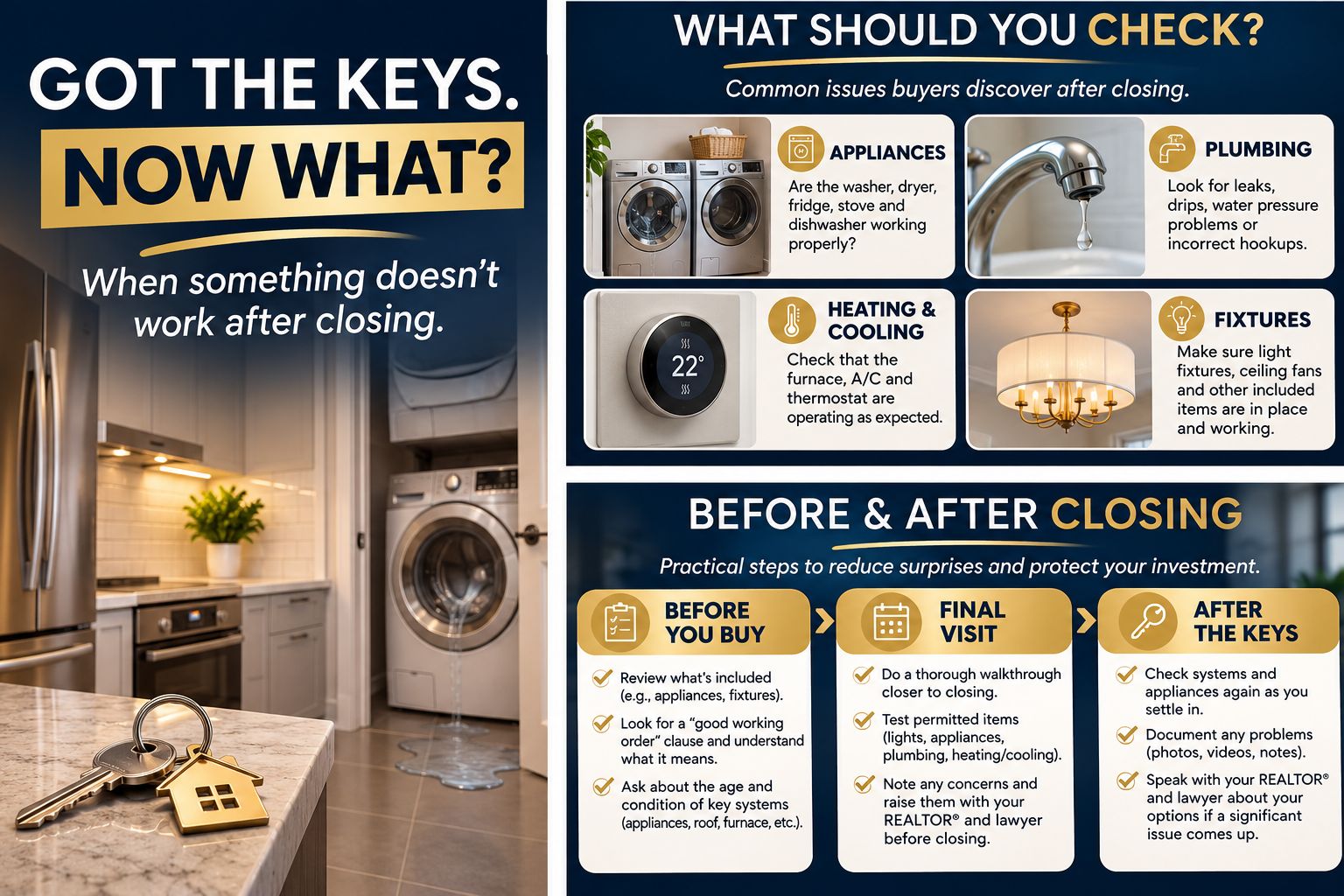
1. What Happens If Appliances Don't Work After Closing in Ontario?
Imagine this: You move into your new home. The fridge is there. The stove is there. The washer and dryer are exactly where they're supposed to be.
Everything looks perfect.
Until you actually try using them.
The washer doesn't drain. The dryer makes a noise that sounds like it's preparing for takeoff. And the dishwasher? Apparently, it's just decorative.
Does the seller have to fix or replace them?
Possibly. But it depends on your Agreement of Purchase and Sale (APS), the condition of the appliances at closing, any warranties in the agreement and the evidence available.
In Ontario, buyers should not assume that appliances automatically come with a warranty simply because they are included in the sale.
A properly drafted agreement may contain a provision stating that specified appliances, chattels or fixtures will be in good working order on completion.
But even then, there can be disagreements over what that actually means.
And that's where things get interesting.
2. What Does "Good Working Order" Actually Mean?
This is one of the most important things Ontario homebuyers should understand.
You might see wording in your Agreement of Purchase and Sale that says appliances or other included items must be in "good working order on completion, normal wear and tear excepted."
Sounds reassuring, doesn't it?
But there's a catch.
Good working order doesn't necessarily mean brand-new condition.
Consider these examples:
A dryer runs and dries clothes but makes a loud squeaking noise.
A refrigerator keeps food cold, but one shelf is damaged.
A dishwasher completes its cycle but makes an unusual grinding sound.
A washing machine runs, but the water connections appear to be leaking.
Are these appliances in good working order?
The answer depends on the facts, the wording of the contract, the seriousness of the problems and the available evidence.
A seller might believe that an older dryer is functioning adequately.
A buyer might reasonably question whether a dryer that makes a continuous, abnormal noise is operating properly.
Neither opinion automatically settles a legal dispute.
The lesson? Don't rely on assumptions about what "working" means. Discuss the warranty wording and any known concerns with your REALTOR® and real estate lawyer before signing.
3. Are Sellers Responsible for Broken Appliances After Closing?
Not automatically.
There are several questions to consider:
Was the appliance specifically included in the purchase agreement?
Did the seller provide a warranty about its condition?
Did the warranty remain enforceable after closing?
Was the problem present when the transaction closed?
Can the buyer document the problem and its cause?
These details matter.
For example, an appliance might break two weeks after closing because a component suddenly fails. That does not necessarily mean the seller breached the agreement.
But if there is credible evidence that an appliance failed to meet an express warranty at the time of closing, the buyer may have a contractual claim.
A warranty is important, but it isn't an automatic repair service.
If a seller disputes the buyer's claim, resolving the disagreement may require negotiation or legal action.
And sometimes, the cost of pursuing a claim can exceed the cost of the appliance itself.
That's why prevention is so important.
4. What About Plumbing Problems Discovered After Closing?
Now we're getting into potentially expensive territory.
Imagine moving into your new home and discovering:
A leaking pipe underneath the kitchen sink.
A toilet that constantly runs.
A shower that doesn't provide hot water.
A drain that repeatedly backs up.
A washing machine connection that leaks when used.
Water entering the basement.
These problems are not all treated the same way.
A worn toilet component may be a relatively minor maintenance issue.
An undisclosed serious plumbing defect that makes the property unsafe could raise very different legal questions.
In Ontario real estate, you'll sometimes hear two terms:
Patent defects: Problems that can generally be discovered through reasonable observation and inspection.
Latent defects: Hidden problems that are not generally discoverable through reasonable inspection. Certain serious latent defects, particularly those affecting safety or habitability, may create seller disclosure obligations.

Not every hidden defect automatically makes the seller legally responsible.
The circumstances matter, including what the seller knew, the nature of the defect, any misrepresentations and the agreement's terms.
If you discover a plumbing problem after closing, document the issue, prevent further damage and contact the appropriate professionals.
5. What If the Furnace or Air Conditioner Doesn't Work After Closing?
Let's imagine you've just moved into your new home in Barrie. It's February. It's freezing outside. You turn up the thermostat.
Nothing.
Congratulations! You've apparently purchased a very expensive refrigerator.
Joking aside, a furnace problem can be far more serious than a broken appliance.
Heating and cooling equipment may be subject to different contractual provisions, warranties, ownership arrangements and maintenance responsibilities.
Before purchasing a property, buyers should investigate:
The age and condition of the furnace and air conditioner.
Available maintenance and service records.
Whether the equipment is owned, rented or financed.
Whether the agreement includes an applicable working-order warranty.
Any known problems or recommended repairs.
Important: Just because a furnace is physically inside the home doesn't necessarily mean the seller owns it.
Rental equipment can create additional obligations and monthly payments, so the contract and any related rental agreements need careful review.
If your heating system stops working immediately after closing, contact an HVAC professional when necessary and speak with your lawyer about whether the issue may involve a contractual obligation.
If the lack of heat creates an immediate safety concern, prioritize safety rather than waiting for a legal dispute to be resolved.
6. What If a Fixture Is Missing or Damaged When You Move In?
Have you ever walked into a home and fallen in love with a beautiful chandelier?
You imagine it hanging above your dining table.
You buy the house. You move in.And the chandelier has mysteriously disappeared.
Surprise!
This is why understanding the difference between chattels and fixtures is so important.
What is a chattel?
A chattel is generally movable personal property that is not permanently attached to the home.
Examples commonly include freestanding refrigerators, washers, dryers and movable furniture.
Chattels should be expressly included in the Agreement of Purchase and Sale if you expect them to remain.
What is a fixture?
A fixture is generally an item attached to the property in a way that makes it part of the real estate.
Examples may include built-in cabinetry, certain attached appliances and installed light fixtures.
Fixtures are generally included unless specifically excluded, but classification can depend on the circumstances.
My advice? If you want something included, make sure it's clearly documented.
Don't assume that because you saw an item during a showing, it will still be there on closing day.
And sellers: if you're planning to take that sentimental chandelier, make sure it's properly excluded in the agreement.
Nobody needs a chandelier dispute on moving day.
7. Can You Test Appliances During a Final Walkthrough in Ontario?
Yes, when the agreement, access and seller's permission allow for the checks you want to perform.
But here's something buyers sometimes misunderstand.
A pre-closing visit is not an unlimited opportunity to inspect, repair or dismantle the property.
The seller still owns the home before closing.
Your rights to enter and the permitted purpose of the visit depend on your Agreement of Purchase and Sale and any additional arrangements.
That said, the final visit is an excellent opportunity to check whether the property appears to be in the agreed condition.
Where permitted, consider checking:
Whether included appliances appear to operate.
Whether taps deliver hot and cold water.
Whether toilets flush and visible plumbing leaks are present.
Whether heating and cooling controls respond.
Whether included light fixtures work.
Whether garage doors and openers operate.
Whether agreed-upon repairs appear complete.
Whether included items are still present.
One warning: Pressing the start button on a washing machine does not prove it can complete a full cycle.
Likewise, briefly turning on a furnace doesn't establish that it has no hidden defects.
If a particular system is especially important or concerning, discuss professional inspection or testing arrangements before removing an applicable inspection condition.
And if something seems wrong during the final visit, the issue can be raised with your lawyer before closing.
8. What Should You Do If Something Doesn't Work After Closing?
First, don't panic.
And please don't start arguing with the seller on social media.
Here's a practical approach.
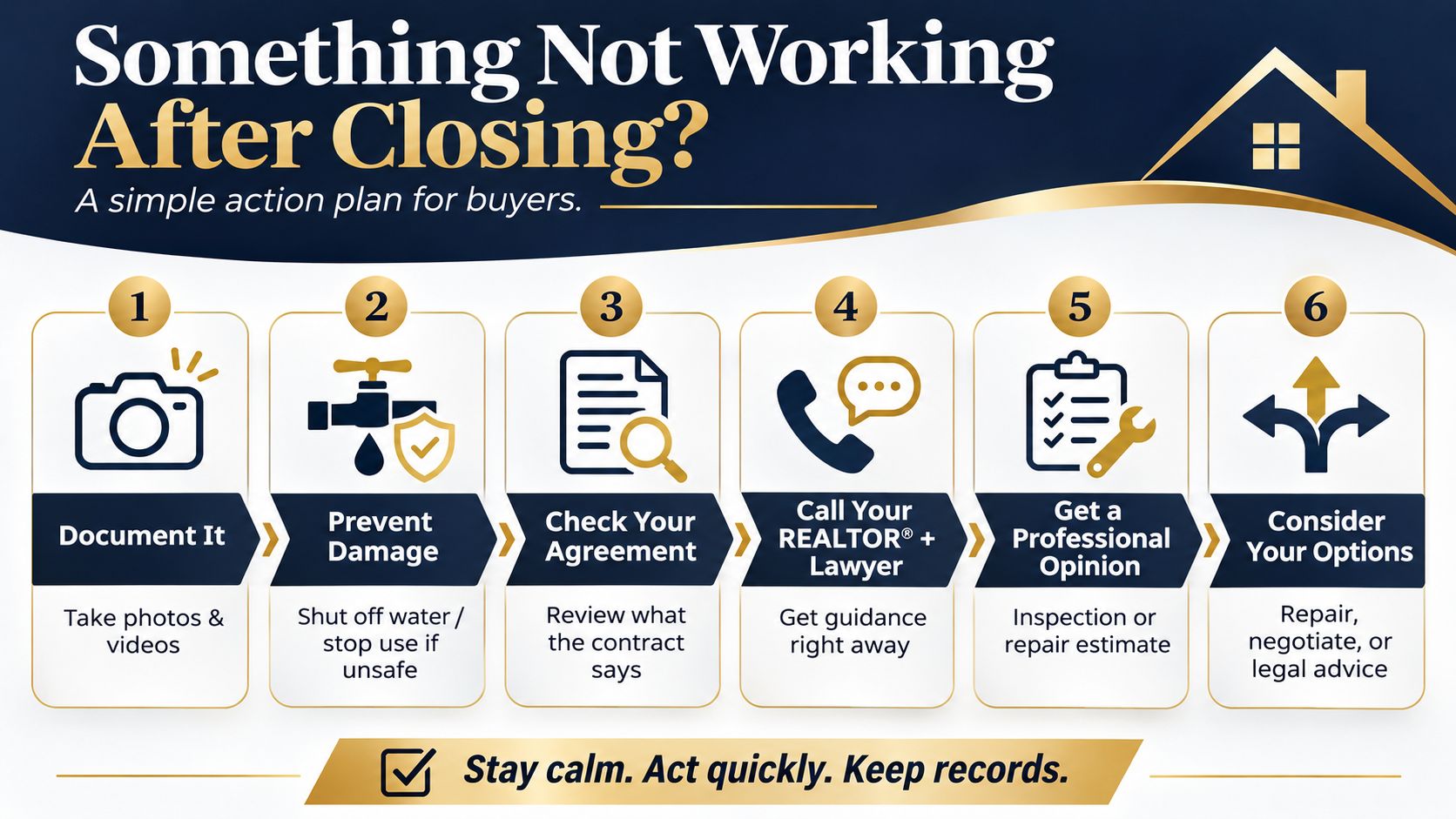
Step 1: Document the problem
Take clear photographs and videos.
Record what happened and when you first noticed it.
For example, if the dryer makes an unusual noise, record the noise during operation.
If water is leaking, photograph the source where it is safe to do so.
Step 2: Prevent further damage
If water is actively leaking, shut off the appropriate water supply if you can do so safely.
For electrical, gas or other hazardous problems, avoid using the equipment and contact a qualified professional.
Your safety comes first.
Step 3: Review your Agreement of Purchase and Sale
Look at the provisions covering:
Included chattels and fixtures.
Working-order warranties.
Seller repair obligations.
Any special clauses or schedules.
Whether particular warranties survive closing.
Don't assume every agreement contains the same protections.
Step 4: Contact your REALTOR® and real estate lawyer
Your REALTOR® can help you locate relevant transaction documents and communicate concerns through the appropriate channels.
Your lawyer can advise you about the agreement, potential remedies, evidence and any applicable deadlines.
Step 5: Get a professional assessment
Where appropriate, obtain a written inspection, repair estimate or technician's report.
An independent professional may be able to identify what failed, possible causes and whether the condition appears longstanding.
That evidence can be useful if responsibility is disputed.
Step 6: Consider your options before spending money on a legal dispute
Possible options may include negotiating a resolution, requesting repairs or compensation, or obtaining advice about a legal claim.
The right choice depends on the amount involved, the strength of the evidence, the agreement and the potential costs.
9. Can You Sue the Seller for Repairs After Closing in Ontario?
Depending on the circumstances, you may be able to pursue a contractual or other legal claim.
Ontario's Small Claims Court handles eligible monetary claims up to $50,000, as of October 2026.
But there's a big difference between being legally entitled to pursue a claim and deciding that litigation is financially worthwhile.
Consider a hypothetical example:
You move in and discover that an included washer and dryer may need $2,500 in repairs or replacement.
You believe the seller breached the working-order warranty.
The seller disagrees.
You now need to consider:
Can you prove the condition existed at closing?
Does the agreement actually cover the problem?
What evidence supports the necessary repairs or damages?
What are the filing, representation and other potential legal costs?
How much time and stress could the dispute involve?
Is there a realistic opportunity to negotiate a settlement?
Winning a claim is not guaranteed, and litigation can involve cost risks.
My point isn't to discourage buyers from protecting their rights. It's to explain why having the right wording, doing your due diligence and preserving evidence matters so much.
10. Does a Home Inspection Cover Appliances, Plumbing and Heating?
A home inspection can reveal important information, but it isn't a guarantee that everything in the home will work perfectly.
The scope of an inspection depends on the inspector, inspection agreement, accessibility and the condition of the property at the time.
For example:
A home inspector may inspect visible plumbing components and accessible heating equipment.
But that doesn't necessarily mean they will run every appliance through a complete operating cycle, inspect concealed plumbing or guarantee the remaining life of a furnace.
Ask your home inspector exactly what is and isn't included.
If you have specific concerns, you may need a licensed plumber, HVAC technician, electrician or appliance specialist.
A professional inspection is one layer of protection.
A properly drafted purchase agreement is another.
And a meaningful final visit is another.
They work together.
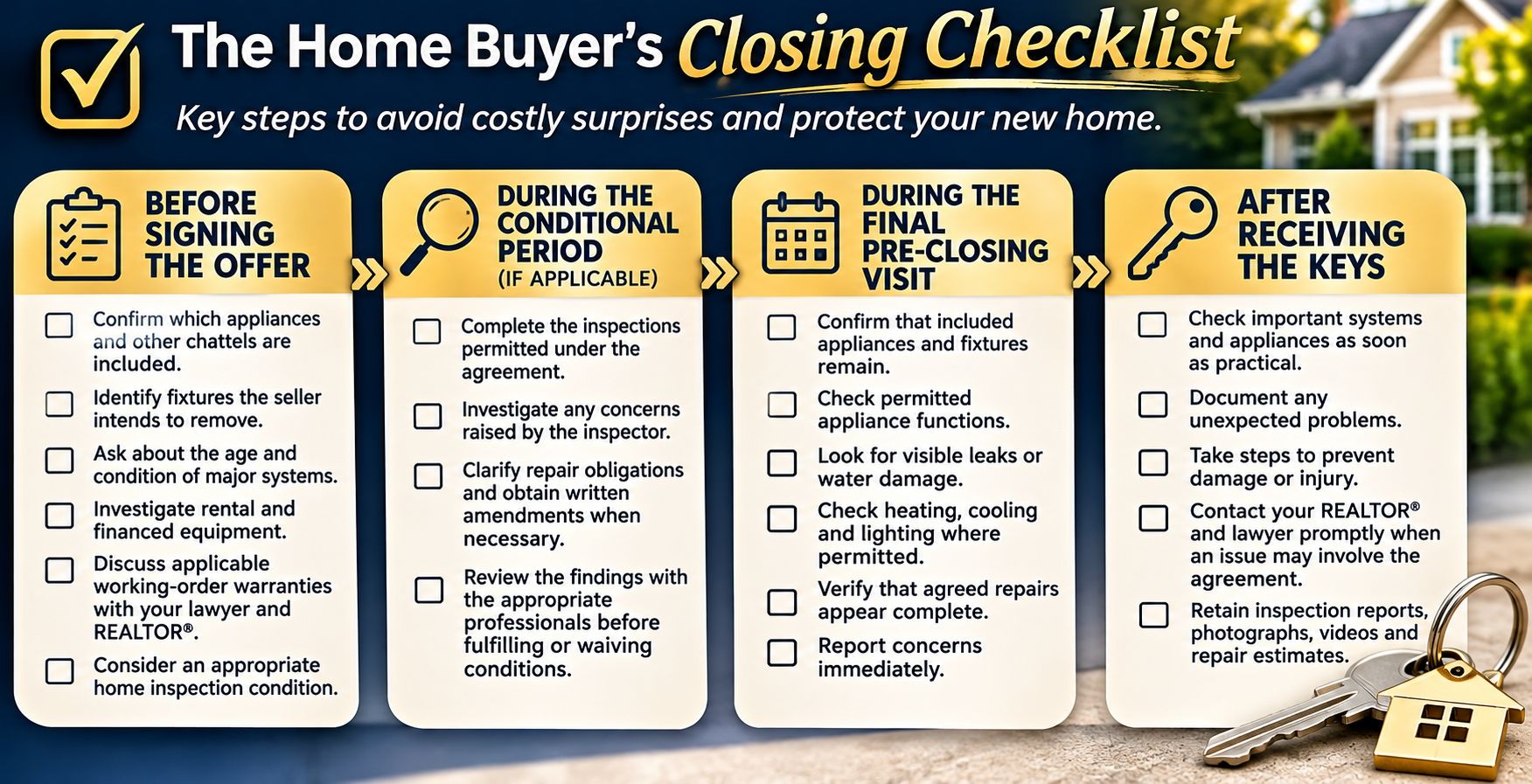
11. The Ontario Homebuyer's Before-and-After-Closing Checklist
Here is the checklist I encourage buyers to keep handy.
12. How Can Ontario Buyers Protect Themselves Before Closing?
After years of helping people buy and sell homes across Barrie, Innisfil and Simcoe County, one thing remains true:
Buying a home isn't just about negotiating the price. It's about understanding what you're actually buying.
A beautiful kitchen doesn't tell you whether the dishwasher works.
A freshly painted basement doesn't tell you whether there's a hidden moisture issue.
And a furnace that turns on during a showing doesn't tell you how many winters it has left.
That's why I believe buyers deserve more than a tour of the property and a set of keys.
They deserve guidance, careful preparation, informed questions and a clear understanding of their purchase agreement.
Because the last thing I want for my buyers is to celebrate their new home on Monday and discover an expensive, avoidable surprise on Tuesday.
The best closing-day surprise? Finding a bottle of champagne in the fridge. Not finding out the fridge doesn't work.
Thinking About Buying a Home in Barrie, Innisfil or Simcoe County?
The price you negotiate matters. But so does everything that comes with the home.
From understanding the Agreement of Purchase and Sale to coordinating inspections and preparing for closing, I help buyers approach their purchase with confidence, clarity and a strategy.
Let's make sure you know what you're buying before you get the keys.

Gemma Leggett | REALTOR®
Barrie, Innisfil & Simcoe County Real Estate
Waterfront & Residential Property Specialist
Website: https://gemmaleggett.ca
Disclaimer: This article is for general educational purposes only and does not constitute legal, financial, engineering or home inspection advice. Real estate contracts and property disputes are fact-specific. Buyers and sellers should consult a qualified Ontario real estate lawyer and other appropriate professionals about their particular circumstances. Information reflects Ontario rules and resources available in November 2026.