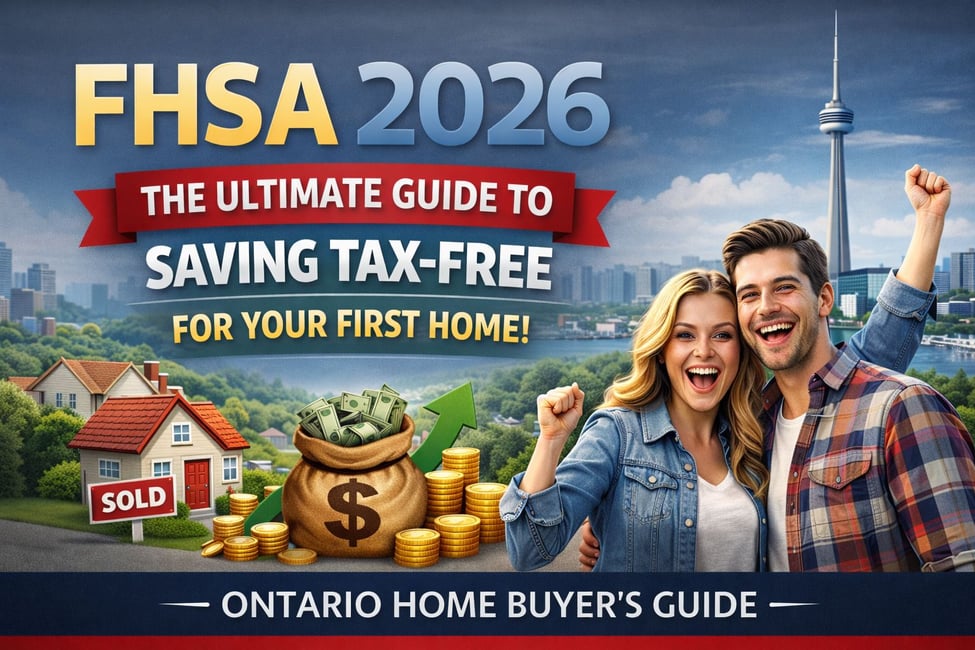
How to actually build the courage (and the cash) to go from renting indefinitely to owning your dream home — even if you love Amazon, Starbucks, and weekend brunch.
🔥 What Is the FHSA? And Why It’s a Game‑Changer
The First Home Savings Account (FHSA) is a registered savings plan created by the Government of Canada to help first‑time buyers save tax‑free for their first home. It blends the best parts of an RRSP and a TFSA — tax deductions when you put money in + tax‑free growth, and tax‑free withdrawals when you buy. That’s why savvy savers call it a financial superhero for first homes.
Here’s what that looks like:
🧠 Tax Deduction Now: Your FHSA contributions reduce your taxable income — meaning you pay less tax this year.
🌱 Tax‑Free Growth: Investments inside your FHSA grow tax‑free as long as the money remains in the account.
🏡 Tax‑Free Down Payment: When you use the money to buy your first home, withdrawals are tax‑free. No sneaky tax bite at the end.
🧾 FHSA Rules You MUST Know (2026)
🧑💻 Eligibility
You can open an FHSA if you are:
✔ A Canadian resident
✔ 18–71 years old by December 31 of the tax year you open it
✔ A first‑time homebuyer (no ownership in current year or last four years)
💰 Contribution Limits
📌 Annual cap: $8,000 per year
📌 Lifetime cap: $40,000 total
📌 Unused room: You can carry forward unused contribution room — up to $8,000 per year — but you cannot stack more than that to create huge annual lump sums.
⚠ Importantly — FHSA contribution room only starts the year you open the account. So opening it sooner gives you more room over time, even if you don’t use it right away.
📅 Timing Tip (2026 Strategy):
If you opened your FHSA before Dec 31, 2025, you already got an extra $8,000 room for 2025 + another $8,000 for 2026 — meaning you could contribute up to $16,000 early in 2026 if you haven’t put anything in yet.
📉 What Happens When You Withdraw?
🏠 Qualifying Withdrawal
To be tax‑free:
✔ You must be a first‑time homebuyer when you withdraw
✔ You must be a Canadian resident when you withdraw
✔ You must have a written purchase agreement by Oct 1 of the year after the withdrawal
✔ You must intend to occupy the home as your principal residence within one year
👉 If all these are met — your money comes out tax‑free to use for a down payment, closing costs, or other qualifying purchase expenses.
❌ Non‑Qualifying Withdrawal
If you take money out for anything other than a first home, the amount becomes taxable income. That’s why FHSA is designed to keep your savings focused on that first home goal.
🔄 Rolling and Transferring: Smart Moves
🔁 RRSP → FHSA
You can transfer funds from your RRSP to your FHSA tax‑free — but this does not give you a new tax deduction (only the FHSA cash contributions do).
🔁 FHSA → RRSP/RRIF (If You Don’t Buy)
If you don’t end up using your FHSA for a first home, you can transfer the balance to your RRSP or RRIF without tax consequences. That’s like bonus retirement savings.
⚠ Contribution room to RRSP must exist at that time — check your latest CRA My Account to confirm.
📊 FHSA vs RRSP vs TFSA — Quick Reality Check
| Account | Tax Deductible | Tax‑Free Growth | Tax‑Free Withdrawals for First Home | Payback Required? |
|---|---|---|---|---|
| FHSA | ✅ Yes | ✅ Yes | ✅ Yes | ❌ No |
| RRSP (HBP) | ✅ Yes | Tax‑Deferred | Yes (HBP) | Yes (Repay over 15 yrs) |
| TFSA | ❌ No | ✅ Yes | Yes (Any reason) | ❌ No |
Long story short: FHSA is the best first step for first‑time buyers because it gives deductions now and tax‑free money when you buy — no repayment required.
🌱 What You Can Invest Inside Your FHSA
Your FHSA isn’t just a savings jar: you can hold investments like:
✔ ETFs
✔ Stocks
✔ Mutual funds
✔ Bonds
✔ GICs
✔ Other qualified securities (check with your institution)
💡 That means your money can grow faster than inflation, instead of just sitting in a regular savings account.
🤯 Real‑World Examples (2026)
⭐ Example 1 — “Smart Starter”
Sarah opens her FHSA in January 2026 and contributes $8,000. She also had $8,000 of unused 2025 room, so her total potential contribution in Jan 2026 is $16,000 — instantly lowering her taxable income for 2026 taxes.
⭐ Example 2 — “Couple Power Move”
Tom and Lily both open FHSAs. Each contributes $40,000 lifetime maximum. Together they have up to $80,000 in tax‑free first home funds — plus the option to stack RRSP HBP funds if needed.
💥 Why Buying Beats Renting (Yes, Even With Amazon & Lattes)
Let’s be real: immediate gratification rules our generation. Amazon Prime delivers everything in two days, Starbucks makes mornings feel better, and social media makes today’s life look so good. But here’s the kicker:
Renting is the ultimate subscription you never win.
You pay someone else’s mortgage instead of building your own equity.
🔑 The Psychology of Ownership
Instead of spending $$ on things that disappear (that extra latte, the new gadget, the impulse buy), imagine this:
✔ Your savings: building equity
✔ Your home: a place that’s yours
✔ Your mortgage: funding your future
Every dollar you put toward owning strengthens your confidence, financial security, and long‑term wealth.
According to psychology principles like those Tony Robbins teaches:
👉 Meaning comes from progress, not consumption.
People who save and invest toward purposeful goals feel more in control, more empowered, and more fulfilled — even if it means saying no to instant gratification today.
Owning isn’t just about houses — it’s about freedom:
✔ Freedom from rent increases
✔ Freedom to customize your space
✔ Freedom to build real wealth
Fear of commitment can keep people renting forever. Fear of missing out keeps us buying things we don’t need. But what we gain from investing in our first home — discipline, confidence, security — that’s crazily powerful.
❓ FHSA Q&A — All the Questions You Want Answered
Q: Can I open an FHSA even if I already own a home that I sold a few years ago?
A: You must not have owned a home in the current year or four previous years. If you sold more than four years ago, you may be eligible. Check CRA rules or talk to your advisor.
Q: Can both partners use FHSA funds for the same home?
A: Yes! If both you and your partner qualify, you each can withdraw tax‑free toward the same qualifying home purchase.
Q: Can FHSA room stack across years?
A: Yes — your unused annual $8,000 limit carries forward to future years (max $8,000 carry).
Q: Can I use FHSA and RRSP HBP together?
A: Yes! You can use both plans for the same home purchase — your FHSA stays tax‑free and your RRSP under HBP needs repayment over 15 years.
Q: What if I never buy a home?
A: You can transfer your FHSA savings to an RRSP or RRIF without immediate tax consequences — effectively boosting retirement savings.
📢 Final Thought: Start Now! Not Later
The biggest advantage you have is time. Every year you don’t open and fund your FHSA is missed opportunity:
✔ Missed tax deductions
✔ Missed investment growth
✔ Missed equity building
Waiting for “the perfect moment” often becomes a lifetime of renting — and that’s a hard habit to break.
Don’t let Amazon Prime and impulse purchases steal your future.
Put that same energy into building something real: your home, your equity, your freedom.
📜 Disclaimer
This blog is for general informational purposes only and does not constitute financial, tax, or investment advice. Always consult a qualified financial advisor or tax professional before making decisions about your FHSA, investments, or home purchase. Information is based on current rules and may change.
✅ Ready to Turn Saving Into Ownership?
Understanding the FHSA is one thing — using it strategically in today’s Ontario market is another.
If you’re renting in Barrie, Innisfil, or anywhere in Simcoe County and wondering:
How much home you could actually afford in 2026
How to time your FHSA savings with the local market
When it makes sense to stop renting and start building equity
That’s where having a local expert matters.
I live and work in this market every day. I help first-time buyers connect the dots between smart saving, real numbers, and real homes — without pressure, without fluff, and without rushing you before you’re ready.
📩 If you want a clear, honest plan: let’s talk.
Whether you’re 6 months out or 3 years away, I’ll help you map out your next best move so when you do buy, you do it confidently.
Your future home starts with the right information and the right local guidance.