
Should You Walk Away From a House Because of Grading Problems? What Ontario Homebuyers Need to Know About Home Inspections

You've found the house. You love the kitchen, you've mentally arranged your furniture, and you've already pictured yourself enjoying your morning coffee in the backyard. Then comes the home inspection.

Everything is going reasonably well until the inspector says:

"We have a grading problem."  A grading problem?

Suddenly, you're picturing a flooded basement, cracked foundations, thousands of dollars in repairs, and your dream home turning into a financial nightmare.

All because the dirt is sloping in the wrong direction?

Well, before you cancel the moving truck you haven't even booked yet, let's talk.

Because here's something I've learned working with buyers throughout Barrie, Innisfil and Simcoe County:

Not every home inspection finding is a deal-breaker. But every finding deserves to be understood.

And sometimes, the way a problem is communicated can have almost as much impact on a buyer as the problem itself.

Let's talk about grading, water intrusion, home inspections, inspector qualifications, and the very real psychology behind buying a home.


What Is Grading Around a House, and Why Does It Matter?


Let's start with the basics.

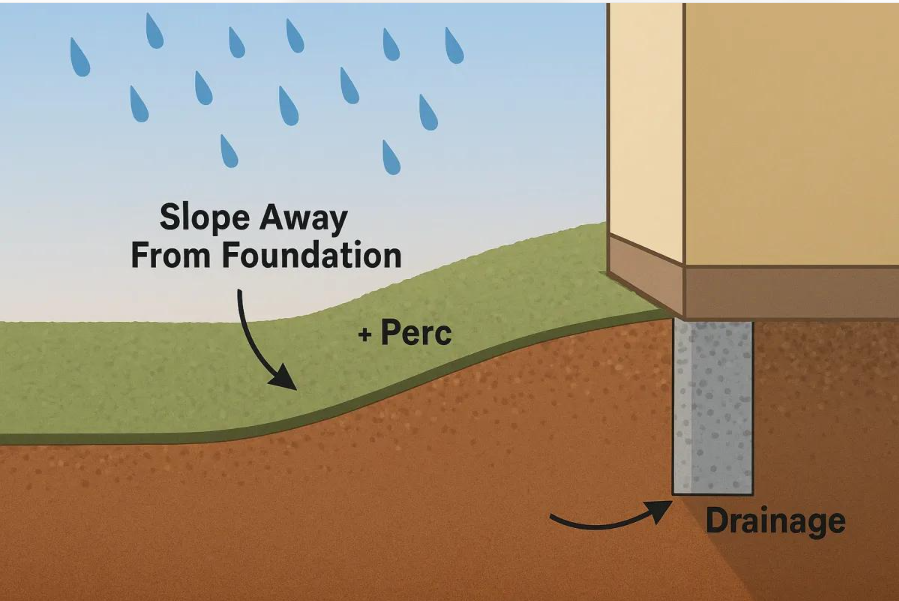
Grading refers to the slope of the ground around your home.

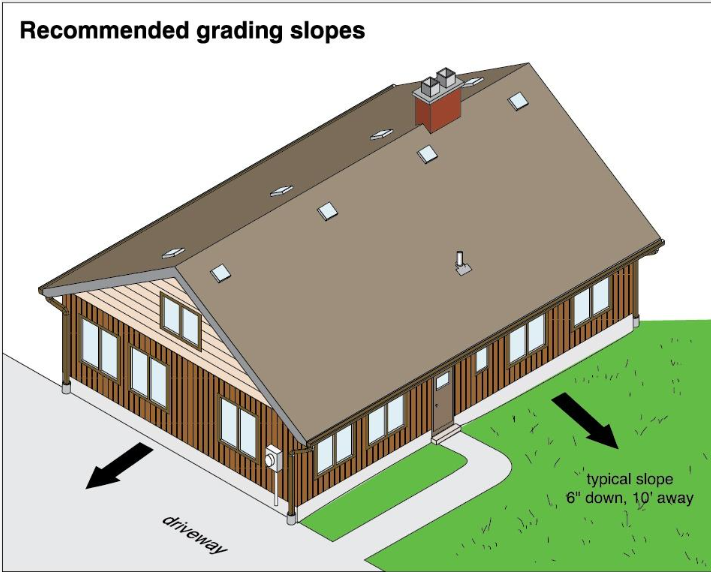
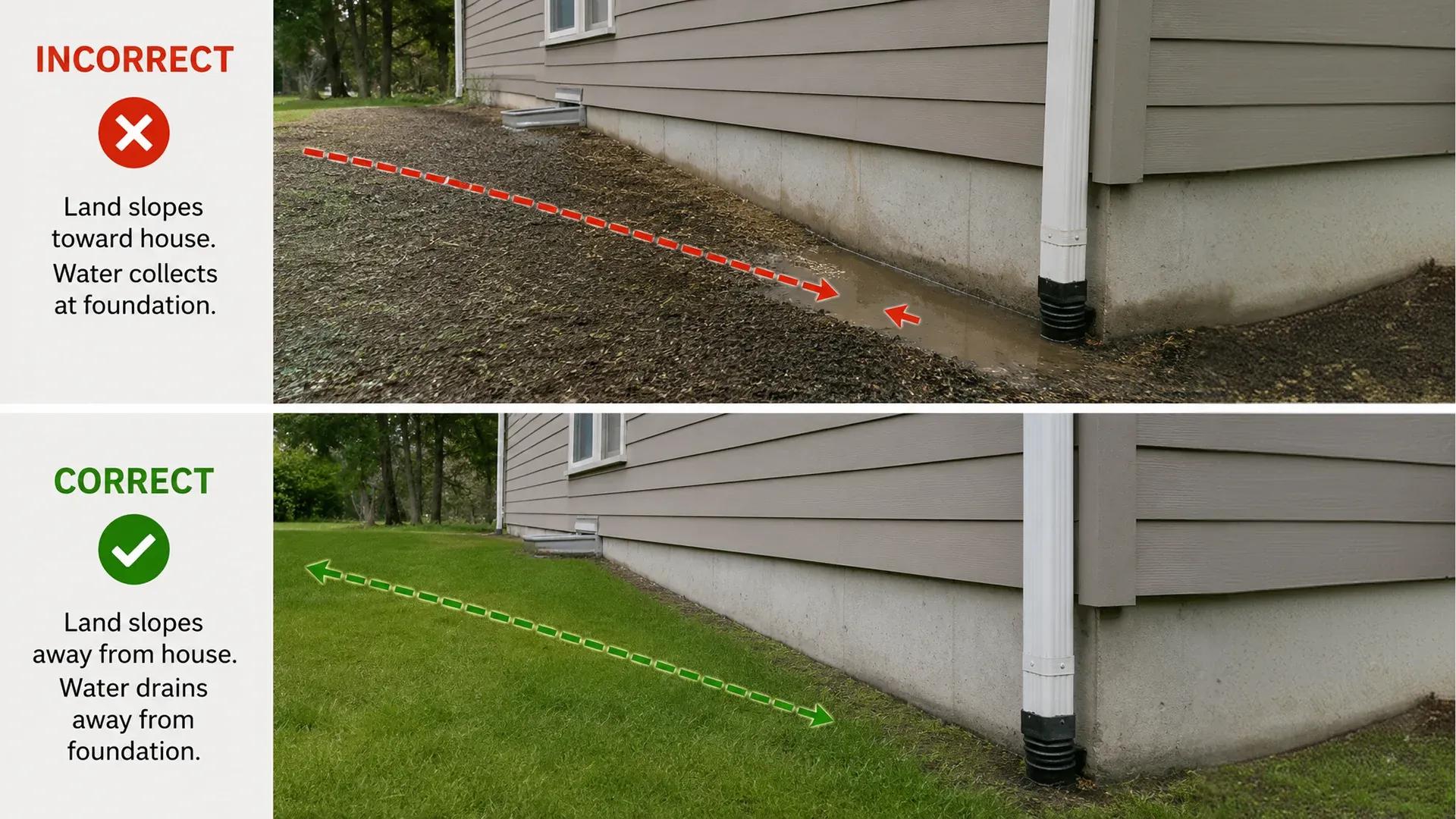
Ideally, the ground should slope away from your foundation, encouraging rainwater and melting snow to travel away from the house rather than collecting against it.

Think of it this way:

Your home needs good drainage just as much as you need a good umbrella during an Ontario spring.

And if you've experienced spring in Barrie, you know Mother Nature doesn't always believe in moderation.

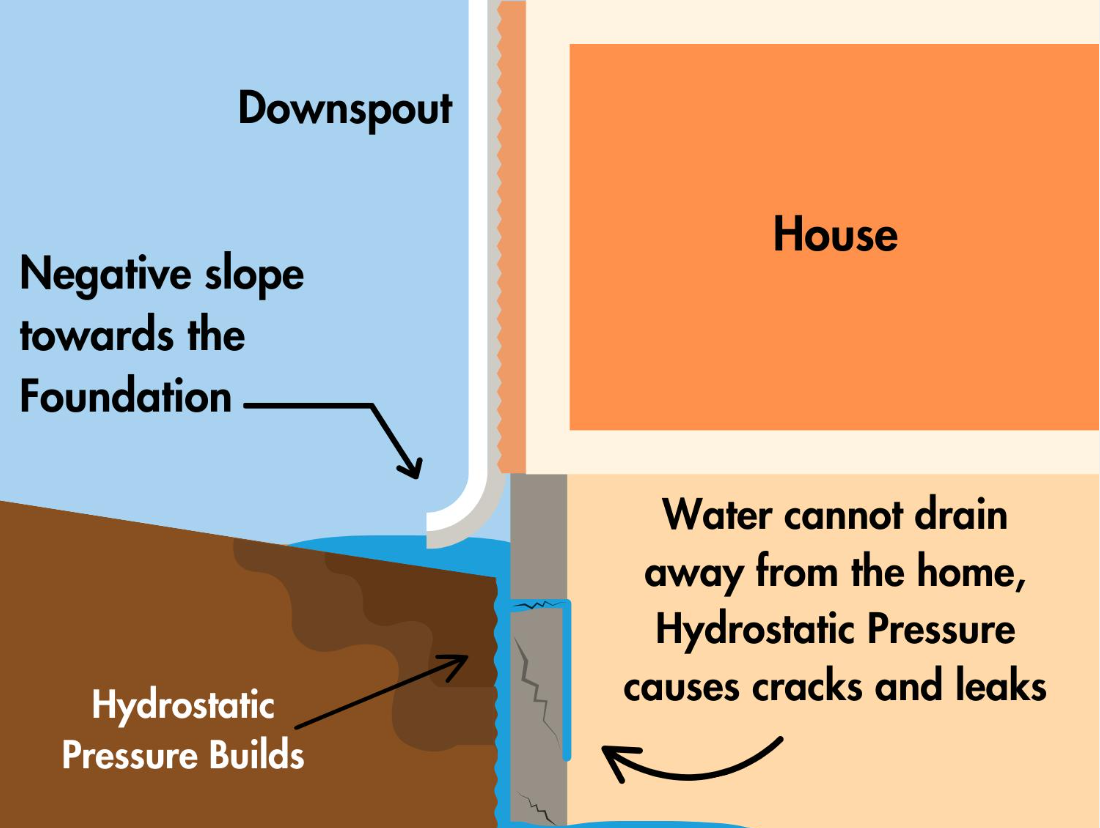
When the ground slopes toward your foundation, water can accumulate near foundation walls, potentially contributing to:

  • Basement leaks or crawlspace moisture

  • Foundation seepage

  • Mould and mildew

  • Wood rot and material deterioration

  • Soil erosion

  • Additional pressure on foundation drainage systems

But notice my choice of words: can contribute.

Poor grading does not automatically mean your foundation is damaged or your basement is flooding.

It means there is a condition that should be assessed and, where necessary, corrected.

Canada's federal flood-prevention guidance recommends directing water away from the building. A slope of approximately 5% is an ideal general target for soil grading, although actual requirements depend on site conditions, surface materials and local regulations.

Government of Canada Property Grading


Why Do So Many Homes in Barrie, Innisfil or anywhere in Simcoe, Have Grading Problems?

Because houses, yards, and the ground around them change over time. And no, your house isn't necessarily falling apart.

In Barrie, Innisfil, Midhurst, Essa, Oro-Medonte and throughout Simcoe County, homeowners deal with changing seasons, heavy rain, snowmelt and freezing temperatures.

Over the years, several things can affect grading:

Soil settlement: Soil around foundations can settle after construction, creating low spots where water collects.

Freeze-thaw cycles: Seasonal freezing and thawing can contribute to movement in soil and hardscaping.

Landscaping changes: Gardens, flower beds, raised patios and decorative borders can unintentionally alter drainage.

Driveway and patio settlement: Interlocking stone, asphalt and concrete surfaces can settle or change slope.

Poor downspout discharge: Even a beautifully graded yard can struggle if the roof runoff is discharged directly beside the foundation.

And here's one people often overlook:

Sometimes homeowners add landscaping because it looks beautiful, without realizing they're redirecting water toward the house.

Beautiful flower bed? Absolutely.

Unexpected backyard swimming pool beside your foundation? Not quite the feature we were hoping for.


How Do You Know if Poor Grading Is a Minor Problem or a Serious Concern?

This is one of the most important questions to ask before purchasing a home.

Not every grading issue requires the same response.


The real question isn't simply: "Is the grading wrong?"

It's: "Has the grading caused damage, is water getting into the home, and what will it take to correct the problem?"

Those are very different questions.

Can Poor Grading Cause Foundation Damage?

Yes, it can.

Water accumulating against foundation walls may find its way through cracks, joints or other vulnerable areas.

Over time, persistent water exposure can contribute to deterioration and moisture-related problems.

However, not all foundation issues are caused by grading, and not all grading issues result in foundation damage.

A foundation crack, for example, needs to be evaluated based on its location, characteristics, movement, associated water entry and other evidence.

Here's what I encourage buyers to understand:

A risk of future damage is not the same as confirmed existing damage.

Both matter, but they call for different conversations.

If a home inspector identifies negative grading but no evidence of water penetration, the next step may be to obtain an opinion and estimate from a qualified drainage or landscaping contractor.

If there is evidence of recurring water infiltration, rotting wood, significant cracking or structural movement, the next step may involve a foundation specialist or structural engineer.

A thorough investigation is much more useful than immediately assuming the worst.


How Much Does It Cost to Fix Grading Around a House in Ontario?

Here's the answer nobody loves hearing:

It depends.

I know. Very helpful, Gemma.

But the costs genuinely vary because grading repair can mean anything from adjusting a small area of soil to redesigning drainage around an entire property.

A small landscaping correction and a full foundation waterproofing project are not remotely the same job—or the same budget.

For that reason, I wouldn't put a generic dollar amount on every grading problem.

The right approach is to obtain written quotes from qualified local contractors, with a clear scope of work, before making a financial decision.

Also, adding soil isn't always the solution. If it raises the ground too close to siding, covers drainage openings or sends water onto a neighbouring property, it can create new problems.

Sometimes the fix is simple. Sometimes the property's layout makes drainage more complicated.

That's why an actual site assessment matters.


Should You Walk Away From a House Because of Poor Grading?

Here's where I want buyers to think carefully. Imagine two houses.

The first has a patio that slopes slightly toward the foundation. There is no documented history of water penetration, and a contractor confirms the patio can be corrected with a defined scope of work.

The second has negative grading, repeated basement flooding, damaged structural framing and a history of unsuccessful repairs.

Both houses technically have grading problems.

Would I treat them the same? Absolutely not.

With the first house, a buyer may decide the correction is manageable.

With the second, I'd want a much more comprehensive investigation, specialist findings and a realistic repair budget before considering proceeding. And depending on those results, walking away may be an entirely reasonable decision.

The goal is not to convince someone to buy a problematic house. The goal is to understand the problem well enough to make the right decision.

A buyer may choose not to proceed because of cost, risk, uncertainty or simply because the property no longer suits their comfort level.

That decision belongs to the buyer. But ideally, it should be based on evidence rather than panic.

What to know before buying a house?


What Does a Home Inspector Actually Do in Ontario?


ONTARIO INSEPCTION ACT 

A home inspector performs a primarily visual, non-invasive assessment of a property's accessible components and systems.

Depending on the applicable inspection standard and agreement, this generally includes examination of:

  • Roofing, gutters and drainage

  • Foundation and visible structural components

  • Exterior walls, windows and doors

  • Plumbing systems

  • Electrical systems

  • Heating and cooling equipment

  • Attic insulation and ventilation

  • Visible basement or crawlspace conditions

  • Exterior grading and drainage

  • Other accessible building components

A home inspection is designed to identify observed defects, potential concerns and areas requiring further investigation.

It is not a guarantee that the house has no hidden problems.

And a home inspector cannot necessarily see what's happening behind finished walls, underground or inside inaccessible areas.

Ontario's homebuying guidance also makes an important distinction: a home inspection is not a pass-or-fail examination, a building-code compliance certification or a warranty.


Think of your home inspector as the property's general health examiner.

They can identify symptoms that deserve attention, but some concerns require a specialist to diagnose the underlying cause.


Are Home Inspectors Licensed in Ontario?

Here's something that surprises many Ontario homebuyers.

As of October 2026, Ontario does not require home inspectors generally to hold a provincial home-inspector licence.

Ontario passed the Home Inspection Act, 2017, but it has not yet been brought into force.


In other words, don't assume someone has completed a particular training program simply because their business card says Home Inspector.

That doesn't mean there aren't excellent, highly trained home inspectors in Ontario.

There absolutely are.

But it does mean buyers need to ask questions about professional qualifications.


What Qualifications Should a Good Home Inspector Have?

I encourage homebuyers in Barrie, Innisfil and Simcoe County to look beyond the price of the inspection.

Important considerations include:

1. Education and technical training

Does the inspector have formal education in home inspection, building science, construction technology or relevant trades?

2. Practical experience

How many homes have they inspected? Do they have experience with the type and age of home you're purchasing?

A century home, a newer subdivision house and a rural bungalow with a crawlspace present different challenges.

3. Professional credentials

One recognized Ontario designation is Registered Home Inspector (RHI) through the Ontario Association of Home Inspectors (OAHI).

The RHI designation requires specified education, practical experience, peer review and continuing education. OAHI's stated requirements include at least 200 paid home inspections and annual continuing education.


Other professional organizations, including the Canadian Association of Home & Property Inspectors (CAHPI), provide standards and professional guidance.

Membership categories and credentials vary, so buyers should verify the individual's actual standing.

4. Insurance

Ask whether the inspector maintains professional errors-and-omissions insurance and commercial general liability insurance.

5. Standards of practice

Ask which inspection standards they follow.

The voluntary CSA A770 Home Inspection Standard is one recognized Canadian reference that buyers can ask about.

6. Communication skills

And here comes the part I believe deserves much more attention.

Can the inspector explain their findings clearly, accurately and objectively?

Because identifying a problem is only part of the job.

Helping the buyer understand what was found, what it could mean and what still needs investigation is equally important.


Should Home Inspectors Tell Buyers Whether They Should Purchase a House? HOME INSPECTION GUIDANCE

I have strong feelings about this one! 

A home inspector's job is to inspect the property and report on its condition, not decide whether the buyer should purchase it.

Inspectors should absolutely point out serious defects, safety hazards, water penetration, structural concerns and potential future risks.

In fact, I expect them to.

I'd much rather have an inspector identify a problem before my buyer purchases the property than discover it six months after closing.

But there's a difference between a professional assessment and a personal purchasing opinion.

For example:

Professional assessment:

"The grading slopes toward the foundation. This increases the potential for water accumulation and penetration. I recommend further assessment and corrective work."

Personal purchasing opinion:

"If I were you, I wouldn't buy this house."

See the difference?

The first communicates an observable condition, a potential consequence and an appropriate next step.

The second makes a judgment about a decision that depends on far more than the inspection alone.

That said, when an inspector discovers an immediate safety hazard or evidence of significant structural failure, strong warnings are entirely appropriate.

The communication should match the seriousness of the evidence—not the inspector's personal comfort level with the property.


Why Can the Way a Home Inspector Communicates Affect a Buyer's Decision?


This might be the most overlooked part of buying a home.

Buying a home isn't just a financial transaction.

It's emotional.

You've spent weeks or months searching. You've looked at properties online, scheduled showings, compared neighbourhoods and probably imagined your life in more houses than you care to admit.

Finally, you've found one that feels right.

Then someone points to an issue and uses alarming language.

Your brain can go from “I love this house!” to “Am I about to make the biggest financial mistake of my life?” in about three seconds.

Welcome to buyer psychology.

What Is Risk Perception in Real Estate?

Risk perception describes how people interpret possible danger or loss.

A buyer's reaction can be influenced by:

  • How serious a problem sounds

  • How much they understand about it

  • Whether they've experienced previous property problems

  • Their financial ability to manage unexpected expenses

  • Their confidence in the professional providing the information

  • The uncertainty surrounding the cost or extent of repairs

And yes, words matter.

Consider these two explanations:

"There's a drainage issue that needs further evaluation."

Versus:

"This whole area is a major problem."

The first gives the buyer something to investigate.

The second may leave them imagining catastrophic damage, whether or not that conclusion is supported.

That doesn't mean inspectors should soften findings to make buyers feel comfortable.

Quite the opposite.

I believe buyers deserve full transparency.

But accuracy, clarity and perspective should accompany that transparency.

An inspector shouldn't have to choose between telling the truth and communicating responsibly.

A good professional can do both.


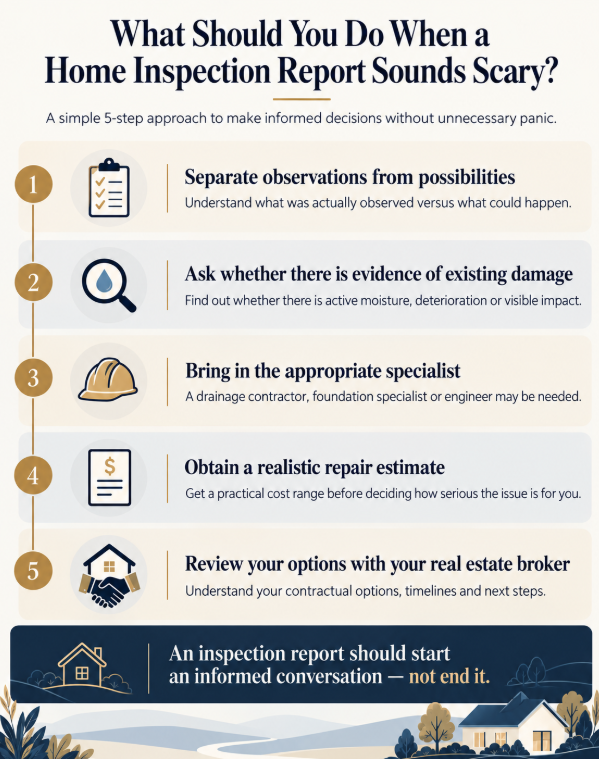
What Should You Do When a Home Inspection Report Sounds Scary?

First, don't ignore it. Second, don't assume the worst.

And third, don't let the clock run out on your inspection condition while everyone is trying to figure out what the problem actually means.

Here's the approach I recommend.


Step 1: Separate observations from possibilities

Ask the inspector: "What did you actually observe?"

A visible water stain is an observation.

A prediction that the foundation may develop serious problems is a possible consequence.

You need to understand both, without confusing them.

Step 2: Ask whether there is evidence of existing damage

For grading concerns, consider questions such as:

  • Was active moisture detected?

  • Was there evidence of previous water entry?

  • Were moisture readings taken, and where?

  • Was any wood rot or structural damage observed?

  • Were previous repairs visible?

  • Were parts of the crawlspace or foundation inaccessible?

Remember, a dry crawlspace on inspection day doesn't prove it never experiences water intrusion.

Step 3: Bring in the appropriate specialist

Depending on the concern, you might need a drainage contractor, foundation specialist, licensed electrician, plumber or structural engineer.

One professional doesn't have to be an expert in every component of a building.

Step 4: Obtain a realistic repair estimate

A potential repair sounds much less mysterious when you know what's involved.

Sometimes the estimate confirms a manageable issue.

Other times, it reveals that the problem is much more expensive or complicated than expected.

Either way, you've gained useful information.

Step 5: Review your options with your real estate broker

Depending on your signed agreement and the circumstances, those options may include requesting a repair, negotiating an adjustment, seeking an agreed extension for further investigation or deciding not to proceed where permitted by the contract.

Inspection conditions, notice requirements and deadlines must be followed carefully, with legal advice where appropriate.

An inspection report should start an informed conversation, not end it.


What Makes a Great Home Inspector Different From a Good One?

A good inspector finds problems.

A great inspector identifies the problems, explains the evidence, communicates the level of concern, acknowledges uncertainty and recommends the right next steps.

For example, I appreciate an inspector who can say:

"This grading should be corrected. I don't have sufficient evidence to determine whether it has caused hidden damage. Here's what I observed, and here's who I recommend you contact."

That's not minimizing the problem.

That's explaining it professionally.

A great inspector also understands that buyers may be hearing unfamiliar construction terminology for the very first time.

Terms like negative grading, efflorescence, foundation seepage, spalling and moisture intrusion can be intimidating.

And let's face it, most people don't spend their weekends discussing the exciting world of foundation drainage.

Unless they're home inspectors.

Or realtors.

Apparently, we know how to party.

The point is simple: Professionalism involves not only what you know, but also how effectively you communicate it.


Why Having an Experienced Barrie or Innisfil Real Estate Broker Matters During a Home Inspection

This is where I believe experienced real estate representation can make a meaningful difference.

My job isn't to tell a buyer that every house is wonderful.

And it certainly isn't to convince someone to ignore a serious problem just to complete a sale.

My responsibility is to help clients understand the information available, coordinate appropriate expertise, assess their contractual options and make decisions aligned with their interests.

When a concern is identified during an inspection, I want my buyers asking:

What do we know? What don't we know? Who can provide the missing answers? And what are our options?

Not simply:

"Should I panic?"

After all, no house is perfect.

Even brand-new homes can have defects.

The objective isn't to find a house with absolutely nothing wrong.

It's to find a property whose condition, risks and costs are acceptable to you.

And sometimes, yes, the smartest decision is to walk away.

Other times, a concerning inspection finding turns out to be something that can be corrected.

The difference is proper due diligence.


Frequently Asked Questions About Grading and Home Inspections in Ontario

1. Is negative grading a deal-breaker when buying a house?

Not necessarily. Negative grading means the ground slopes toward the house rather than away from it. The seriousness depends on whether water is accumulating, whether damage has occurred, and the feasibility and cost of correcting the drainage.

2. Can you buy a house with poor grading?

Yes. Buyers can purchase homes with grading deficiencies, provided they understand the risks and are comfortable with the necessary repairs. An appropriate professional assessment is recommended before making that decision.

3. Does poor grading always cause basement flooding?

No. Poor grading increases the risk of water accumulating near a foundation, but it doesn't automatically mean water has entered the basement or crawlspace.

4. Can a house have moisture problems even if the basement is dry during the inspection?

Absolutely. Water penetration can be intermittent or seasonal. A dry basement on inspection day doesn't rule out previous flooding or future water intrusion.

5. Who fixes grading problems around a house?

Depending on the issue, a qualified landscaping contractor, drainage specialist, hardscaping contractor or foundation professional may be appropriate. More complicated site-drainage issues may require engineering advice.

6. Are home inspectors required to be licensed in Ontario?

As of October 2026, there is no mandatory Ontario provincial home-inspector licensing regime in force. Buyers should independently verify an inspector's credentials, experience, standards of practice and insurance.

7. Can a home inspector tell you not to buy a house?

A home inspector may explain serious concerns and recommend further investigation, but the final purchasing decision belongs to the buyer. Inspectors should clearly distinguish observed defects, suspected problems, safety warnings and personal preferences.

8. Can you negotiate after a bad home inspection in Ontario?

Potentially, yes. Depending on the purchase agreement and the seller's willingness, buyers may be able to negotiate repairs or price adjustments. No seller is automatically obligated to renegotiate, and buyers must comply with all contractual conditions and deadlines.

9. Should you get a second opinion after a home inspection?

A second professional opinion can be valuable when findings are unclear, potentially expensive or outside the original inspector's expertise. A specialist's assessment may be more useful than simply repeating the same general home inspection.

10. Are grading problems common in older Barrie and Innisfil homes?

Grading and drainage deficiencies can occur in both older and newer homes. Settlement, landscaping alterations and changes to patios or driveways can all affect drainage over time.

11. Does a home inspection guarantee that a house has no problems?

No. A typical home inspection is a limited, visual assessment of accessible components, not an exhaustive investigation or a guarantee against hidden defects.

12. What should first-time homebuyers do if an inspector finds multiple problems?

Ask the inspector to explain which findings involve immediate safety concerns, existing damage, routine maintenance or further investigation. Obtain specialist assessments and repair estimates where needed, then review your options with your real estate broker and lawyer before the applicable deadlines.


Buying a Home in Barrie, Innisfil or Simcoe County? Let's Make Sure You Understand What You're Buying.

Finding the right home isn't about finding a property that's absolutely perfect.

It's about understanding what you're purchasing, knowing which questions to ask and having the right professionals supporting you.

Whether you're buying your first home in Barrie, searching for a bungalow in Innisfil, considering an older property in Midhurst or exploring waterfront real estate around Lake Simcoe, I'm here to help you navigate the process with confidence.

I'll help you understand the homebuying process, connect with appropriate professionals and evaluate your options without unnecessary pressure.

Because buying a home should be exciting.

Not feel like an episode of a home-renovation disaster show.

Let's find you a home you'll love—and help you understand what's underneath the pretty kitchen countertops, too.

Gemma Leggett
Real Estate Broker | RE/MAX Hallmark York Group
Barrie • Innisfil • Lake Simcoe • Simcoe County

Explore Homes and Connect With Gemma


Disclaimer

This article is for general educational and informational purposes only and does not constitute legal, engineering, structural, home inspection, building-code, drainage or construction advice.

Every property is unique. Grading concerns, moisture conditions, foundation defects and repair requirements must be assessed based on the property's actual conditions by appropriately qualified professionals. The absence of visible moisture or damage during a home inspection does not guarantee that hidden or future problems do not exist.

Home inspection practices, applicable regulations, local drainage requirements, professional credentials and contractual rights may change. Buyers should verify current requirements, seek independent professional advice where appropriate, and consult their real estate lawyer regarding purchase agreements, conditions and deadlines.

The examples discussed are illustrative and are not intended to evaluate or criticize any identifiable home inspector or property.


Oct 26, 2026

Recent Blog Posts

Oct 26, 2026

You've found the house. You love the kitchen, you've mentally arranged your furniture, and you've already pictured yourself enjoying your morning coffee in the backyard. Then comes the home inspection.

Everything is going reasonably well until the inspector says:

"We have a grading problem."  A grading problem?

Suddenly, you're picturing a flooded basement, cracked foundations, thousands of dollars in repairs, and your dream home turning into a financial nightmare.

All because the dirt is sloping in the wrong direction?

Well, before you cancel the moving truck you haven't even booked yet, let's talk.

Because here's something I've learned working with buyers throughout Barrie, Innisfil and Simcoe County:

Not every home inspection finding is a deal-breaker. But every finding deserves to be understood.

And sometimes, the way a problem is communicated can have almost as much impact on a buyer as the problem itself.

Let's talk about grading, water intrusion, home inspections, inspector qualifications, and the very real psychology behind buying a home.


What Is Grading Around a House, and Why Does It Matter?


Let's start with the basics.

Grading refers to the slope of the ground around your home.

Ideally, the ground should slope away from your foundation, encouraging rainwater and melting snow to travel away from the house rather than collecting against it.

Think of it this way:

Your home needs good drainage just as much as you need a good umbrella during an Ontario spring.

And if you've experienced spring in Barrie, you know Mother Nature doesn't always believe in moderation.

When the ground slopes toward your foundation, water can accumulate near foundation walls, potentially contributing to:

  • Basement leaks or crawlspace moisture

  • Foundation seepage

  • Mould and mildew

  • Wood rot and material deterioration

  • Soil erosion

  • Additional pressure on foundation drainage systems

But notice my choice of words: can contribute.

Poor grading does not automatically mean your foundation is damaged or your basement is flooding.

It means there is a condition that should be assessed and, where necessary, corrected.

Canada's federal flood-prevention guidance recommends directing water away from the building. A slope of approximately 5% is an ideal general target for soil grading, although actual requirements depend on site conditions, surface materials and local regulations.

Government of Canada Property Grading


Why Do So Many Homes in Barrie, Innisfil or anywhere in Simcoe, Have Grading Problems?

Because houses, yards, and the ground around them change over time. And no, your house isn't necessarily falling apart.

In Barrie, Innisfil, Midhurst, Essa, Oro-Medonte and throughout Simcoe County, homeowners deal with changing seasons, heavy rain, snowmelt and freezing temperatures.

Over the years, several things can affect grading:

Soil settlement: Soil around foundations can settle after construction, creating low spots where water collects.

Freeze-thaw cycles: Seasonal freezing and thawing can contribute to movement in soil and hardscaping.

Landscaping changes: Gardens, flower beds, raised patios and decorative borders can unintentionally alter drainage.

Driveway and patio settlement: Interlocking stone, asphalt and concrete surfaces can settle or change slope.

Poor downspout discharge: Even a beautifully graded yard can struggle if the roof runoff is discharged directly beside the foundation.

And here's one people often overlook:

Sometimes homeowners add landscaping because it looks beautiful, without realizing they're redirecting water toward the house.

Beautiful flower bed? Absolutely.

Unexpected backyard swimming pool beside your foundation? Not quite the feature we were hoping for.


How Do You Know if Poor Grading Is a Minor Problem or a Serious Concern?

This is one of the most important questions to ask before purchasing a home.

Not every grading issue requires the same response.
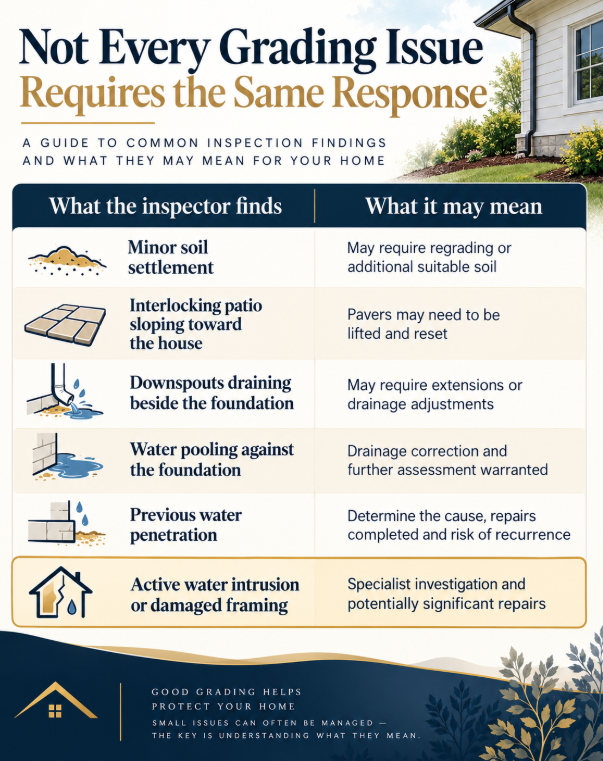


The real question isn't simply: "Is the grading wrong?"

It's: "Has the grading caused damage, is water getting into the home, and what will it take to correct the problem?"

Those are very different questions.

Can Poor Grading Cause Foundation Damage?

Yes, it can.

Water accumulating against foundation walls may find its way through cracks, joints or other vulnerable areas.

Over time, persistent water exposure can contribute to deterioration and moisture-related problems.

However, not all foundation issues are caused by grading, and not all grading issues result in foundation damage.

A foundation crack, for example, needs to be evaluated based on its location, characteristics, movement, associated water entry and other evidence.

Here's what I encourage buyers to understand:

A risk of future damage is not the same as confirmed existing damage.

Both matter, but they call for different conversations.

If a home inspector identifies negative grading but no evidence of water penetration, the next step may be to obtain an opinion and estimate from a qualified drainage or landscaping contractor.

If there is evidence of recurring water infiltration, rotting wood, significant cracking or structural movement, the next step may involve a foundation specialist or structural engineer.

A thorough investigation is much more useful than immediately assuming the worst.


How Much Does It Cost to Fix Grading Around a House in Ontario?

Here's the answer nobody loves hearing:

It depends.

I know. Very helpful, Gemma.

But the costs genuinely vary because grading repair can mean anything from adjusting a small area of soil to redesigning drainage around an entire property.
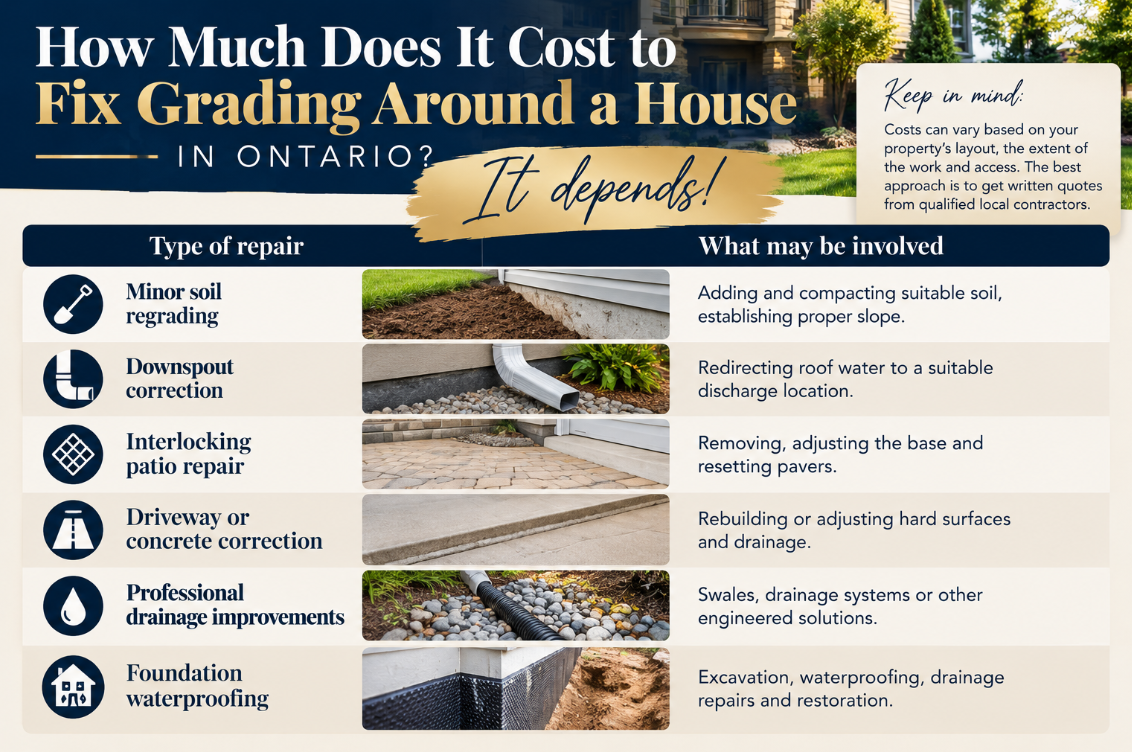
A small landscaping correction and a full foundation waterproofing project are not remotely the same job—or the same budget.

For that reason, I wouldn't put a generic dollar amount on every grading problem.

The right approach is to obtain written quotes from qualified local contractors, with a clear scope of work, before making a financial decision.

Also, adding soil isn't always the solution. If it raises the ground too close to siding, covers drainage openings or sends water onto a neighbouring property, it can create new problems.

Sometimes the fix is simple. Sometimes the property's layout makes drainage more complicated.

That's why an actual site assessment matters.


Should You Walk Away From a House Because of Poor Grading?

Here's where I want buyers to think carefully. Imagine two houses.

The first has a patio that slopes slightly toward the foundation. There is no documented history of water penetration, and a contractor confirms the patio can be corrected with a defined scope of work.

The second has negative grading, repeated basement flooding, damaged structural framing and a history of unsuccessful repairs.

Both houses technically have grading problems.

Would I treat them the same? Absolutely not.

With the first house, a buyer may decide the correction is manageable.

With the second, I'd want a much more comprehensive investigation, specialist findings and a realistic repair budget before considering proceeding. And depending on those results, walking away may be an entirely reasonable decision.

The goal is not to convince someone to buy a problematic house. The goal is to understand the problem well enough to make the right decision.

A buyer may choose not to proceed because of cost, risk, uncertainty or simply because the property no longer suits their comfort level.

That decision belongs to the buyer. But ideally, it should be based on evidence rather than panic.

What to know before buying a house?


What Does a Home Inspector Actually Do in Ontario?


ONTARIO INSEPCTION ACT 

A home inspector performs a primarily visual, non-invasive assessment of a property's accessible components and systems.

Depending on the applicable inspection standard and agreement, this generally includes examination of:

  • Roofing, gutters and drainage

  • Foundation and visible structural components

  • Exterior walls, windows and doors

  • Plumbing systems

  • Electrical systems

  • Heating and cooling equipment

  • Attic insulation and ventilation

  • Visible basement or crawlspace conditions

  • Exterior grading and drainage

  • Other accessible building components

A home inspection is designed to identify observed defects, potential concerns and areas requiring further investigation.

It is not a guarantee that the house has no hidden problems.

And a home inspector cannot necessarily see what's happening behind finished walls, underground or inside inaccessible areas.

Ontario's homebuying guidance also makes an important distinction: a home inspection is not a pass-or-fail examination, a building-code compliance certification or a warranty.


Think of your home inspector as the property's general health examiner.

They can identify symptoms that deserve attention, but some concerns require a specialist to diagnose the underlying cause.


Are Home Inspectors Licensed in Ontario?

Here's something that surprises many Ontario homebuyers.

As of October 2026, Ontario does not require home inspectors generally to hold a provincial home-inspector licence.

Ontario passed the Home Inspection Act, 2017, but it has not yet been brought into force.


In other words, don't assume someone has completed a particular training program simply because their business card says Home Inspector.

That doesn't mean there aren't excellent, highly trained home inspectors in Ontario.

There absolutely are.

But it does mean buyers need to ask questions about professional qualifications.

What Qualifications Should a Good Home Inspector Have?

I encourage homebuyers in Barrie, Innisfil and Simcoe County to look beyond the price of the inspection.

Important considerations include:

1. Education and technical training

Does the inspector have formal education in home inspection, building science, construction technology or relevant trades?

2. Practical experience

How many homes have they inspected? Do they have experience with the type and age of home you're purchasing?

A century home, a newer subdivision house and a rural bungalow with a crawlspace present different challenges.

3. Professional credentials

One recognized Ontario designation is Registered Home Inspector (RHI) through the Ontario Association of Home Inspectors (OAHI).

The RHI designation requires specified education, practical experience, peer review and continuing education. OAHI's stated requirements include at least 200 paid home inspections and annual continuing education.


Other professional organizations, including the Canadian Association of Home & Property Inspectors (CAHPI), provide standards and professional guidance.

Membership categories and credentials vary, so buyers should verify the individual's actual standing.

4. Insurance

Ask whether the inspector maintains professional errors-and-omissions insurance and commercial general liability insurance.

5. Standards of practice

Ask which inspection standards they follow.

The voluntary CSA A770 Home Inspection Standard is one recognized Canadian reference that buyers can ask about.

6. Communication skills

And here comes the part I believe deserves much more attention.

Can the inspector explain their findings clearly, accurately and objectively?

Because identifying a problem is only part of the job.

Helping the buyer understand what was found, what it could mean and what still needs investigation is equally important.


Should Home Inspectors Tell Buyers Whether They Should Purchase a House? HOME INSPECTION GUIDANCE

I have strong feelings about this one! 

A home inspector's job is to inspect the property and report on its condition, not decide whether the buyer should purchase it.

Inspectors should absolutely point out serious defects, safety hazards, water penetration, structural concerns and potential future risks.

In fact, I expect them to.

I'd much rather have an inspector identify a problem before my buyer purchases the property than discover it six months after closing.

But there's a difference between a professional assessment and a personal purchasing opinion.

For example:

Professional assessment:

"The grading slopes toward the foundation. This increases the potential for water accumulation and penetration. I recommend further assessment and corrective work."

Personal purchasing opinion:

"If I were you, I wouldn't buy this house."

See the difference?

The first communicates an observable condition, a potential consequence and an appropriate next step.

The second makes a judgment about a decision that depends on far more than the inspection alone.

That said, when an inspector discovers an immediate safety hazard or evidence of significant structural failure, strong warnings are entirely appropriate.

The communication should match the seriousness of the evidence—not the inspector's personal comfort level with the property.


Why Can the Way a Home Inspector Communicates Affect a Buyer's Decision?


This might be the most overlooked part of buying a home.

Buying a home isn't just a financial transaction.

It's emotional.

You've spent weeks or months searching. You've looked at properties online, scheduled showings, compared neighbourhoods and probably imagined your life in more houses than you care to admit.

Finally, you've found one that feels right.

Then someone points to an issue and uses alarming language.

Your brain can go from “I love this house!” to “Am I about to make the biggest financial mistake of my life?” in about three seconds.

Welcome to buyer psychology.

What Is Risk Perception in Real Estate?

Risk perception describes how people interpret possible danger or loss.

A buyer's reaction can be influenced by:

  • How serious a problem sounds

  • How much they understand about it

  • Whether they've experienced previous property problems

  • Their financial ability to manage unexpected expenses

  • Their confidence in the professional providing the information

  • The uncertainty surrounding the cost or extent of repairs

And yes, words matter.

Consider these two explanations:

"There's a drainage issue that needs further evaluation."

Versus:

"This whole area is a major problem."

The first gives the buyer something to investigate.

The second may leave them imagining catastrophic damage, whether or not that conclusion is supported.

That doesn't mean inspectors should soften findings to make buyers feel comfortable.

Quite the opposite.

I believe buyers deserve full transparency.

But accuracy, clarity and perspective should accompany that transparency.

An inspector shouldn't have to choose between telling the truth and communicating responsibly.

A good professional can do both.


What Should You Do When a Home Inspection Report Sounds Scary?

First, don't ignore it. Second, don't assume the worst.

And third, don't let the clock run out on your inspection condition while everyone is trying to figure out what the problem actually means.

Here's the approach I recommend.
 

Step 1: Separate observations from possibilities

Ask the inspector: "What did you actually observe?"

A visible water stain is an observation.

A prediction that the foundation may develop serious problems is a possible consequence.

You need to understand both, without confusing them.

Step 2: Ask whether there is evidence of existing damage

For grading concerns, consider questions such as:

  • Was active moisture detected?

  • Was there evidence of previous water entry?

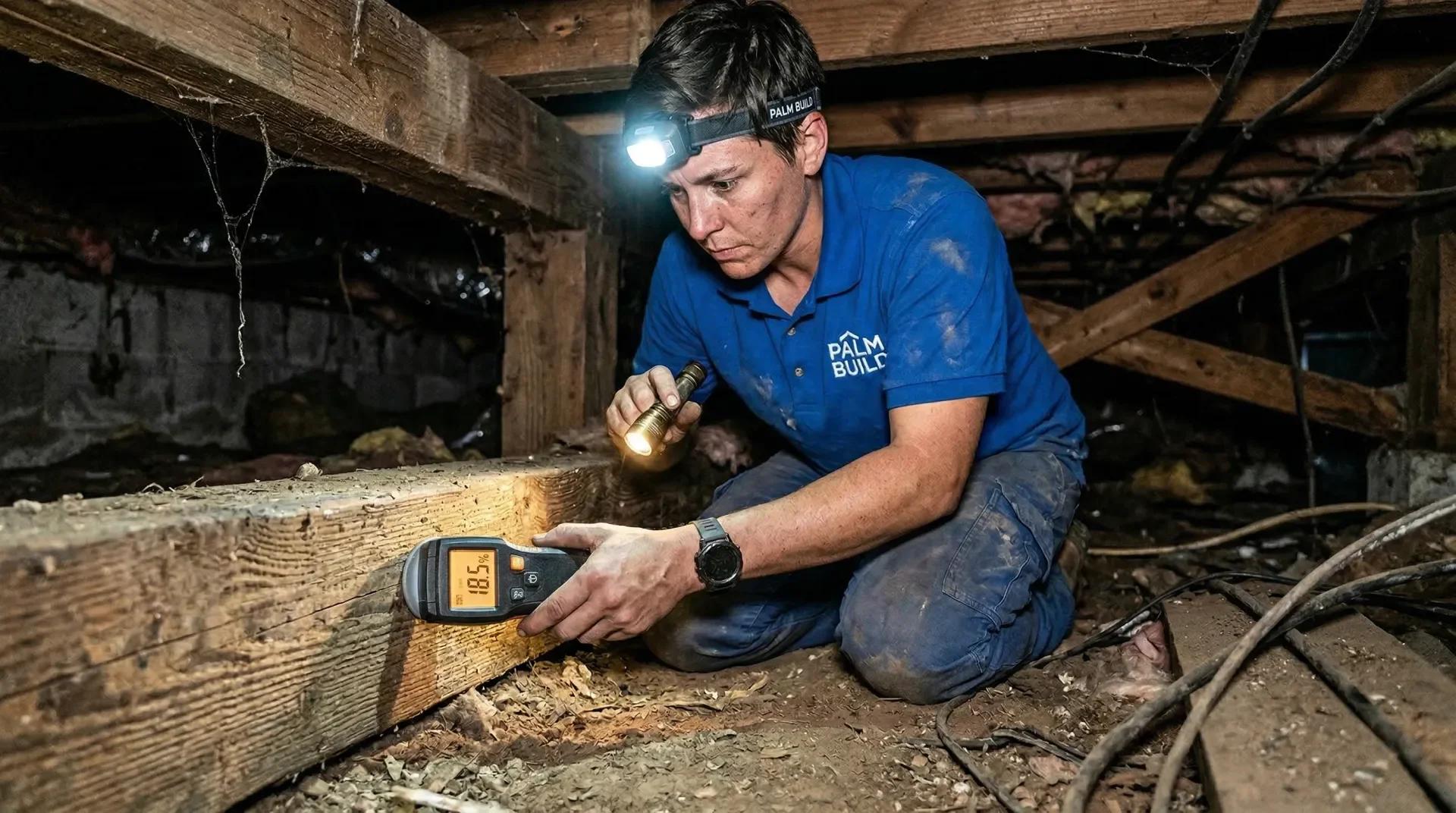
  • Were moisture readings taken, and where?

  • Was any wood rot or structural damage observed?

  • Were previous repairs visible?

  • Were parts of the crawlspace or foundation inaccessible?

Remember, a dry crawlspace on inspection day doesn't prove it never experiences water intrusion.

Step 3: Bring in the appropriate specialist

Depending on the concern, you might need a drainage contractor, foundation specialist, licensed electrician, plumber or structural engineer.

One professional doesn't have to be an expert in every component of a building.

Step 4: Obtain a realistic repair estimate

A potential repair sounds much less mysterious when you know what's involved.

Sometimes the estimate confirms a manageable issue.

Other times, it reveals that the problem is much more expensive or complicated than expected.

Either way, you've gained useful information.

Step 5: Review your options with your real estate broker

Depending on your signed agreement and the circumstances, those options may include requesting a repair, negotiating an adjustment, seeking an agreed extension for further investigation or deciding not to proceed where permitted by the contract.

Inspection conditions, notice requirements and deadlines must be followed carefully, with legal advice where appropriate.

An inspection report should start an informed conversation, not end it.


What Makes a Great Home Inspector Different From a Good One?

A good inspector finds problems.

A great inspector identifies the problems, explains the evidence, communicates the level of concern, acknowledges uncertainty and recommends the right next steps.

For example, I appreciate an inspector who can say:

"This grading should be corrected. I don't have sufficient evidence to determine whether it has caused hidden damage. Here's what I observed, and here's who I recommend you contact."

That's not minimizing the problem.

That's explaining it professionally.

A great inspector also understands that buyers may be hearing unfamiliar construction terminology for the very first time.

Terms like negative grading, efflorescence, foundation seepage, spalling and moisture intrusion can be intimidating.

And let's face it, most people don't spend their weekends discussing the exciting world of foundation drainage.

Unless they're home inspectors.

Or realtors.

Apparently, we know how to party.

The point is simple: Professionalism involves not only what you know, but also how effectively you communicate it.


Why Having an Experienced Barrie or Innisfil Real Estate Broker Matters During a Home Inspection

This is where I believe experienced real estate representation can make a meaningful difference.

My job isn't to tell a buyer that every house is wonderful.

And it certainly isn't to convince someone to ignore a serious problem just to complete a sale.

My responsibility is to help clients understand the information available, coordinate appropriate expertise, assess their contractual options and make decisions aligned with their interests.

When a concern is identified during an inspection, I want my buyers asking:

What do we know? What don't we know? Who can provide the missing answers? And what are our options?

Not simply:

"Should I panic?"

After all, no house is perfect.

Even brand-new homes can have defects.

The objective isn't to find a house with absolutely nothing wrong.

It's to find a property whose condition, risks and costs are acceptable to you.

And sometimes, yes, the smartest decision is to walk away.

Other times, a concerning inspection finding turns out to be something that can be corrected.

The difference is proper due diligence.


Frequently Asked Questions About Grading and Home Inspections in Ontario

1. Is negative grading a deal-breaker when buying a house?

Not necessarily. Negative grading means the ground slopes toward the house rather than away from it. The seriousness depends on whether water is accumulating, whether damage has occurred, and the feasibility and cost of correcting the drainage.

2. Can you buy a house with poor grading?

Yes. Buyers can purchase homes with grading deficiencies, provided they understand the risks and are comfortable with the necessary repairs. An appropriate professional assessment is recommended before making that decision.

3. Does poor grading always cause basement flooding?

No. Poor grading increases the risk of water accumulating near a foundation, but it doesn't automatically mean water has entered the basement or crawlspace.

4. Can a house have moisture problems even if the basement is dry during the inspection?

Absolutely. Water penetration can be intermittent or seasonal. A dry basement on inspection day doesn't rule out previous flooding or future water intrusion.

5. Who fixes grading problems around a house?

Depending on the issue, a qualified landscaping contractor, drainage specialist, hardscaping contractor or foundation professional may be appropriate. More complicated site-drainage issues may require engineering advice.

6. Are home inspectors required to be licensed in Ontario?

As of October 2026, there is no mandatory Ontario provincial home-inspector licensing regime in force. Buyers should independently verify an inspector's credentials, experience, standards of practice and insurance.

7. Can a home inspector tell you not to buy a house?

A home inspector may explain serious concerns and recommend further investigation, but the final purchasing decision belongs to the buyer. Inspectors should clearly distinguish observed defects, suspected problems, safety warnings and personal preferences.

8. Can you negotiate after a bad home inspection in Ontario?

Potentially, yes. Depending on the purchase agreement and the seller's willingness, buyers may be able to negotiate repairs or price adjustments. No seller is automatically obligated to renegotiate, and buyers must comply with all contractual conditions and deadlines.

9. Should you get a second opinion after a home inspection?

A second professional opinion can be valuable when findings are unclear, potentially expensive or outside the original inspector's expertise. A specialist's assessment may be more useful than simply repeating the same general home inspection.

10. Are grading problems common in older Barrie and Innisfil homes?

Grading and drainage deficiencies can occur in both older and newer homes. Settlement, landscaping alterations and changes to patios or driveways can all affect drainage over time.

11. Does a home inspection guarantee that a house has no problems?

No. A typical home inspection is a limited, visual assessment of accessible components, not an exhaustive investigation or a guarantee against hidden defects.

12. What should first-time homebuyers do if an inspector finds multiple problems?

Ask the inspector to explain which findings involve immediate safety concerns, existing damage, routine maintenance or further investigation. Obtain specialist assessments and repair estimates where needed, then review your options with your real estate broker and lawyer before the applicable deadlines.


Buying a Home in Barrie, Innisfil or Simcoe County? Let's Make Sure You Understand What You're Buying.

Finding the right home isn't about finding a property that's absolutely perfect.

It's about understanding what you're purchasing, knowing which questions to ask and having the right professionals supporting you.

Whether you're buying your first home in Barrie, searching for a bungalow in Innisfil, considering an older property in Midhurst or exploring waterfront real estate around Lake Simcoe, I'm here to help you navigate the process with confidence.

I'll help you understand the homebuying process, connect with appropriate professionals and evaluate your options without unnecessary pressure.

Because buying a home should be exciting.

Not feel like an episode of a home-renovation disaster show.

Let's find you a home you'll love—and help you understand what's underneath the pretty kitchen countertops, too.

Gemma Leggett
Real Estate Broker | RE/MAX Hallmark York Group
Barrie • Innisfil • Lake Simcoe • Simcoe County

Explore Homes and Connect With Gemma


Disclaimer

This article is for general educational and informational purposes only and does not constitute legal, engineering, structural, home inspection, building-code, drainage or construction advice.

Every property is unique. Grading concerns, moisture conditions, foundation defects and repair requirements must be assessed based on the property's actual conditions by appropriately qualified professionals. The absence of visible moisture or damage during a home inspection does not guarantee that hidden or future problems do not exist.

Home inspection practices, applicable regulations, local drainage requirements, professional credentials and contractual rights may change. Buyers should verify current requirements, seek independent professional advice where appropriate, and consult their real estate lawyer regarding purchase agreements, conditions and deadlines.

The examples discussed are illustrative and are not intended to evaluate or criticize any identifiable home inspector or property.


...
Oct 19, 2026

You found your dream home. Your offer was accepted. Congratulations! But before you start booking inspectors and spending money, there's something you need to understand.

Just because your offer was accepted doesn't mean you should start spending money on everything at once.

Let me explain.

Recently, I was working with buyers purchasing a property that required several inspections and additional due diligence.

We had a home inspection to arrange, a septic system to examine, well water to test, and other important details to investigate.

But there was one little problem.

We hadn't received confirmation from the bank that the mortgage financing was approved.

So I asked my buyers a simple question:

Why would we spend $500–$600 on a home inspection, plus potentially hundreds more on septic and well inspections, if the bank hasn't confirmed you can actually purchase the property?

Exactly!

Now, sometimes deadlines mean we have to work on several conditions simultaneously. But whenever possible, I prefer to organize the process strategically.

Because buying a home isn't just about finding the right property.

It's about protecting your money, understanding your contractual obligations, and knowing when—and when not—to spend it.

Let's talk about the conditions you can include in an Ontario Agreement of Purchase and Sale, which ones matter most, and why the order in which you investigate them can make a big difference.


1. What Conditions Can You Include in an Ontario Agreement of Purchase and Sale?

First, let's clear up a common misunderstanding.

There isn't one universal checklist of conditions that every homebuyer must use.

An Agreement of Purchase and Sale (APS) can contain different conditions depending on the property, the buyer's circumstances, and what the seller agrees to.

Some are common. Others are very specific.

And yes, you can negotiate conditions that go well beyond financing and a home inspection.

The important thing is that the conditions are clearly written, legally appropriate, and relevant to the transaction.

The Real Estate Council of Ontario (RECO) encourages buyers to consider conditions that provide appropriate protection, including financing, inspections and selling an existing home. Real Estate Council of Ontario

Let's explore the possibilities.


A. Financial Conditions

1. Mortgage Financing Condition

Allows the buyer time to arrange satisfactory mortgage financing for the property.

2. Sale of Buyer's Existing Property Condition

Makes the purchase conditional on the buyer selling their current home under the terms specified in the agreement.

This can help buyers avoid carrying two properties when they cannot afford to do so.

3. Property Appraisal Condition

Allows the buyer to obtain a satisfactory appraisal.

This can be particularly relevant if the lender requires an appraisal or the property's purchase price is difficult to support.

4. Mortgage Insurer Approval Condition

Addresses the approval requirements of a mortgage insurer when mortgage default insurance is necessary.

5. Acceptable Home Insurance Condition

Allows the buyer to confirm that suitable insurance is available at an acceptable cost.

This can be particularly important for properties with older wiring, certain heating systems, past water damage or other insurance concerns.

6. Down Payment Funds or Gift Confirmation

A specifically drafted condition may address the verified availability of funds required for the purchase.

7. Bridge Financing Condition

May be appropriate when the buyer needs short-term financing between selling one property and purchasing another.

8. Assumption of an Existing Mortgage

Where a mortgage is potentially assumable, a condition can address obtaining the necessary lender approval.

9. Seller Take-Back Mortgage Approval

If the seller agrees to provide part of the financing, the agreement may contain conditions relating to the terms and required documentation.

10. Review of Financing for Investment Properties

For investment properties, buyers may require financing approval that accounts for anticipated rental income and lender requirements.

My advice: Being pre-approved before shopping is important, but the financing condition is where we confirm whether the actual purchase works.

We'll explore that distinction shortly.


B. Home and Property Inspection Conditions

This is where buyers sometimes discover that their dream home comes with a few surprises.

And I'm not talking about the wallpaper.

11. General Home Inspection

A professional inspection of the home's accessible systems, components and overall condition.

12. Structural Inspection

Review by an appropriate specialist or structural engineer when there are concerns involving foundations, load-bearing walls, beams or other structural components.

13. Roof Inspection

Particularly relevant for older roofing systems or properties showing signs of leaks.

14. Electrical Inspection

A specialist evaluation of wiring, electrical panels or other potential safety concerns.

15. Plumbing Inspection

Assessment of plumbing systems, drainage or suspected leaks.

16. HVAC Inspection

Review of heating, ventilation and air conditioning equipment.

17. Fireplace, Wood Stove or Chimney Inspection

May involve a qualified specialist or a WETT inspection, depending on the installation and insurer's requirements.

18. Sewer Line Inspection

A camera inspection can help identify root intrusion, blockages or damaged underground sewer lines.

19. Foundation or Basement Water Intrusion Inspection

Particularly relevant when there are signs of moisture, cracks or previous flooding.

20. Mould or Indoor Air Quality Investigation

Specialized assessment when there is evidence or reasonable concern about moisture, mould or indoor air quality.

21. Asbestos or Hazardous Materials Assessment

May be appropriate for older properties or buildings with materials that could contain asbestos.

22. Radon Testing

Allows buyers to assess radon levels. Because reliable testing often requires an extended period, timelines need careful consideration.

23. Pest or Wood-Destroying Insect Inspection

Can help identify evidence of termites, carpenter ants or other infestations.

24. Pool or Hot Tub Inspection

Evaluation of equipment, plumbing, structural condition and safety-related components.

25. Outbuilding Inspection

For garages, workshops, barns, sheds or other structures.

26. Specialist Inspection of Unique Building Systems

This could include geothermal systems, solar installations, generators, elevators or specialized heating equipment.

Important: A general home inspection does not automatically cover every system or hidden component. Additional specialists may be necessary.


C. Rural Property, Septic and Well Conditions

If you're buying a rural property in Innisfil, Oro-Medonte, Springwater, Essa, Clearview or elsewhere in Simcoe County, this section deserves special attention.

Rural properties can require considerably more investigation than a typical urban home.

27. Septic System Inspection

A qualified professional evaluates the septic system and available information about its condition.

28. Septic Pumping and Maintenance Documentation

The agreement may require the seller to arrange pumping, provide maintenance records or supply other specific septic information.

A septic pumping requirement is not a substitute for a proper septic inspection.

29. Septic Permit and Capacity Verification

Allows investigation of permits, approved design and whether the system is appropriate for the property's intended use.

30. Well Inspection

Evaluation of the well, its construction and accessible components.

31. Well Water Quality Testing

Testing for relevant contaminants, including bacteriological testing.

Additional chemical testing may be appropriate depending on location and circumstances.

32. Well Flow Rate and Recovery Testing

Helps determine whether the well can provide sufficient water for the household.

Water quality and water quantity are two different things.

33. Well Records and Permit Review

Where available, buyers can investigate well records, construction details and other documentation.

34. Private Road Maintenance Agreement Review

Important when access depends on a privately maintained road.

Who maintains it?

Who pays for snow removal?

What happens if repairs are required?

35. Legal Access Verification

Confirms whether the property has appropriate legal access.

36. Environmental Assessment

Can be particularly important for properties with historical commercial, industrial, agricultural or potentially contaminating uses.

37. Agricultural or Farm-Related Due Diligence

Depending on the property, this may involve farm leases, drainage, nutrient management issues, agricultural zoning or other specialized matters.

38. Conservation Authority and Floodplain Review

Allows the buyer to investigate applicable development restrictions, flood hazards and regulated areas.

39. Soil or Geotechnical Investigation

Potentially important when a buyer intends to construct a new building, addition or other substantial improvement.

40. Drainage and Grading Investigation

Relevant when there are concerns about standing water, drainage patterns or neighbouring properties.

These investigations can cost hundreds or thousands of dollars.

Which brings us back to my original point:

Before spending money on all of them, make sure you're approaching the conditions in a sensible order.


D. Legal, Zoning and Municipal Due Diligence Conditions

This is one category I believe buyers frequently underestimate.

Just because something already exists on a property doesn't automatically mean it was legally built or can be used the way you intend.

41. Lawyer's Review of the Agreement

Allows a lawyer to review specified legal aspects of the purchase within the agreed period.

42. Title Review

Allows investigation of ownership, registered interests and title-related concerns.

Your lawyer ordinarily conducts a title search as part of closing. A separate condition may be appropriate when an issue needs to be resolved before the purchase becomes firm.

43. Survey Review

Particularly useful when property boundaries, encroachments or proposed construction are important.

44. Zoning Verification

Confirms whether the buyer's intended use is permitted under applicable zoning rules.

45. Building Permit Verification

Allows investigation of existing structures, additions and renovations.

46. Outstanding Building Permit or Work Order Review

Can address open permits, outstanding orders or other municipal compliance concerns.

47. Secondary Suite or Apartment Legality

Important when purchasing a property with a basement apartment, converted garage or other secondary dwelling.

48. Future Construction Feasibility

For buyers intending to build a garage, workshop, garden suite, addition or other improvement.

49. Easement and Right-of-Way Review

Important when utility access, shared driveways, neighbouring rights or other easements affect the land.

50. Heritage Designation Investigation

Relevant if the property may be subject to heritage restrictions.

51. Development Charges and Municipal Fee Investigation

Particularly relevant when the buyer plans construction or redevelopment.

52. Environmental or Land-Use Restrictions

Includes investigating applicable environmental regulations, development limitations and other land-use constraints.

53. Rental, Tenancy or Occupancy Review

For tenanted properties, buyers may need to review leases, lawful rents, deposits, tenant rights and whether the intended occupancy arrangements are legally possible.

54. Municipal Property File Review

Allows investigation of municipal records relevant to the property.

55. Tax, Assessment or Special Charge Review

May be relevant where there are outstanding charges, local improvement costs or unusual assessments.

Here's a situation worth thinking about.

You purchase a beautiful rural home on a large lot.

Your plan?

Build a detached garage, maybe add a workshop and eventually put in a pool.

Sounds wonderful!

But after closing, you discover that conservation restrictions or zoning requirements prevent your plans.

Wouldn't you rather know that BEFORE the property becomes yours?

Exactly.

That's why due diligence matters.


E. Waterfront Property Conditions — Especially Important Around Lake Simcoe

Waterfront properties are one of my specialties, and they deserve their own category.

Buying waterfront isn't quite the same as buying a house in a subdivision.

You may have shoreline restrictions, dock considerations, erosion concerns and questions about ownership that simply don't arise with many inland properties.

56. Shoreline Ownership Verification

Confirms the legal extent of ownership and whether any shore road allowance or other interest affects the shoreline.

57. Shore Road Allowance Investigation

Determines whether an unopened shore road allowance exists and whether it is owned by the municipality or has been closed and conveyed.

58. Dock Permit and Compliance Investigation

Reviews whether existing docking facilities require authorizations and whether relevant approvals exist.

59. Waterfront Access Rights

Confirms whether the property includes legal waterfront access, deeded access, an easement or some other arrangement.

60. Shoreline Alteration and Conservation Restrictions

Investigates restrictions relating to shoreline work, retaining walls, vegetation removal or other alterations.

61. Floodplain and Erosion Hazard Review

Important for properties potentially affected by high water levels, flooding or shoreline erosion.

62. Boathouse Permit and Compliance Review

Determines whether the boathouse and its intended use comply with applicable rules.

63. Water Depth and Docking Suitability Investigation

Particularly relevant to buyers who own boats.

A gorgeous waterfront home doesn't necessarily mean your boat can reach the dock safely.

64. Waterfront Septic Setback and Compliance Review

Important when a septic system is near a lake, river or other sensitive area.

65. Shared Waterfront Facility Agreement Review

For properties with shared docks, beaches, private associations or common waterfront facilities.

66. Riparian Rights and Other Waterfront Title Matters

These can be complex and should be reviewed with a lawyer familiar with waterfront property.

67. Shoreline Stability or Erosion Assessment

May be appropriate when there are signs of erosion or concerns about retaining walls and shoreline protection.

68. Water Access and Navigability Investigation

Relevant where the buyer's intended boating use depends on access routes, navigability or physical conditions.

A condition should be drafted around the particular investigation rather than assuming any one approval or right automatically exists.


F. Condominium Conditions — Barrie, Friday Harbour and Beyond

Buying a condominium comes with an entirely different set of considerations.

69. Status Certificate Review

Allows the buyer's lawyer to examine the condominium corporation's financial and legal information.

70. Condominium Rules and Restrictions Review

Important for buyers concerned about pets, parking, renovations, short-term rentals or other restrictions.

71. Reserve Fund and Financial Review

Helps assess the corporation's financial position and potential future expenses.

72. Special Assessment Review

Addresses existing or anticipated special assessments where disclosed.

73. Parking and Locker Verification

Confirms the legal nature and details of parking spaces and storage lockers.

74. Exclusive-Use Common Element Verification

Useful where a terrace, garden, parking area or other space is described as exclusively available to a unit.

75. Resort or Club Fee Review

Especially relevant for resort-style communities such as Friday Harbour, where buyers should understand any applicable club, resort or other contractual fees.

76. Rental and Short-Term Rental Restriction Review

Important for buyers purchasing an investment property.

77. Litigation and Insurance Review

Allows examination of significant legal and insurance matters affecting the condominium corporation.

Did you know? Ontario condominium corporations generally must provide a status certificate within 10 days of receiving a request and payment. The statutory preparation fee cannot exceed $100, including taxes and materials. This does not necessarily include a lawyer's review fee. Condominium Authority of Ontario


G. Other Conditions Buyers Can Negotiate

Depending on the transaction, additional conditions may include:

  1. Satisfactory review of a property's rental income and expense statements.

  2. Review of existing leases and tenant documentation.

  3. Verification that specified chattels or equipment are included.

  4. Review of solar panel agreements, equipment leases or financing arrangements.

  5. Review of rental contracts for furnaces, water heaters or other equipment.

  6. Satisfactory review of property management or service agreements.

  7. Verification of transferable warranties.

  8. Review of a home business's legal use requirements.

  9. Obtaining required permits or approvals for an intended use.

  10. Approval from a condominium corporation or other third party, where applicable.

  11. Seller completion of specifically identified repairs or other work.

  12. Satisfactory review of documentation relating to previous property damage or insurance claims.

  13. Satisfactory investigation of any material property issue specifically identified by the buyer.

Some of these are more appropriately drafted as seller representations, warranties, covenants or closing obligations, rather than buyer conditions.

That's an important distinction.

For example, if you want the seller to remove debris from the property, a properly drafted closing obligation may be more appropriate than making the entire purchase conditional on debris removal.

The goal isn't to cram 90 conditions into your offer.

The goal is to identify the protections that actually matter for the property you're buying.

And remember: the seller must agree to the proposed conditions. Adding unnecessary conditions can also make an offer less attractive.


2. In What Order Should You Fulfill Your Home Buying Conditions?

Now we're getting to what I consider one of the most important parts of the purchasing process.

The order matters because your money matters.

Here's how I generally like to approach things when the agreement, deadlines and circumstances allow it.


STEP 1: Confirm Your Mortgage Financing

Before booking several expensive inspections, I want my buyers to understand where their financing stands.

If the bank cannot approve the mortgage, spending money on every other investigation may accomplish very little.

Let's imagine you're buying a rural property in Simcoe County.

Your estimated due diligence expenses might look like this:


These are hypothetical planning figures, not verified local quotes. Actual costs vary by property, professional and scope of service.

Imagine spending almost $2,000 and then finding out your mortgage has been declined.

Ouch.

That's why I prefer to confirm financing as early as possible.

But there's an important catch.

You should not assume that all the other conditions can simply be postponed.

Every condition has its own contractual deadline.

And sometimes a lender needs an inspection, appraisal, septic report or other property information before issuing approval.

When that happens, the investigations must be coordinated.

My preferred approach

First, get the mortgage application and property documents to the lender immediately.

While the lender reviews the application, start gathering documents, booking specialists provisionally where practical, and identifying any time-sensitive investigations.

If financing is denied early, you may avoid additional expenses.

If financing looks promising but final approval depends on an appraisal or another report, prioritize what the lender requires.

And if the condition deadlines are approaching?

We may need to request an extension.

Never let a condition expire simply because you're waiting for the bank.

An extension requires agreement from the other party. The seller is not obligated to grant one.


3. Mortgage Pre-Approval vs. Final Mortgage Approval: What's the Difference?

This is a HUGE misunderstanding among homebuyers.

I often hear:

"Gemma, don't worry. I've already been pre-approved!"

Wonderful!

But let me explain why that doesn't mean your mortgage is guaranteed.

What Is a Mortgage Pre-Approval?

Before you start shopping, your mortgage broker or lender may review your:

  • Income and employment
  • Credit history and existing debts
  • Down payment
  • Financial obligations
  • Estimated borrowing capacity

Based on the information available, the lender may indicate how much you could qualify to borrow.

This is incredibly helpful.

It gives you a starting budget before we start looking at properties.

But here's what many people don't realize.

Mortgage pre-approval is NOT the same as final mortgage approval.

The Financial Consumer Agency of Canada confirms that a pre-approval doesn't guarantee the lender will approve your mortgage for a specific property. Canada


What Happens After Your Offer Is Accepted?

Now the lender has something it didn't necessarily have during pre-approval:

An actual property to evaluate.

The lender may review:

  1. Your signed Agreement of Purchase and Sale.
  2. The actual purchase price.
  3. The property's location, type and condition.
  4. Your updated financial documentation.
  5. The property's appraised value, if required.
  6. Mortgage default insurance requirements, if applicable.
  7. Any property-specific risks or lending restrictions.

For example, imagine you've been pre-approved to buy a $700,000 home.

You find a beautiful rural property in Innisfil and negotiate a purchase price of $690,000.

Everything looks good.

Then the lender orders an appraisal.

The appraisal comes back at $650,000.

Suddenly, the lender may not be willing to advance the amount you originally expected.

You might need a larger down payment, a different financing arrangement or further negotiations.

And that can change everything.

CMHC confirms that the property's value is an important factor in determining how much mortgage financing a lender will provide. CMHC

Another important consideration

Some lenders may give a conditional mortgage approval, but still require certain documentation before the loan can be funded.

An approval with outstanding requirements isn't necessarily the same as a fully cleared mortgage.

Before removing your financing condition, you should understand what has been approved, what remains outstanding and whether the financing is satisfactory under your agreement.

Your mortgage professional should explain any remaining risks.

So when should you remove your financing condition?

Only after you have carefully reviewed the lender's approval, understand any outstanding requirements, and are satisfied you can proceed.

Once you remove the condition and the deal becomes firm, failing to obtain the funds on closing can expose you to serious financial consequences.


4. STEP 2: Review the Important Documents and Potential Deal-Breakers

While the bank is working on financing, I like to identify issues we can investigate without immediately spending large sums of money.

For example:

Buying a rural property?

Let's investigate zoning and potential conservation restrictions.

Planning to build a garage?

Let's contact the municipality to understand whether your plans may be permitted.

Buying a waterfront property?

Let's review shoreline ownership, access and relevant restrictions.

Buying a Barrie condominium?

Let's make sure the status certificate has been requested promptly.

Some preliminary information can be obtained relatively inexpensively.

However, written professional opinions, municipal searches, surveys and other detailed investigations may involve fees.

The idea is simple:

Identify the potential deal-breakers early, especially those that could make the property unsuitable for your plans.

After all, there's no sense buying a property that doesn't allow you to do the very thing you purchased it for.


5. STEP 3: Complete the Home Inspection

Once financing is sufficiently reassuring—or sooner if the deadline requires it—we need to examine the house itself.

A home inspection helps buyers better understand the property's condition.

But remember:

A home inspector cannot see through walls.

A standard inspection has limitations.

If the inspector finds structural movement, electrical concerns, water intrusion or another issue requiring specialized expertise, additional inspections may be recommended.

And depending on what we discover, buyers may want to:

  • Proceed with the purchase.
  • Obtain additional professional opinions.
  • Negotiate repairs or a price adjustment, if the seller agrees.
  • Decline to fulfill the inspection condition if the concerns genuinely make the inspection unsatisfactory under the agreement.

The available options depend on the wording of the condition and the circumstances.


6. STEP 4: Complete Septic, Well and Specialized Inspections

This is especially relevant to rural buyers around Barrie, Innisfil and Simcoe County.

A home might look beautiful.

But what about the systems you can't see?

Septic systems

An inspection may uncover concerns about the tank, drainage bed, system condition or compliance.

Repairs can be expensive.

Private wells

Buyers need to consider both water quality and quantity.

A water test that comes back acceptable for the parameters tested does not automatically mean the well supplies enough water for everyday use.

Likewise, a strong flow rate does not prove the water is safe to drink.

These are separate investigations.

Specialist inspections

Depending on the property, you may require additional assessments of foundations, pools, electrical systems, environmental concerns or outbuildings.

These inspections are not expenses I recommend skipping just to save money.

The objective is to schedule them intelligently without compromising proper due diligence.


7. STEP 5: Complete Legal and Municipal Due Diligence

This stage includes resolving any outstanding questions about the property's legal status and intended use.

But here's something important:

Legal and municipal due diligence shouldn't always wait until the end.

Some investigations require more time than a home inspection.

Your lawyer should be involved early, particularly when reviewing title, surveys, easements, property boundaries or complicated contractual provisions.

Municipal investigations may also take longer than expected.

For rural properties, I often want to know:

Can you legally use the property the way you intend?

Were additions constructed with the appropriate permits?

Is that converted garage a legally permitted dwelling?

Are there conservation restrictions?

Does the survey accurately reflect what you believe you're purchasing?

These are questions worth investigating before the agreement becomes firm.

My preferred order, summarized 


8. What Happens to Your Deposit If You Don't Fulfill Your Conditions?

This is one of the biggest questions buyers ask.

Let's say you purchase a home in Barrie for $700,000.

You provide a $25,000 deposit.

Your offer includes financing and home inspection conditions.

Then your lender declines the mortgage.

Do you lose your $25,000 deposit?

Not necessarily.

In fact, if your agreement contains a properly drafted financing condition, you act in good faith, and the agreement terminates according to its terms because the condition was not satisfied, you would generally be entitled to the return of your deposit.

But there's an important difference between being entitled to the deposit and actually receiving the money.

Where Does Your Deposit Go?

In a typical Ontario resale transaction, the deposit is held in a real estate brokerage's trust account.

It doesn't simply go into the seller's personal bank account.

When the sale closes, the deposit is credited toward the purchase price.

If the agreement ends under a valid condition, the deposit will ordinarily need to be released according to the applicable legal and trust requirements.


What Is a Mutual Release?

A mutual release is a document that can formally end the parties' contractual obligations and direct how the deposit should be distributed.

However, the agreement may already have become null and void under its conditional terms.

In that situation, the parties may still need to sign a direction authorizing the brokerage to release the deposit, even though a broader release of legal claims is not necessarily required.

If the parties disagree about the deposit, the money may remain in trust until the matter is resolved through proper authorization or a court order. Ontario Real Estate Source

Here's what you need to understand.

A failed condition does not automatically mean the buyer has breached the contract.

But neither does it mean that a buyer can simply invent a reason to cancel.

Which brings us to a VERY important topic.


9. Can You Walk Away From a Conditional Offer in Ontario?

The short answer?

Potentially, yes—but you must have a legitimate contractual basis and act in good faith.

A signed Agreement of Purchase and Sale is a binding legal contract, even while conditions remain outstanding.

A condition gives you a defined contractual protection.

It does not automatically give you unlimited freedom to change your mind.

Let's look at a few examples.

Example 1: Your Financing Is Declined

You apply for mortgage financing promptly.

You provide the requested documents.

Your lender reviews the application and determines you don't qualify for satisfactory financing.

If your agreement includes an appropriate financing condition and you follow its terms, this may provide a valid basis for the agreement to terminate.

Example 2: The Home Inspection Reveals Problems

You hire a professional inspector.

The inspection identifies concerns about the foundation, roof or other property components.

After reviewing the findings, you're genuinely not satisfied with the property's condition.

Depending on the wording of the inspection condition, you may have the right not to proceed.

Example 3: The Property Cannot Be Used as Intended

You purchase a rural home because you want to build a large workshop.

Your offer includes a properly drafted condition permitting you to investigate whether that use is possible.

You discover that the necessary approvals cannot be obtained.

That may provide a valid reason not to fulfill the condition, depending on its wording.

Example 4: You Simply Change Your Mind

You sign an agreement.

Two days later, you see another house you like better.

Or perhaps you decide the original property isn't as exciting anymore.

That doesn't automatically give you the legal right to cancel your purchase.

You cannot assume that an unrelated financing or inspection condition gives you a free pass to walk away.

Ontario courts have considered these issues.

In Marshall v. Bernard Place Corp., the Ontario Court of Appeal examined an inspection condition that gave the buyer broad discretion to assess the inspection results.

The court confirmed that contractual discretion must still be exercised honestly and in good faith. The buyers were entitled to rely on their inspection condition in the circumstances of that case. CTDJ


What Does Acting in Good Faith Actually Mean?

In practical terms, buyers should:

  • Make genuine efforts to satisfy their conditions.
  • Provide truthful information to lenders and professionals.
  • Take reasonable steps required by the agreement.
  • Respect contractual deadlines.
  • Base their decisions on legitimate concerns relevant to the conditions.
  • Avoid using conditions dishonestly as an excuse to escape a purchase.

Good faith does not mean a buyer must accept every inspection issue or agree to unsuitable financing.

The buyer's rights depend on the specific contractual wording and circumstances.

However, conditions are protections, not loopholes.


10. What Happens If You Walk Away After the Deal Is Firm?

This is where things can become very expensive.

Once all conditions have been fulfilled or waived and the agreement is firm, the buyer is generally obligated to complete the purchase.

If the buyer fails to close without a legally valid excuse, the consequences can include:

Losing the deposit.

Being sued for damages.

Paying additional costs arising from the failed transaction.

For example, imagine you agree to purchase a property for $800,000.

The agreement becomes firm.

Then you decide you no longer want it.

The seller eventually resells the property for $750,000.

Depending on the circumstances, the seller may pursue damages arising from your breach, potentially including the $50,000 price difference and certain additional losses.

A deposit may be forfeited, and the seller's recoverable damages may exceed the deposit. The treatment of any deposit and damages depends on the contract and applicable law.

RECO warns that failing to complete a binding agreement can expose buyers to significant legal and financial consequences. Real Estate Council of Ontario

A deposit is not simply the price you pay to change your mind.

And that's why I believe buyers should understand every condition before signing their agreement.


11. Should You Waive Your Conditions to Make Your Offer More Attractive?

This is a question that comes up frequently in competitive markets.

And the answer isn't always simple.

Removing conditions can make an offer more attractive to a seller.

But it can also transfer significant risk to the buyer.

Imagine purchasing a rural property without a septic inspection.

You move in.

Then you discover the septic system needs major repairs or replacement.

Or imagine purchasing a waterfront property without investigating shoreline restrictions.

You close on the property and discover that the improvements you planned cannot be approved.

Suddenly, that condition-free offer doesn't feel like such a great idea.

Are There Alternatives?

Sometimes.

Depending on the situation, buyers may be able to:

  • Arrange a pre-offer inspection.
  • Obtain preliminary financing guidance.
  • Review available property documents before submitting an offer.
  • Negotiate a shorter condition period.
  • Focus on the conditions presenting the greatest risks.

But these alternatives aren't always practical, and they don't eliminate every risk.

The objective is to submit an offer that's competitive without exposing yourself to risks you don't understand or cannot afford.


12. How Many Days Should Conditions Last in an Ontario Real Estate Offer?

There's no universal answer.

The appropriate period depends on:

  • The complexity of the property.
  • The lender's approval process.
  • The availability of inspectors.
  • Municipal response times.
  • The seller's willingness to accept the proposed period.
  • The investigations required.

For example, a relatively straightforward Barrie home may need fewer investigations than a rural waterfront property with a septic system, private well, multiple outbuildings and development restrictions.

A condominium purchase also requires enough time to obtain and review the status certificate.

One of the biggest mistakes buyers can make is accepting a condition period that isn't realistic for the investigations they need.

I would rather negotiate sufficient time at the beginning than discover later that we cannot complete the necessary investigations before the deadlines.

And if additional time becomes necessary, an extension must be negotiated and properly documented before the relevant deadline.


13. Frequently Asked Questions About Home Buying Conditions in Ontario

Can I put more than one condition in an offer?

Absolutely. Ontario buyers can propose multiple conditions, including financing, home inspection, septic inspection, well testing, status certificate review and municipal due diligence.

The seller must agree to the terms.

Can I include a financing condition if I'm already pre-approved?

Yes. A mortgage pre-approval doesn't guarantee financing for a specific property.

A financing condition can provide an opportunity to confirm satisfactory mortgage arrangements after your offer is accepted.

Should I get financing approval before paying for a home inspection?

When practical, I recommend addressing financing first to avoid unnecessary expenses.

However, inspection deadlines and lender requirements may mean the two processes need to happen at the same time.

Can I lose my deposit if my financing isn't approved?

If you have a properly drafted financing condition, act in good faith and comply with the agreement, you would generally be entitled to the return of your deposit when the condition cannot be satisfied.

However, the funds may remain in trust until the required direction or legal authorization is provided.

What if the seller refuses to return my deposit?

A disagreement over the deposit may require negotiation or legal proceedings.

A brokerage cannot simply decide which party deserves disputed trust funds.

Can I cancel my home purchase because I don't like the inspection report?

Possibly. It depends on the wording of the inspection condition, the findings and whether you're exercising your contractual rights honestly and in good faith.

Can I back out of a house purchase after signing in Ontario?

You may be able to terminate the agreement if a valid contractual condition is not satisfied or another legal right of termination applies.

However, signing a conditional offer does not automatically provide an unrestricted cancellation right.

What happens if I don't waive my conditions by the deadline?

Many standard buyer conditions are drafted so that the agreement becomes null and void unless the required written notice is delivered by the deadline.

But conditions aren't all drafted the same way.

The exact wording determines what happens, including whether notice is required and what obligations survive.

Can I extend my financing condition?

Yes, if the seller agrees to an extension.

Neither party should assume an extension is automatic.

Do I need a lawyer before removing my conditions?

You should involve your lawyer early whenever legal issues arise, especially for complex properties, title concerns, zoning matters or unfamiliar contractual provisions.


14. My Advice to Buyers in Barrie, Innisfil and Simcoe County

Buying a home is exciting.

I love seeing my buyers find that perfect property.

But there's something even more satisfying.

Watching my buyers get the keys knowing they've done their homework and understand what they're purchasing.

Because my job isn't simply to help you buy a house.

It's also to help you ask the right questions, organize the process, identify risks and involve the right professionals before you make a major financial commitment.

And sometimes that means having conversations that aren't particularly exciting.

Like septic systems.

Or municipal permits.

Or whether the bank will actually approve your mortgage.

Not exactly the glamorous part of real estate, I know!

But those conversations can protect you from expensive surprises.

And that's worth a lot more than a pretty kitchen.


Thinking About Buying a Home in Barrie, Innisfil or Around Lake Simcoe?

“Buying a home isn't just about knowing what conditions to include. It's about knowing which ones to investigate first, which ones protect your money, and what happens if something goes wrong.”


Before you fall in love with a property, let's make sure you understand what you're buying—and how to protect yourself.

Whether you're purchasing your first home, a rural property, a waterfront home or a condominium, every purchase comes with different considerations.

I'll help you understand which conditions may be relevant, coordinate the process with your lender and other professionals, and approach the purchase with a clear plan.

Because finding the right home is important. Buying it the right way matters just as much.

Gemma Leggett
Real Estate Broker
Barrie | Innisfil | Lake Simcoe | Simcoe County
🌐 gemmaleggett.ca

Have questions about buying a home? Contact me before you make your offer.

Disclaimer: This article is intended for general educational purposes and does not constitute legal, mortgage, engineering, environmental or other professional advice. Conditions and contractual rights depend on the precise wording of the Agreement of Purchase and Sale and the circumstances of the transaction. Buyers should consult qualified legal, mortgage, inspection and other professionals as appropriate.


...
Oct 07, 2026


Every time the Bank of Canada makes an announcement, the headlines start. “Will rates drop?” / “Should buyers wait?” / “Is now finally the time to get back into the market?”

And meanwhile, something pretty important has been happening quietly in the background.

Fixed mortgage rates have been going UP! Wait... what?

Didn't we spend the last year talking about interest rates coming down? Yes.

And this is exactly why Canadian buyers need to understand one very important thing: The Bank of Canada does NOT directly control fixed mortgage rates.

So if you're sitting on the sidelines waiting for the next Bank of Canada announcement before buying a home in Barrie, Innisfil or Simcoe County, you may be watching the wrong number.

Let's talk about it.

What's the Difference Between a Fixed and Variable Mortgage Rate?

The key distinction is that variable mortgage rates are closely tied to the Bank of Canada/prime rate, while fixed mortgage rates are driven much more by the bond market, particularly Government of Canada bond yields. 

And that creates a very timely story for buyers in Barrie, Innisfil and Simcoe County.

Let's make this simple because mortgages already have enough terminology to make perfectly intelligent people want a glass of wine.

A variable mortgage rate is closely connected to your lender's prime rate. Prime is heavily influenced by the Bank of Canada's overnight rate.

So: Bank of Canada cuts → Prime generally falls → Variable mortgage rates generally fall.

Easy enough.

But fixed mortgage rates work differently! 

They're influenced much more heavily by the bond market, particularly Government of Canada bond yields. And bond yields don't wait politely for the Bank of Canada to make an announcement.

They move based on what financial markets believe is coming next: inflation, economic growth, government borrowing, future interest rates and other economic risks.

That means fixed rates can start rising even while Canadians are waiting for the Bank of Canada to cut rates.

And that's essentially what we've been seeing.


What the last five years actually show

Here are the actual rates on newly advanced uninsured 5-year fixed mortgages rather than banks' advertised “posted rates.” CMHC's historical data shows this progression: roughly 2% in early 2021, climbing to 2.5% by the end of 2021, roughly 5.2% by the end of 2022, around 6% at the end of 2023, falling through 2024 to roughly 4.6%, and settling around the low-to-mid 4% range during 2025. Canada Mortgage and Housing Corporation

The pandemic lows were extraordinary. Some of the lowest advertised/discounted 5-year fixed rates actually reached about 1.39%. That wasn't normal mortgage pricing—it was an historic anomaly. 

The five-year fixed mortgage roller coaster


But 2026 is the really interesting part

This is what I want readers to understand.

During the summer, competitive fixed rates became much more attractive. In July, for example, the lowest insured 5-year fixed rate was around 4.09%, with some shorter fixed terms actually below 4%. 

Then something happened while everybody kept staring at the Bank of Canada. Bond yields started climbing.

The Government of Canada 5-year bond yield was approximately 3.01% on June 30. By late September it had reached approximately 3.69%. Bank of Canada And fixed mortgage rates followed.

By October 6, the lowest listed 5-year fixed rate was around 4.34%, while average insured 5-year fixed rates were approximately 4.96% among the major banks and 4.88% among national lenders.


You can wait for the Bank of Canada to lower rates and still end up paying a higher mortgage rate.

That's the misconception worth educating people about!


What Have Fixed Mortgage Rates Done Over the Last 10 Years?


Important: these are posted benchmark rates, not necessarily the discounted fixed rate a buyer would actually receive. They're best for showing the trend over time. Treadstone Associates

2016–2021: relatively stable/low-rate environment
2022: sharp move upward
2023–2024: peak period
2025–2026: improvement, but nowhere near the ultra-cheap mortgage environment people became accustomed to.

And there is an even more dramatic consumer-rate example: actual discounted 5-year fixed offers fell as low as about 1.39% in December 2020. Statistics Canada

People shouldn't base today's buying decisions on the abnormal mortgage rates they remember from 2020–2021.


What Have Fixed Mortgage Rates Done Over the Last 20 Years?


Fixed vs. variable: this statistic surprised me

According to CMHC's 2025 Mortgage Consumer Survey:

62% had fixed-rate mortgages, 25% variable, and 9% had a combination of fixed and variable. Fixed declined from 69% in 2024, while variable increased from 23% to 25%. CMHC

There's another useful way to measure it. Bank of Canada data covering the stock of mortgages at federally regulated institutions found roughly 80% of outstanding mortgages were fixed and 20% variable as of September 2024. The difference is because the two studies measure different populations/definitions, so I would not mix the statistics without explaining that. Bank of Canada

For a consumer blog, I'd use the CMHC 62% / 25% / 9% figures because they're easier to understand.

What type of mortgage are Canadians choosing?


VARIABLE RATE → Watch the Bank of Canada 

The Bank of Canada changes its overnight rate → lenders' prime rates generally respond → variable mortgage rates respond.

FIXED RATE → Watch the bond market

Government bond yields rise → lenders' funding costs/market pricing rise → fixed mortgage rates tend to rise.

Bond yields fall → fixed rates can fall.

So when someone tells you:

“I'm waiting until the Bank of Canada cuts rates before I buy.”

Your response becomes:

“Which rate are you waiting for?”

Because that's the entire point.

Does Half a Percentage Point Really Matter?

YES!!!! Here is what 0.25% actually costs

For example, on a $600,000 mortgage amortized over 25 years:


Going from 4.00% to 4.50% is about $165/month, or nearly $2,000 per year.

And there's another consequence buyers forget: a higher mortgage rate can reduce how much they qualify to borrow.

That matters enormously for someone waiting six months hoping rates improve while simultaneously watching fixed rates rise.


Should You Wait for Mortgage Rates to Drop Before Buying a Home?

This is where I think buyers need to change the question!!!! Instead of asking: “When will rates drop?”

Ask: “If the right property comes along today, do the numbers work for me today?”

Because nobody... not your Realtor, your mortgage broker, economists or the guy on TikTok with seventeen charts behind him can guarantee where mortgage rates will be six months from now.

And waiting has a cost too! 

The rate could fall. The rate could rise. 

Home prices could fall. Home prices could rise.

The property you wanted could sell. Or another opportunity could appear.

That's why I don't believe buyers should make a real estate decision based solely on trying to perfectly time an interest rate.

What Should Barrie, Innisfil and Simcoe County Buyers Do Right Now?

Before deciding to wait, talk to a qualified mortgage professional and find out:

What fixed rates are actually available to you today?

What variable rates are available?

What's the difference in monthly payment?

How much do you qualify for?

Can your rate be held while you shop?

And what happens to your purchasing power if rates move another 0.25% or 0.50%?

Then we can look at the other side of the equation:

What is happening with home prices and negotiating opportunities in the local real estate market?

Because your mortgage rate is only one part of the purchase.

Sometimes the opportunity to negotiate $25,000, $40,000 or $50,000 off a home's price matters a lot more than trying to predict the next 0.25% move in interest rates.

And that's the conversation I wish more buyers were having.


Mortgage rates and examples in this article are for general educational purposes only and can change without notice. Available rates depend on the borrower, lender, mortgage type, down payment, credit profile, property and other factors. I am a Real Estate Broker, not a mortgage broker or financial advisor. Speak with a qualified mortgage professional for advice specific to your situation.


Thinking about buying in Barrie, Innisfil, Simcoe County or around Lake Simcoe?

Before you decide to wait for “rates to come down,” let's look at the whole picture today's home prices, negotiating opportunities, inventory and what your budget can actually buy right now.


Gemma Leggett | Real Estate Broker
Barrie & Lake Simcoe Waterfront Real Estate

...
1
2
3
...
101