

If you checked out of the real estate market for the summer, now is a good time to check back in.
July and August gave us some very interesting clues about where the Simcoe County real estate market may be heading this fall.
Was it booming? No.
Was it crashing? Also No.
What I saw was a market becoming more selective.
Buyers negotiated harder. Some listings took longer to sell. Sellers who were holding onto yesterday’s prices had a tougher time. But properly priced homes still sold — and yes, I was still seeing multiple offers.
And waterfront? Buyers were definitely still looking.
So instead of throwing a hundred statistics at you, let’s look at what actually happened across Simcoe County, Barrie and Innisfil in July and August 2026 — and, more importantly, what it means if you're thinking about buying or selling this fall.
📊 The Simcoe County Summer Market in 60 Seconds
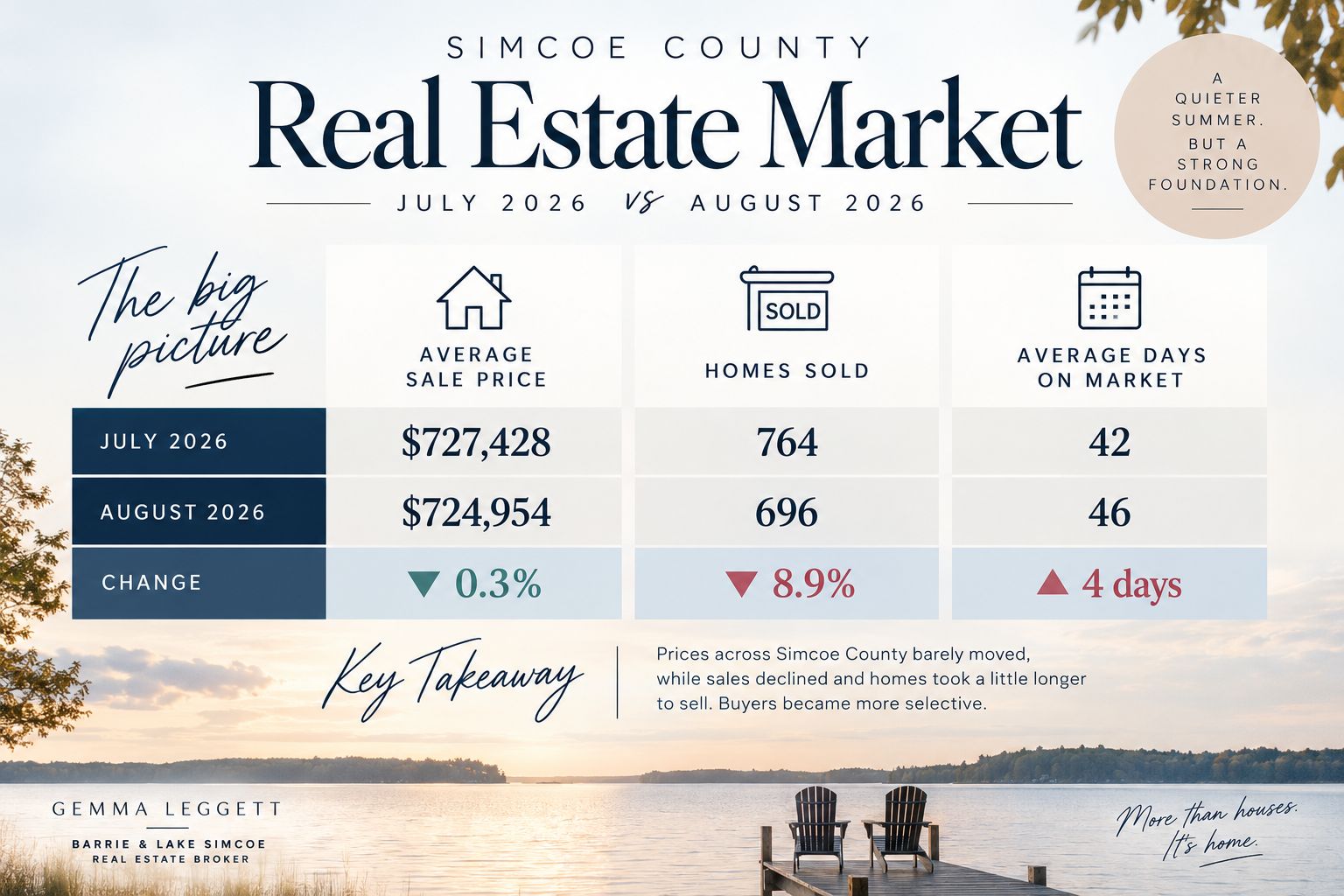
My takeaway?
Prices across Simcoe County barely moved. Activity did.
The average selling price slipped just 0.3% between July and August, while the number of transactions dropped almost 9% and homes took a little longer to sell.
That distinction matters.
A slowdown in the number of homes selling does not automatically mean home values are collapsing.
It tells me buyers became more deliberate.
They had time to look.
They negotiated.
And they were less willing to overlook a home that was overpriced simply because the seller hoped someone would eventually pay it.
🏙️ Barrie Real Estate: Buyers Had More Time to Think
Barrie showed a little more softness through August.
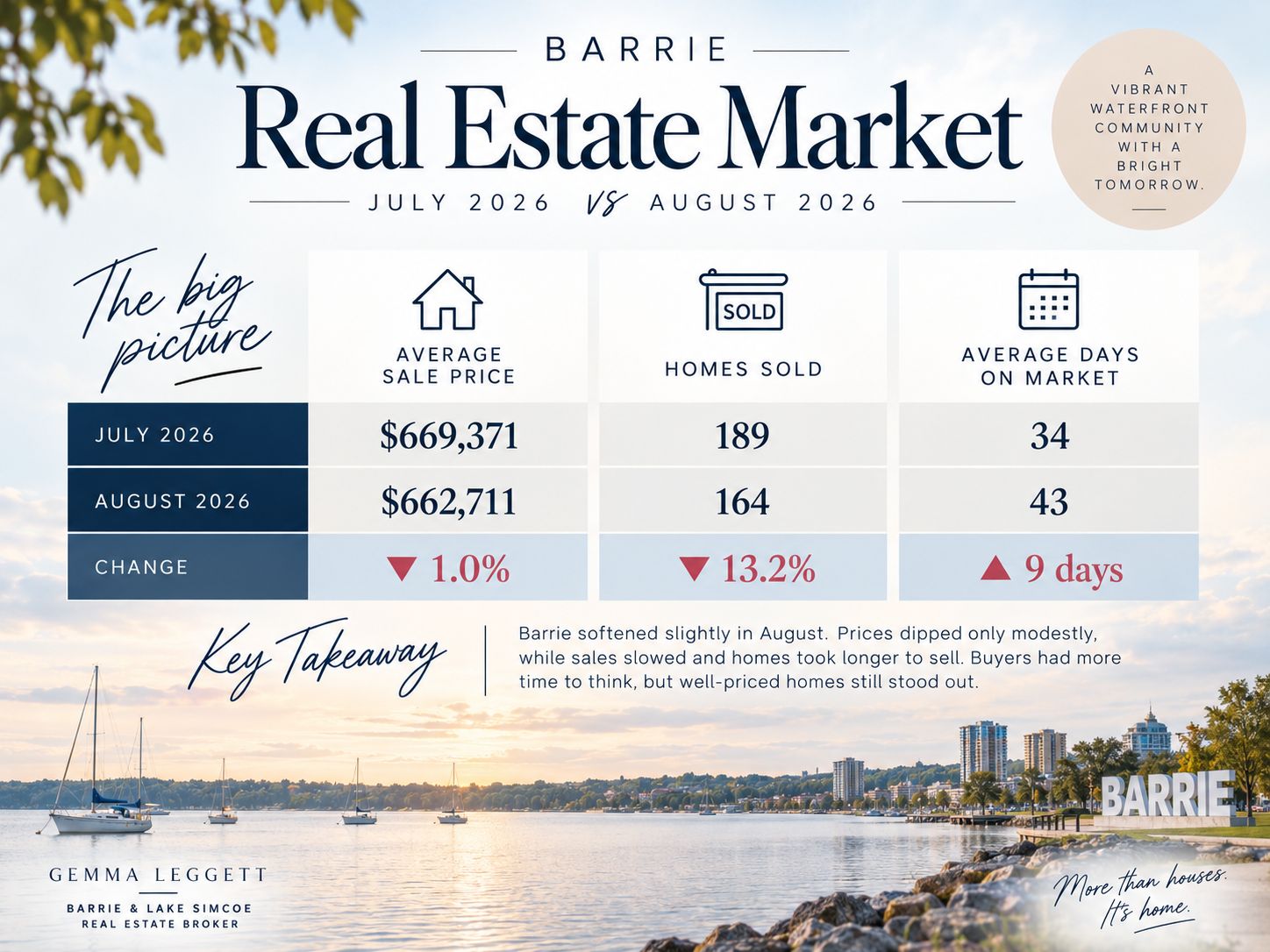
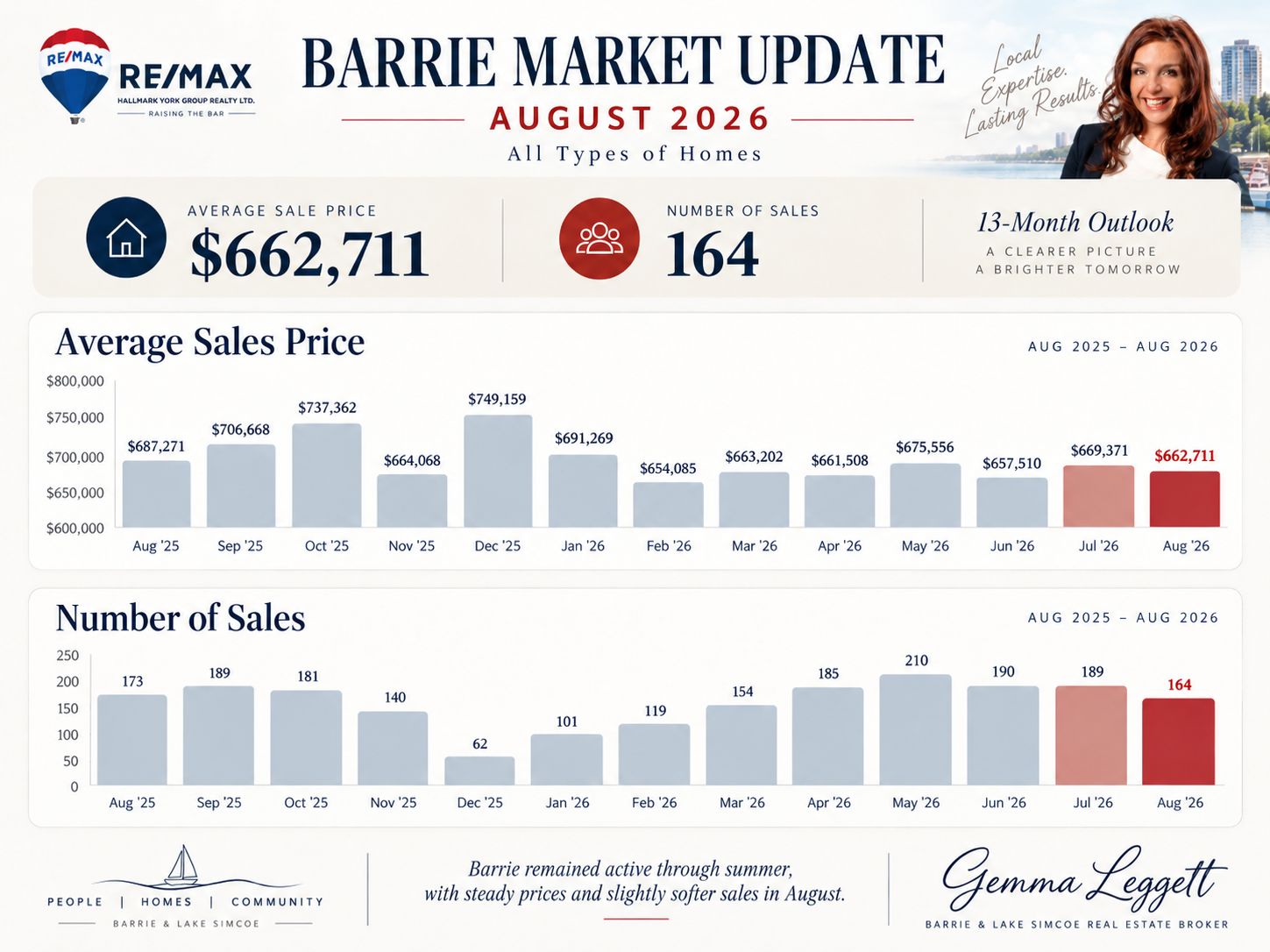
Barrie's average price declined only about 1% month-over-month, but sales dropped from 189 to 164. The number that catches my attention more is days on market.
It increased from 34 days in July to 43 days in August.
That doesn't mean every Barrie home took 43 days to sell. Far from it.
What it does mean is that buyers weren't feeling pressured to buy just anything.
And I saw this firsthand.
A home that was:
- priced correctly,
- presented properly,
- in good condition,
- and positioned well against its competition
could still attract strong interest.
I've still dealt with multiple offers.
But buyers were much less forgiving of listings that came to market too high.
That is a major difference from the frenzy markets we've experienced in the past.
🌊 Innisfil Real Estate: Don't Let One Number Fool You
Now let's talk about Innisfil, because this is exactly why I don't like looking at one monthly average and announcing:
“Innisfil home prices fell 11%!”
Yes, the numbers show this:
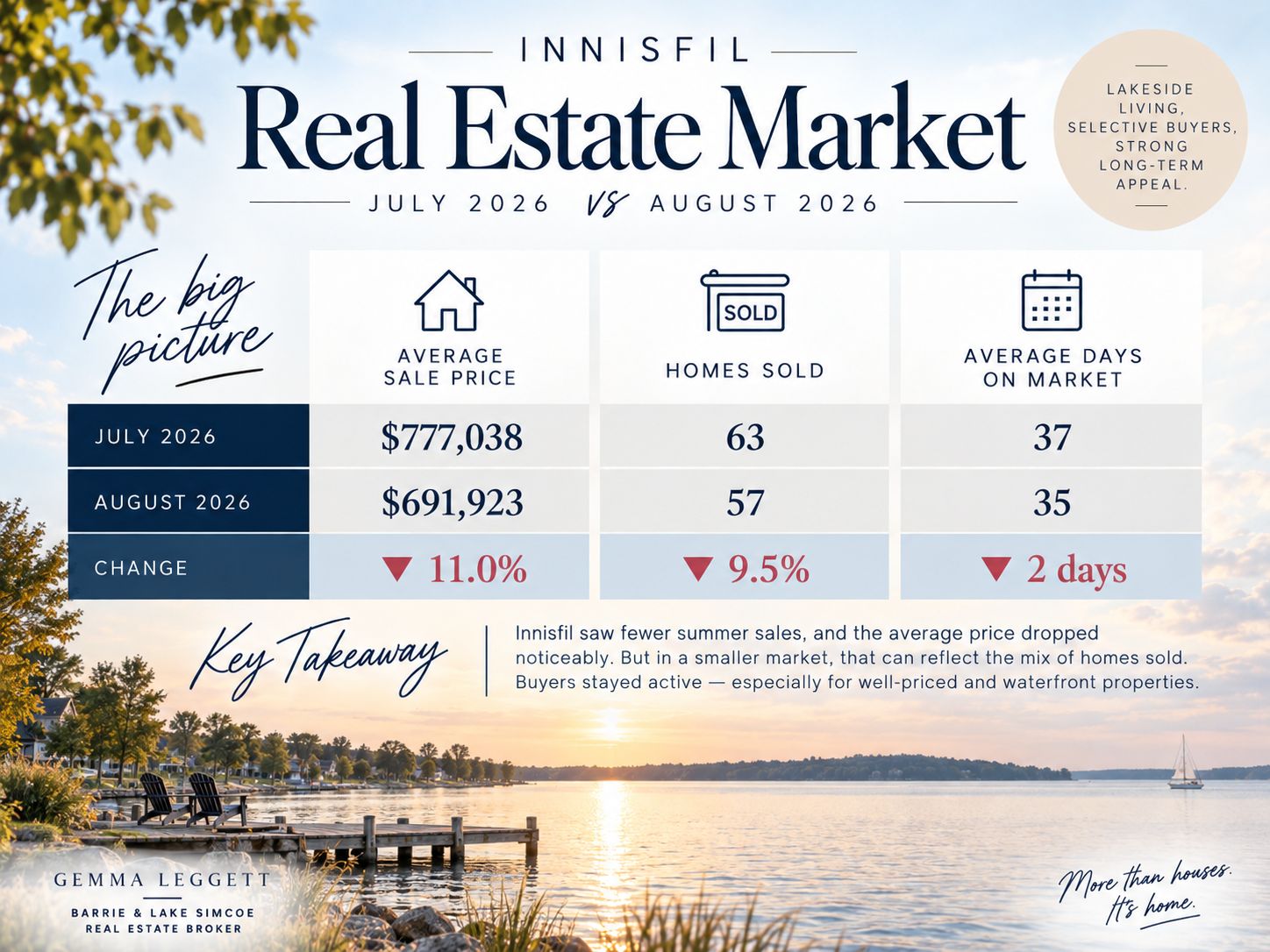
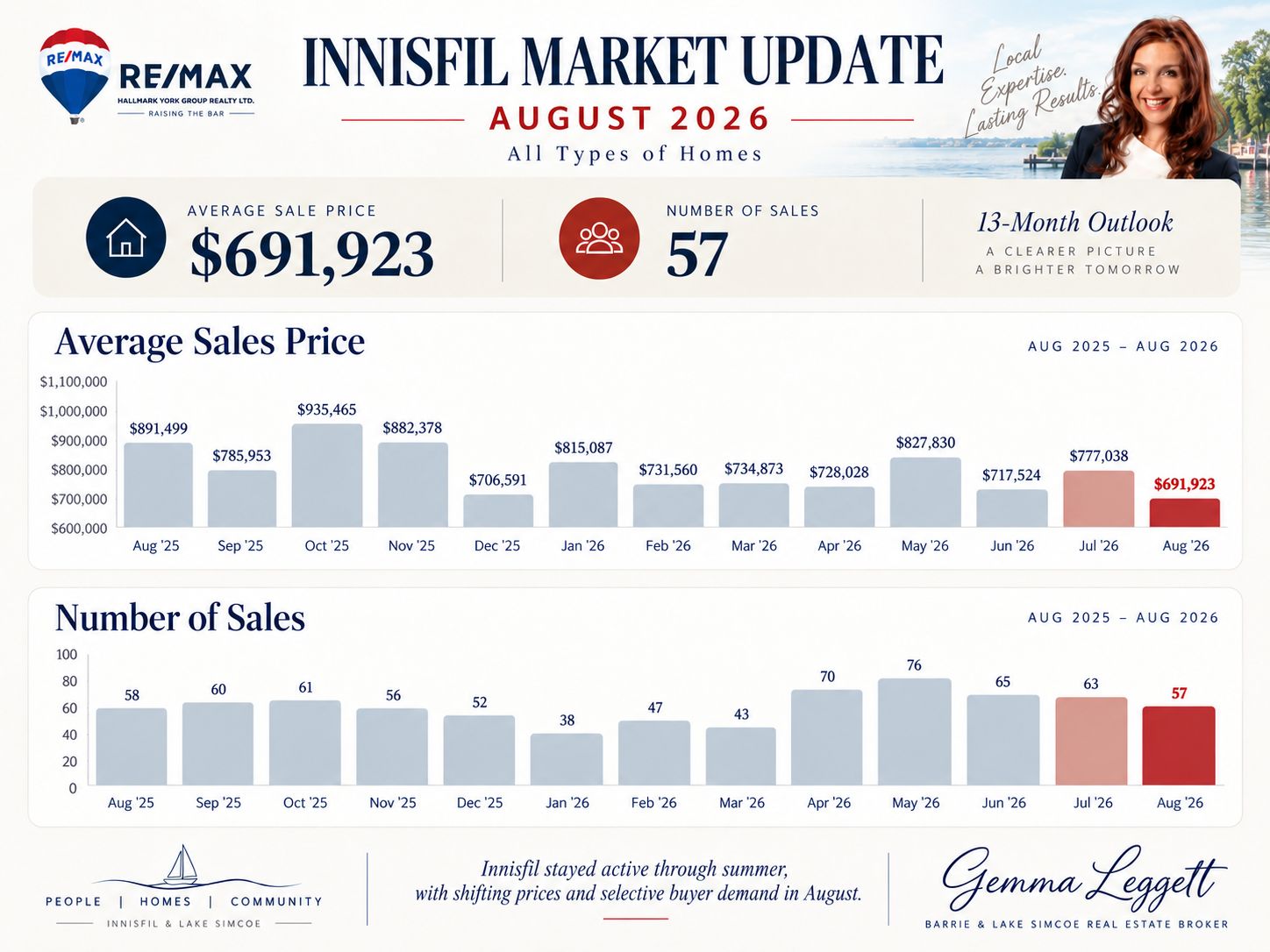
The average fell by approximately 11%.
But only 57 properties sold in August.
In a smaller market such as Innisfil — where one month can include anything from condos and starter homes to multimillion-dollar Lake Simcoe waterfront properties — the mix of properties sold can dramatically move the average.
That's why I would never tell an Innisfil homeowner:
“Your house lost 11% of its value in one month.”
It almost certainly did not.
This is where neighbourhood, property type, condition, lot, location and comparable sales matter far more than a municipality-wide average.
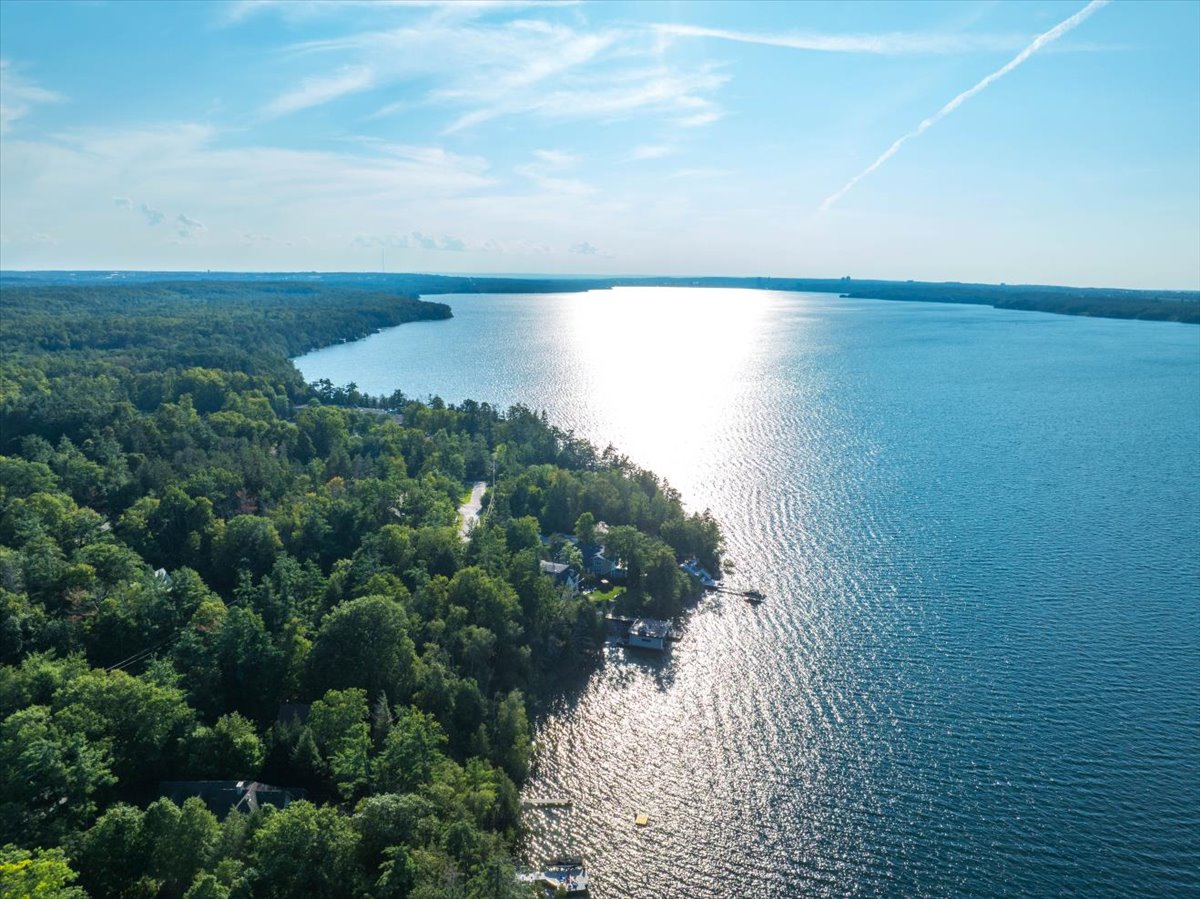
🌊 What About the Lake Simcoe Waterfront Market?
This is where broad statistics become even less useful.
There really isn't one single “Lake Simcoe waterfront market.”
A renovated year-round waterfront home with a good shoreline, western exposure and usable dockage is a very different product from:
- an older seasonal cottage,
- a property with difficult water access,
- a water-access rather than waterfront property,
- a home requiring major renovation,
- or a luxury property competing above $2 million.
And the buyers know it.
What I noticed this summer: waterfront buyers were still active.
But they were selective.
They were looking closely at value, not simply the fact that a house sits beside the lake.
Things like shoreline, water depth, exposure, privacy, renovation quality, docking, access and location can make an enormous difference.
And because genuine waterfront inventory is limited, a special property that is priced properly can behave very differently from the rest of the market.
That's why I would be particularly careful using a Simcoe County or even an Innisfil average to determine the value of a Lake Simcoe waterfront home.
👀 What I Saw Behind the Numbers This Summer
Statistics are useful.
But they don't tell you what happens during a showing, what buyers are saying after they leave, or what happens when an offer finally lands on the table.
Here's what I personally saw throughout July and August:
Buyers negotiated more.
There was definitely more willingness to negotiate price, closing dates, conditions and other terms.
Listings were taking longer.
There was less of the “I need to buy this tonight before somebody else does” mentality.
Buyers had more breathing room.
Well-priced homes still sold.
This is probably the most important point.
The market wasn't dead.
Homes that made sense at their asking price were still getting attention.
Multiple offers did not disappear.
I personally dealt with multiple-offer situations this summer.
They're simply not happening everywhere anymore.
Some sellers were still unrealistic.
And this was one of the biggest disconnects I saw.
What a neighbouring home sold for two years ago doesn't determine what a buyer will pay for yours today.
The market decides.
Waterfront buyers remained active.
Lifestyle still matters.
People who want Lake Simcoe aren't necessarily abandoning that dream because the broader market is slower — but they are doing their homework.

This is where things get particularly interesting heading into fall.
1. The Bank of Canada Isn't Cutting — At Least Not Yet
The Bank of Canada held its overnight rate at 2.25% on July 15, and then held it again at 2.25% on September 2. The rate has now remained at that level through several consecutive decisions.
That matters because anyone waiting for another dramatic drop in borrowing costs hasn't received it.
The Bank says the current rate remains appropriate while it weighs economic growth against renewed inflation risks.
Why homeowners should care:
Stable rates remove some uncertainty for buyers, but they also mean waiting for significantly cheaper borrowing may not produce the result some buyers were hoping for.
The next Bank of Canada rate announcement is October 28, 2026.
2. Inflation Jumped Back to 3%
This is something worth watching.
Canada's Consumer Price Index increased 3.0% year-over-year in July, up from 2.8% in June.
A large part of that increase came from gasoline and travel-related costs. Importantly, inflation excluding gasoline remained considerably lower at 2.2%.
Why it matters:
Higher inflation makes it more difficult for the Bank of Canada to justify aggressively cutting interest rates.
So although buyers would obviously welcome lower mortgage rates, economic conditions still matter.
3. The Canadian Economy Actually Grew
Despite all the pessimistic economic headlines we've heard, Canada's economy expanded during the second quarter.
Real GDP increased 0.8% in Q2 2026, helped by higher exports, household spending and business investment. First-quarter growth was also revised slightly upward.
That's important because housing doesn't operate in isolation.
Employment, consumer confidence, economic growth, inflation and borrowing costs all influence how comfortable people feel making a major purchase.
4. Employment Is Sending Mixed Signals
Canada's unemployment rate sat at 6.4% in July, even as employment increased that month.
Then employment declined by approximately 42,000 jobs in August.
So we're still dealing with an economy giving us mixed signals:
Growth? Yes.
Inflation completely defeated? No.
Labour market booming? Also no.
And that's one reason I don't expect the fall real estate market to suddenly behave like 2021 again.
🏡 Thinking About Selling in Barrie, Innisfil or Simcoe County This Fall?
Here's what I would pay attention to.
1. Don't price using yesterday's market.
This is probably the biggest mistake a seller can make right now.
Buyers can see the same comparable listings we can.
If three similar homes are available and yours is $75,000 too high, buyers aren't going to negotiate against themselves.
They're going to the next house.
2. The first impression matters more in a slower market.
Photography.
Presentation.
Repairs.
Staging.
Marketing.
Price.
When buyers have choices, weaknesses become easier to compare.
3. Don't confuse “no offer” with “no buyers.”
Sometimes the buyers are there.
They're simply telling you — through their silence — that the price doesn't make sense.
4. Be prepared to negotiate.
Negotiation is back.
And that's not necessarily bad.
A successful sale doesn't mean you “won” every term.
It means you created the strongest overall result available in the market you were actually selling in.
🔑 Thinking About Buying This Fall?
There are opportunities here too.
Look closely at days on market.
A property that's been listed for three days and one that's been listed for 63 days are two completely different negotiations.
Don't assume every seller is desperate.
This is important.
A slower market does not mean every seller will accept a low offer.
I've also seen well-positioned properties generate competition.
Conditions have value again.
Depending on the property and situation, buyers may have more opportunity to protect themselves with financing, inspection or other conditions.
Look beyond the asking price.
Sometimes the best opportunity isn't the cheapest listing.
It may be the property where the seller's circumstances, days on market and competition create room for a smart negotiation.
🔮 So... What Happens to the Simcoe County Real Estate Market This Fall?
I don't believe one statistic can answer that.
I'm watching three things very closely.
1. Inventory
September traditionally brings new listings.
The question isn't simply whether inventory increases.
It's whether buyer demand increases with it.
2. Buyer Confidence
There are buyers who spent the summer watching.
Some travelled.
Some waited.
Some hoped rates or prices would fall further.
If those buyers come back into the market at the same time this fall, the balance can shift surprisingly quickly in certain neighbourhoods and price ranges.
3. Mortgage Rates
The Bank of Canada is holding at 2.25%, but inflation and global uncertainty are keeping the outlook complicated. The Bank specifically said in September that inflation risks have increased while trade developments have made the growth outlook more uncertain.
That makes the October 28 rate decision one to watch.
So, Is Simcoe County a Buyer's Market or a Seller's Market?
The better answer is:
It depends on the house.
And I think that's the biggest story coming out of this summer.
The days when you could describe an entire region with one label are becoming less useful.
An overpriced property sitting for 70 days?
The buyer has leverage.
A beautifully presented home that just hit the market at the right price?
Completely different conversation.
A rare Lake Simcoe waterfront property with desirable shoreline and very little competition?
Different again.
This is a property-by-property market.
❓ Simcoe County Real Estate FAQ — Summer 2026
Are home prices dropping in Simcoe County?
Not dramatically based on the July-to-August numbers. Simcoe County's average sale price moved from $727,428 in July to $724,954 in August — a decline of only about 0.3%. Transaction volume declined more noticeably.
Are Barrie home prices falling?
Barrie's average sale price moved from $669,371 in July to $662,711 in August, approximately a 1% decline month-over-month. However, individual neighbourhoods and property types can perform very differently from the city-wide average.
Did Innisfil home prices really fall 11% in August?
The monthly average did — from $777,038 to $691,923 — but that does not mean every Innisfil property lost 11% of its value.
Only 57 transactions occurred in August, and differences in the mix of properties sold can significantly influence an average in a smaller market.
Is fall 2026 a good time to buy in Barrie or Innisfil?
For some buyers, it could be.
Longer listing times and increased negotiation can create opportunities, particularly on properties that have been on the market for a while.
But desirable and well-priced homes can still attract competition, so a blanket “lowball everything” strategy isn't necessarily effective.
Is Lake Simcoe waterfront real estate slowing down?
Waterfront buyers remained active this summer, but they were selective.
Waterfront properties also shouldn't be evaluated exclusively using municipality-wide averages because shoreline quality, water depth, exposure, docking, condition and exact location can materially affect value.
Should I sell this fall or wait until spring 2027?
There isn't one correct answer.
The better question is:
What is happening with your specific property, price range and neighbourhood?
Sometimes waiting helps.
Sometimes additional competition in spring works against you.
And sometimes selling when fewer comparable properties are available gives your home an advantage.
That's something I would determine by looking at your actual competition rather than trying to predict the entire market six months from now.
The Bottom Line
If July and August taught us anything, it's this:
The Simcoe County real estate market isn't frozen. It's selective.
Buyers are negotiating.
Homes are taking longer in some areas.
Overpriced properties are being exposed.
Yet well-priced homes are still selling, multiple offers are still happening, and Lake Simcoe waterfront buyers are still looking.
The difference is that strategy matters again.
And frankly, I think that's a healthier market than one where people feel they have 20 minutes to decide whether to spend $900,000.
If you're thinking about buying, selling or moving anywhere around Barrie, Innisfil or Lake Simcoe this fall, don't make the decision based on a national headline — or even the average price for Simcoe County.
Let's look at what is actually happening around your home.
Want to know what your home would realistically sell for in today's market?
Contact me for your market analysis. I'll show you the recent sales, your current competition and what I believe your home could realistically achieve — not an automated online estimate.