

The first summer job is a milestone. My daughter had her first and I LOVED IT!
Maybe your teenager worked at a restaurant, a marina, a golf course, a summer camp, a retail store, a landscaping company or one of the many seasonal businesses around Barrie, Innisfil and Lake Simcoe.
They probably remember the excitement of getting that first paycheque.
Then they looked at the amount deposited into their bank account and thought:
“Wait… where did the rest of my money go?” 😂
Welcome to adulthood.
But that first job is about much more than earning spending money. It can be one of the best opportunities parents have to teach their kids about taxes, saving, investing, budgeting, credit and eventually buying their first home.
And those lessons don't have to wait until they're adults.
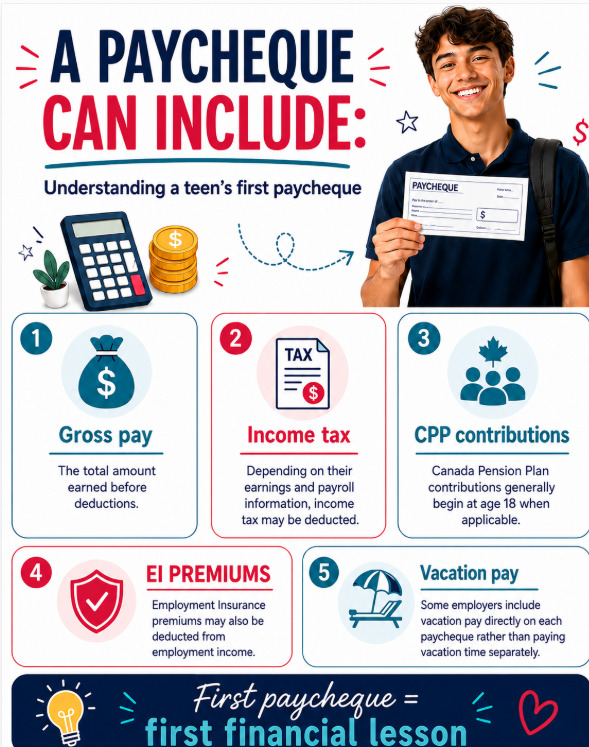
💰 First Lesson: Gross Pay Is NOT Take-Home Pay
If your teen earns $16.60 an hour and works 20 hours, they might quickly calculate:
$16.60 × 20 hours = $332
But their bank account may tell a different story.
The important lesson?
What you earn and what you have available to spend are two very different numbers.
Learning that at 15 or 16 is considerably less painful than learning it after signing a lease, buying a car or getting a mortgage.
🧾 Does a Teenager Have to File a Tax Return in Canada?
This is where many parents get confused.
There isn't a special rule saying that teenagers automatically have to file simply because they had a summer job.
Whether they are required to file depends on their individual circumstances, including their income and whether they owe tax or CPP.
However, even when they aren't technically required to file, filing a tax return can still make sense.
The CRA specifically notes that students may want to file if they are entitled to a refund or want CRA to determine eligibility for certain benefits and credits.
Your teen should particularly look at filing if:
- Income tax was deducted from their pay and they may be entitled to receive some of it back.
- They earned income from more than one employer.
- They earned cash income, tips or income from side jobs.
- They had self-employment income.
- They are required to pay tax or make applicable CPP contributions.
- They want to establish the habit of filing their own return.
And yes:
Cash income still counts.
Babysitting, landscaping, tutoring, delivery work, social-media work and other side income can have tax implications depending on the circumstances.
CRA says employment income includes salary, wages, commissions, bonuses, tips, gratuities and honoraria, and income from all applicable sources needs to be properly reported.
💵 Could Your Teen Actually Get Money BACK?
Possibly.
If an employer deducted income tax throughout the year but your teenager ultimately had little taxable income, some or all of that tax may come back as a refund after the return is assessed.
That's an excellent teaching opportunity.
Because a tax refund isn't really “free money.”
It usually means:
More tax was withheld during the year than was ultimately required.
That distinction matters.
Otherwise, we raise another generation that treats every tax refund like an unexpected shopping spree. 😂
🗂️ Teach Them to Read Their T4
Early the following year, an employee normally receives a T4 Statement of Remuneration Paid from their employer.
Don't just file it for them.
Sit down together and show them what they're looking at.
A T4 can include information such as:
- employment income
- income tax deducted
- CPP contributions where applicable
- EI premiums
- employer information
Employment income is generally reported in Box 14 of the T4.
Even if you use an accountant or tax software, let your teenager participate.
This is their financial life.
📋 Don't Throw Away the Pay Stubs
Encourage your teenager to keep:
- pay stubs
- T4 slips
- records of tips
- records from multiple employers
- documentation relating to side income
- relevant tax documents
Better yet, create a simple digital folder:
FINANCES → TAXES → 2026
Congratulations.
Your teenager now has a financial filing system more organized than approximately half the adults they know. 😂
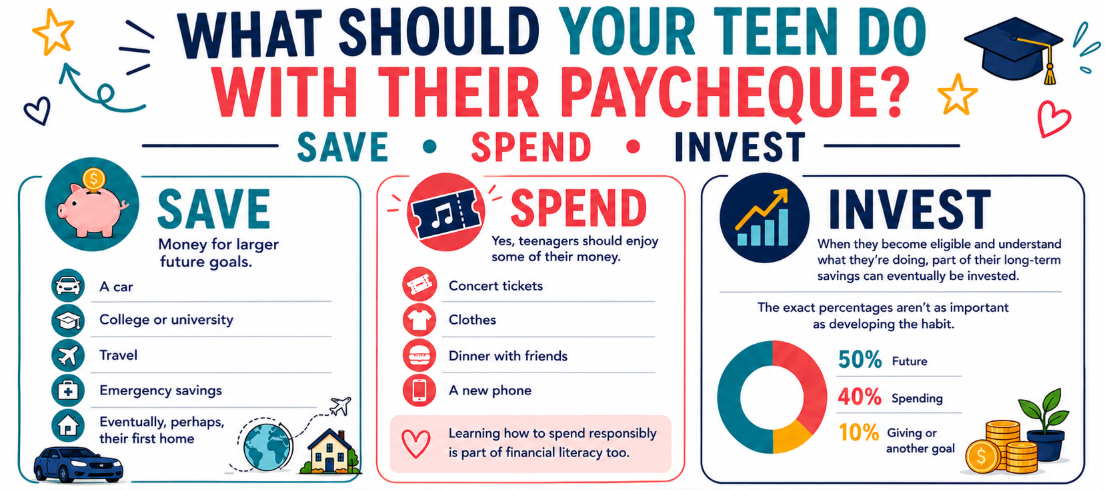
🏦 Then Comes the Important Conversation: What Do We Do With the Money?
This is where the summer job becomes a financial literacy lesson rather than simply a source of spending money.
Instead of saying:
“Save all of it.”
Or:
“It's your money. Spend it however you want.”
Teach them that money can have different jobs.
For example, every paycheque could be divided into:
🧠 Teach Them the Difference Between WANT and NEED
This sounds basic.
It isn't.
Ask your teenager:
Do you need it? Do you want it? Could you wait 48 hours before buying it?
How many hours did you have to work to pay for it?
That last question is particularly powerful.
A $120 pair of shoes feels different when you think:
“I worked almost an entire shift for these.”
Suddenly financial literacy becomes very real.
🚗 The First Big Trap: The Car
For many teenagers, their first major financial goal is a vehicle.
They see:
Car payment: $325/month
Parents need to help them see:
Car payment + insurance + gas + repairs + maintenance + registration + parking.
The true cost of ownership is always bigger than the purchase price.
Sound familiar? It should. Because the exact same principle applies to real estate.
A home isn't just the mortgage payment.
There can also be:
- property taxes
- insurance
- utilities
- maintenance
- repairs
- condo fees
- closing costs
Teaching your child to calculate the total cost of ownership on a $7,000 used car is preparation for evaluating a $700,000 house someday.
💳 Their First Credit Card Is NOT Free Money
Once your teen becomes old enough to obtain credit, another conversation becomes critical:
Credit is borrowed money.
A credit card should not become an extension of their income.
Teach them:
Charge → receive statement → pay balance in full → repeat.
Not:
Charge → minimum payment → charge more → panic.
Credit history can eventually influence applications for loans and mortgages.
And when I work with first-time home buyers, one thing becomes very clear:
The financial habits established years before buying the house often determine how easy—or difficult—the purchase becomes.
📊 Talk About Credit Scores Before They Need One
Teenagers don't need to become credit experts.
But they should understand the basics.
Creditworthiness can be affected by things such as:
- paying bills on time
- how much available credit they use
- how long they've had credit
- applications for new credit
- different forms of borrowing
The goal isn't to become obsessed with a number.
The goal is to understand:
Your financial behaviour creates a financial reputation.
📈 What About Investing?
Here's another conversation worth having early.
Saving and investing are different.
Savings are generally appropriate for money you may need relatively soon.
Investing means putting money into assets that can fluctuate in value in pursuit of longer-term growth.

A teenager has one financial advantage that adults would pay almost anything to get back:
TIME.
What Happens When They Turn 18?
This is when several important Canadian savings tools start entering the conversation.
TFSA — Tax-Free Savings Account
A Canadian resident generally begins accumulating TFSA contribution room at age 18 and can open a TFSA once the applicable eligibility requirements are met.
Investment growth and qualifying withdrawals from a TFSA are generally tax-free. CRA confirms that Canadian residents can generally open one beginning at age 18 with a valid SIN.
That's something teenagers should know before turning 18.
🏠 And This Is Where Real Estate Enters the Conversation
One of the smartest conversations parents can have with young adults is about the:
First Home Savings Account — FHSA
The FHSA was specifically designed to help eligible first-time buyers save toward purchasing or building a qualifying first home.
An eligible adult first-time buyer can open an FHSA and receive $8,000 of participation room in the first year the account is opened. Contributions are generally deductible, while qualifying withdrawals used toward the purchase of a first home can be tax-free.
That's powerful.
But here's the part young people need to understand:
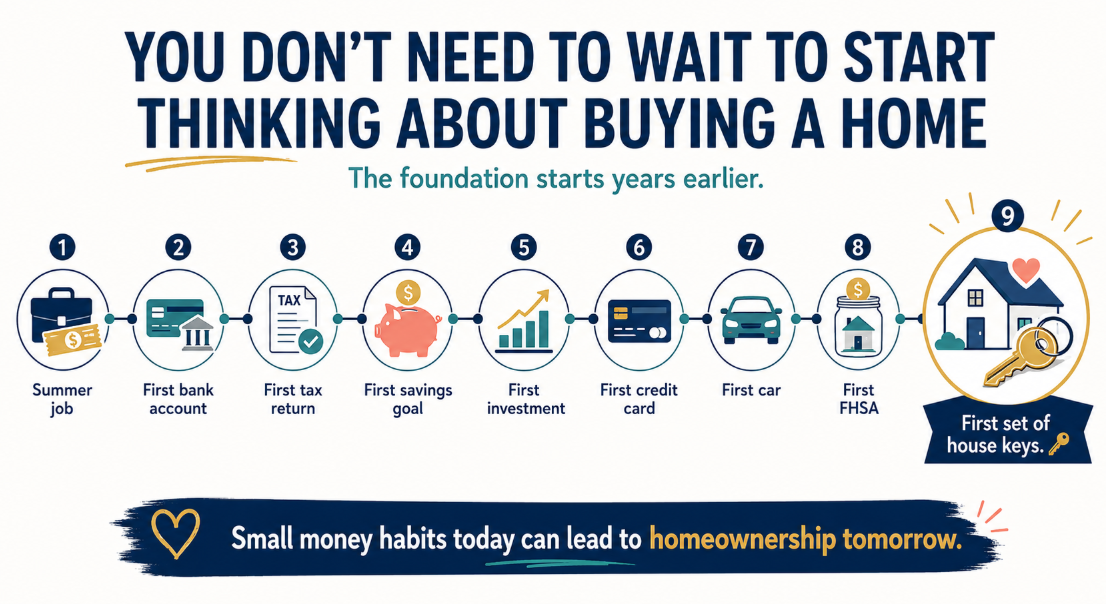
🏡 Imagine Starting at 18
Suppose your teenager eventually decides:
“I'd like to own a home someday.”
They don't have to know where. They don't have to know when. They don't even need to know what type of home. What they need is the financial foundation.
Imagine entering your twenties already understanding:
- budgeting
- credit
- taxes
- saving
- investing
- registered accounts
- borrowing
- compound growth
That's a very different starting position from learning everything six months before trying to qualify for a mortgage.
💡 The Down Payment Isn't the Only Thing They Need
This is another misconception worth correcting early.
Young people often think:
House price → save down payment → buy house.
There is more to it.
Future first-time buyers may eventually need money for things like:
- down payment
- legal fees
- home inspection
- moving expenses
- adjustments
- insurance
- immediate repairs or purchases
- emergency reserves
And mortgage qualification considers much more than how much cash someone has saved.
Income, debts, borrowing history and overall financial circumstances matter too.
🏠 Canada Has Other First-Time Buyer Programs Too
Future programs can always change, so young adults should check the current rules when they're actually preparing to buy.
One current example is the Home Buyers' Plan, which permits eligible buyers to withdraw money from an RRSP toward a qualifying home.
The current HBP withdrawal limit is $60,000, and eligible buyers can potentially combine an HBP withdrawal with a qualifying FHSA withdrawal for the same home.
Your 16-year-old doesn't need to memorize that.
But they should understand something much bigger:
Canada provides savings tools designed specifically to help people prepare financially for homeownership.
Knowing they exist changes the conversation from:
“I'll never afford a house.”
to:
“What would I need to do to eventually afford one?”
That's a much better question.
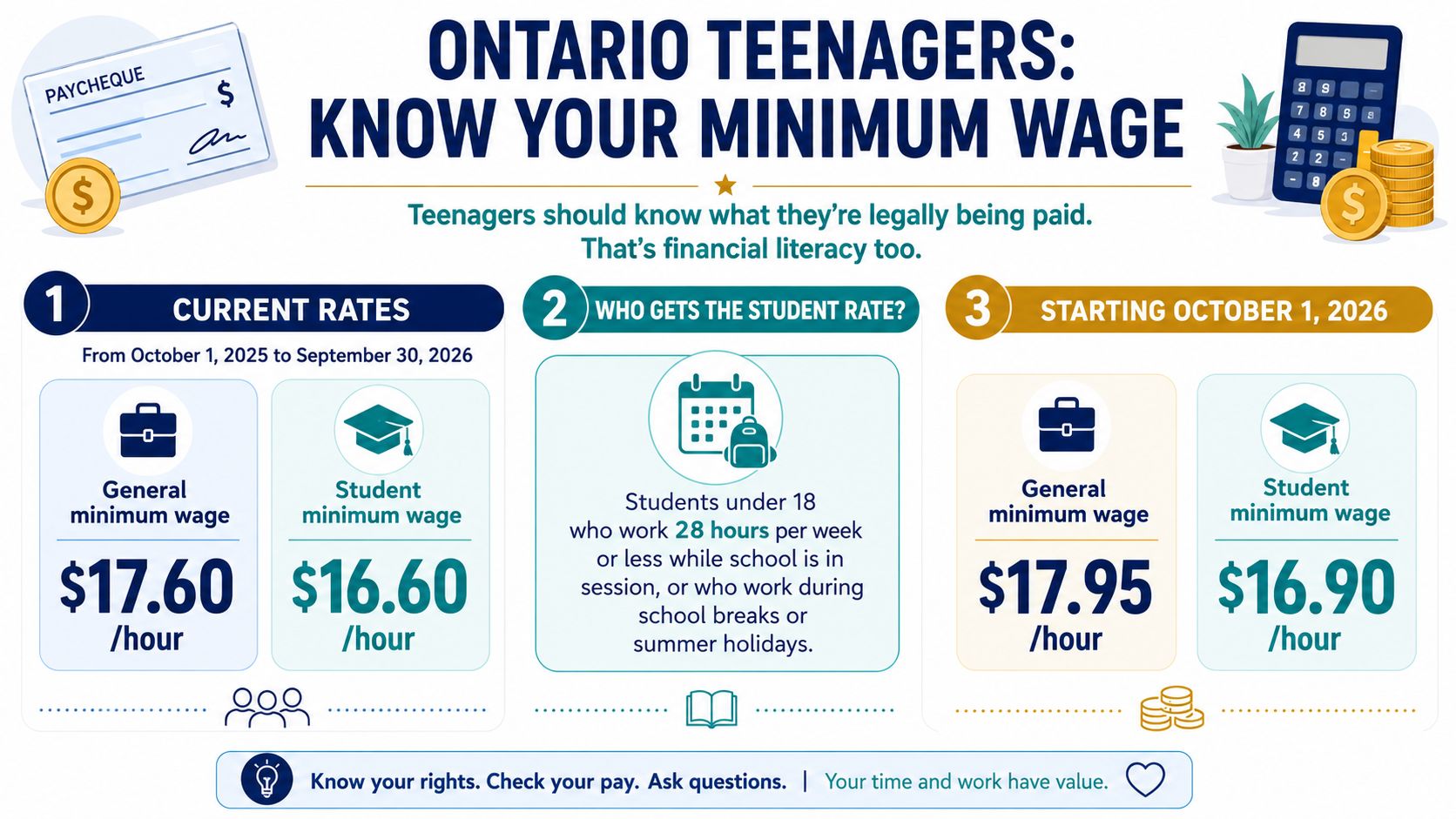
👩💼 Ontario Teenagers: Know Your Minimum Wage
For parents here in Ontario, this is important. Teenagers should know what they're legally being paid. That's financial literacy too.
👷 Summer Jobs Also Teach Something Money Can't
A job isn't only about money.
Teenagers learn:
- how to show up on time
- how to take direction
- how to communicate with adults
- how to handle difficult customers
- how to make mistakes
- how to solve problems
- how to work when they don't particularly feel like working
- how long it actually takes to earn $100
Those lessons are enormously valuable.
👨👩👧 Parents: Don't Do Everything For Them
It can be tempting.
You open the bank account.
You organize the paperwork.
You file the tax return.
You transfer their savings.
You tell them how much they're allowed to spend.
And they learn...
Nothing.
Instead, sit beside them.
Let them:
- read the pay stub
- check their bank balance
- calculate what was deducted
- decide how much to save
- organize the tax documents
- participate in filing the return
- set the savings goal
Financial literacy isn't information.
It's a skill.
And skills require practice.
📌 A Simple End-of-Summer Money Meeting
Before the school year gets busy again, sit down with your teenager for 20 minutes.
Ask:
1. How much did you earn this summer?
2. How much did you actually take home?
3. How much did you spend?
4. What did you spend it on?
No judgment.
Just look.
5. How much did you save?
6. What are you saving toward?
7. What did your paycheque teach you about taxes and deductions?
8. Where is your T4 going to go when it arrives?
9. What's one financial goal for next summer?
10. What's one thing you'd like to eventually buy without borrowing money?
That conversation could be worth considerably more than the summer paycheque itself.
❓ Frequently Asked Questions About Teenagers, Summer Jobs & Taxes
Does my teenager have to file taxes if they only worked during the summer?
Not necessarily. Filing requirements depend on the teen's individual tax circumstances rather than simply their age or the fact that they had a job. However, filing may still be worthwhile to claim a refund or establish eligibility for certain benefits.
Does a teenager have to report tips?
Tips and gratuities can be considered income and may need to be reported.
Should my teenager file if tax was deducted from their paycheque?
It is worth checking. If more income tax was deducted than they ultimately owe, filing is how they can claim the resulting refund.
When does a teenager start contributing to CPP?
CPP contributions generally begin once an employee reaches age 18 and otherwise meets the applicable CPP requirements.
Can my teenager open a TFSA?
Generally, Canadian residents begin accumulating TFSA contribution room at 18 and may open a TFSA when they meet the eligibility requirements.
When should my child start thinking about buying a home?
Financially?
Years before they actually want one.
Good saving, borrowing and budgeting habits developed during high school and early adulthood can make purchasing a first home considerably easier later.
🏡 From First Paycheque to First Home
As a Realtor, I spend a lot of time helping people with the final step:
Buying the house.
But long before someone starts scrolling through listings or walking into an open house, the financial part of their home-buying story has already started.
It may have started with a teenager standing behind a counter in Barrie.
Working at a marina on Lake Simcoe.
Cutting lawns in Innisfil.
Serving ice cream.
Babysitting.
Working construction.
Or opening that very first paycheque.
Because buying a home isn't one financial decision.
It's often the result of years of small financial decisions.
⭐ THE BOTTOM LINE
Your teenager's summer job isn't just about earning money.
It's an opportunity to teach them:
How to earn it. How to read their paycheque. How taxes work. How to save it.
How to spend it intentionally. How to eventually invest it. How to use credit responsibly.
And maybe one day, how to turn those habits into the keys to their first home. 🔑
Don't just teach kids how to earn money.
Teach them what to do with it.
Tax rules and government programs change. This article provides general educational information and isn't individual tax, accounting, legal, investment or mortgage advice. Families should confirm current rules with CRA and appropriate financial professionals.